 EN
EN 

AI Summary
- The knowledge management software market is projected to reach $16.22 billion in 2026, while Gartner predicts 60% of AI projects will be abandoned because underlying knowledge and data are not ready.
- KM is becoming AI infrastructure: fragmented, duplicated, outdated, unstructured, and ungoverned knowledge reduces AI performance. Success metrics increasingly include AI answer quality, search success rate, freshness, and consistency.
- Semantic layers and knowledge graphs are becoming foundational for agentic AI by connecting terminology, metadata, taxonomies, ontologies, and relationships. Agentic AI also requires a governed single source of truth, traceability, and source attribution.
- Conversational discovery raises the consequences of incorrect knowledge because systems synthesize direct answers. Governance must address access, currency, and tracing AI outputs to verified sources, with regulatory requirements including EU AI Act Article 50.
- Self-healing knowledge bases use AI to identify undocumented questions, draft updates, and flag stale content. This supports continuous maintenance as documentation backlogs constrain conversational GenAI quality.
AI-generated content. It may contain errors.
See Document360 in action
According to Mordor Intelligence, the knowledge management software market is on track to reach $16.22 billion in 2026. Growth alone doesn’t tell the real story, though. Gartner predicts that 60% of AI projects will be abandoned by the end of 2026 because the knowledge and data underneath them aren’t ready. Organisations aren’t just spending more on knowledge management. Many are scrambling to fix it before it takes their AI investments down with it.
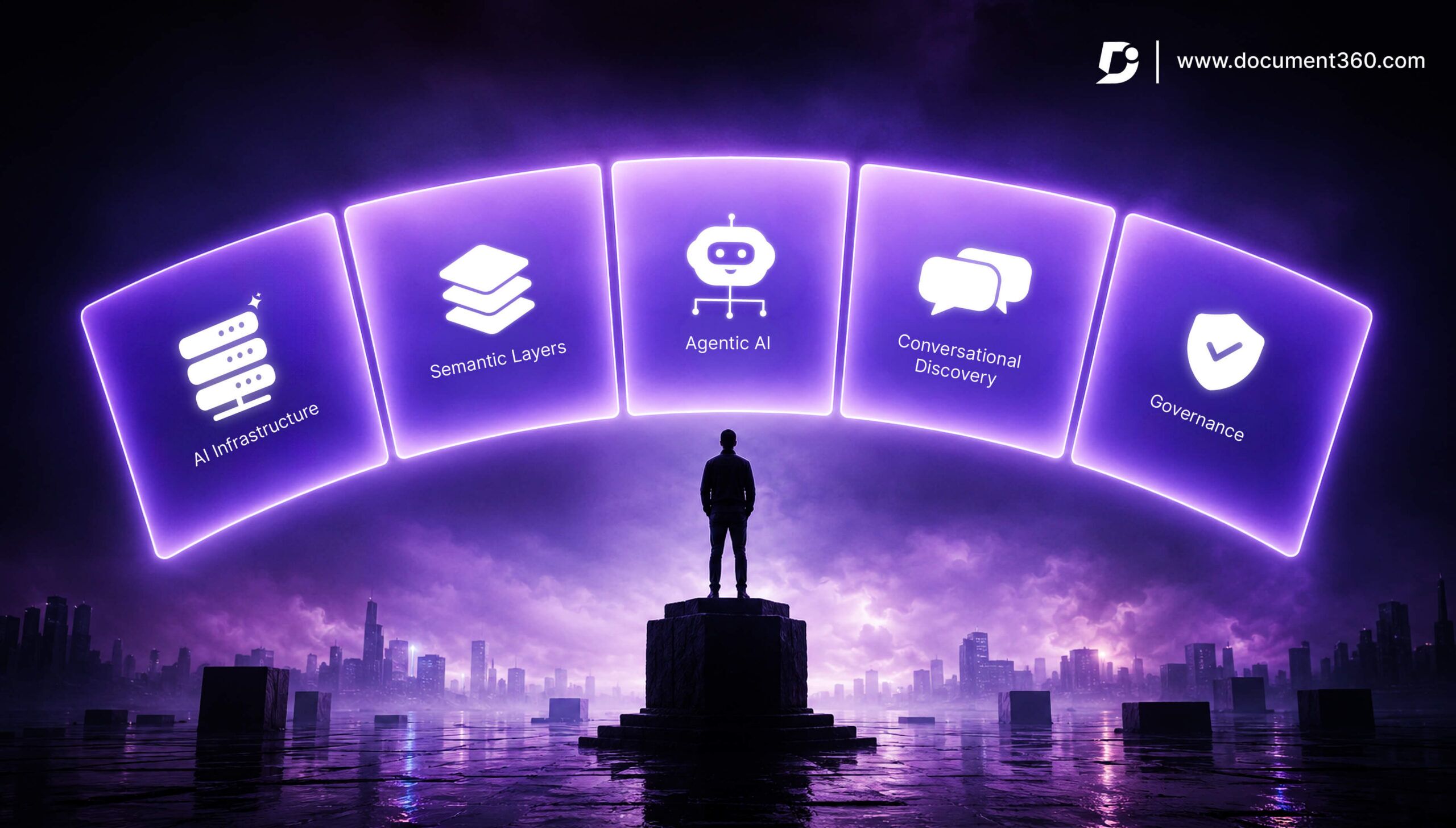
Every trend below is drawn from research published in 2025 and 2026, and each map to something knowledge teams are already contending with: AI in knowledge management as core infrastructure, semantic layers, agentic AI, conversational discovery, governance, and self-healing maintenance.
📝 TL;DR
Knowledge management in 2026 has stopped being a documentation side-project and become the infrastructure AI, search, and compliance all depend on.
- AI systems don’t fail because the models are weak; they fail because the knowledge feeding them is fragmented, duplicated, or outdated, which is why KM is now treated as AI infrastructure, not a separate function.
- Semantic layers and knowledge graphs are moving from niche to mainstream, giving AI agents structured meaning to reason across instead of just text to retrieve.
- Agentic AI needs a persistent, governed single source of truth; isolated documentation and one-off chatbot answers can’t support autonomous, multi-step tasks.
- Governance now carries legal weight, not just budget justification, with regulations like the EU AI Act’s Article 50 making documentation of data lineage and human oversight enforceable.
- Self-healing knowledge base systems that flag stale content and trigger reviews automatically are becoming a standard architecture pattern rather than a nice-to-have.
1. KM Is Now the Foundation for AI, not a Separate Function

For years, knowledge management sat next to the IT stack: useful, but optional to the “real” technology roadmap. That’s no longer true. Gartner’s research predicts that 60% of AI projects would be abandoned by 2026 is now playing out in production environments.
The root cause of this is structural, not technical. FluidTopics and Enterprise Knowledge‘s Zach Wahl both point to the same issue in their 2026 trend research: AI systems need standardized terminology, consistent metadata, and semantic context to function, and most knowledge bases were never built with that in mind. They were built for human readers who could tolerate inconsistency, guess at context, and skip past a duplicate article without much cost. AI systems can’t do any of that.
The problem is significant. MIT’s Project NANDA found that roughly 95% of generative AI pilots showed no measurable profit-and-loss impact in mid-2025 not because the underlying models failed, but because the knowledge feeding them was unstructured and ungoverned.
This shift also changes how organizations measure knowledge management success. Traditional metrics such as article count or documentation completeness are giving way to measures like AI answer quality, search success rate, knowledge freshness, and content consistency because these directly influence how effectively AI systems perform.
💡 Tip
Run a quick test before any AI rollout. Pull the five articles your AI will lean on most and check each for duplicates, conflicting versions, and a last-updated date. Whatever you find is exactly what your AI will repeat back, only faster and with more confidence.
2. Semantic Layers and Knowledge Graphs Are Entering the Mainstream
At Gartner’s Data & Analytics Summit in March 2026, semantic layers and knowledge graphs were formally positioned as foundational infrastructure for agentic AI, not optional enhancements. That’s a meaningful shift in framing. A few years ago, semantic layers were a data-team concern. Now they’re a KM concern too.
Enterprise Knowledge’s 2026 KM trends report names “KM plus semantic layers powering enterprise AI” as its top trend for the year, and notes that client requests to implement semantic layers to get AI initiatives off the ground have become specific and urgent not exploratory conversations, but active projects with deadlines.
A semantic layer translates raw content into structured meaning that AI agents can reason across, rather than just retrieve from. Think of the difference between a folder of PDFs and a system that understands “refund policy” and “return policy” refer to the same concept, that a “customer” in the billing system is the same entity as a “user” in the support system, and that an article marked “deprecated” shouldn’t be surfaced as current guidance. Traditional search treats all that as separate strings of text to match. A semantic layer treats it as connected meaning.
Semantic layers also reduce ambiguity by connecting related business concepts through metadata, taxonomies, and enterprise ontologies. This allows AI systems to understand relationships instead of relying solely on keyword matching, resulting in more accurate retrieval and reasoning across organizational knowledge.
💡 Tip
Before starting an AI initiative, pick ten common questions and check if the terminology used to answer them is consistent everywhere. Inconsistencies are exactly what a semantic layer must untangle first.
3. Agentic AI Needs a Single Source of Truth

The message from Gartner’s 2026 summit was direct: 2026 is the year of the AI agent. Unlike a chatbot that answers a single question and stops, an agent executes multi-step tasks autonomously and it fails without persistent, governed knowledge to draw from at every step.
Gartner also warned that 60% of agentic analytics projects relying solely on point-to-point integrations will fail by 2028 without semantic knowledge foundations underneath them. The integration layer isn’t the hard part. The knowledge layer is.
Unlike conversational AI that simply retrieves information, agentic AI plans, reasons, and executes tasks across multiple systems. That makes documentation quality significantly more important because every action an AI agent performs depends on reliable knowledge, traceable sources, and clearly governed business rules.
The other requirement that becomes non-negotiable with agentic AI is traceability and source attribution. When an agent takes an action approving a refund, updating a customer record, escalating a ticket someone eventually needs to answer, “based on what information?” A single source of truth that can’t show its sourcing is a liability, not an asset, the moment an agent’s decision gets questioned. This is a large part of why the AI-driven KM market is growing at a 46.7% compound annual rate, from $7.66 billion in 2025 to a projected $11.24 billion in 2026 much of that growth is organizations building the governed, traceable knowledge layer their agentic AI initiatives depend on.
💡 Tip
Pick one action you’d let an agent take on its own: approving a refund, closing a ticket, or updating a record. Now ask whether the knowledge behind that decision can show its source on demand. If it can’t, that’s the article to fix before you give the agent the keys, not after someone questions the call.
4. From Enterprise Search to Conversational, Agentic Discovery
For three decades, search-and-retrieve was the end goal of knowledge management technology. Find the right document, and the job was done. Enterprise Knowledge’s 2026 report names the shift away from that model from enterprise search to conversational AI as one of the field’s top five trends. Search is no longer the destination. It’s the starting point for a synthesized answer.
Employees increasingly expect a direct answer instead of a ranked list of ten documents to read through themselves. That expectation shows up consistently across the field’s 2026 forecasts, and it connects directly to the consumer-grade search trend, people are comparing their internal tools to Google and ChatGPT, and internal tools are losing that comparison.
This shift raises the stakes on everything covered so far. A wrong answer that’s synthesized and delivered directly, with confidence, is more consequential than a wrong document buried on page three of a results list a reader skimming ten results has some chance of self-correcting; a reader handed one confident answer usually doesn’t. That’s exactly why the semantic layers and governance discussed above matter more, not less, as search gives way to direct answers. The margin for a knowledge base to be “roughly right” is disappearing.
💡 Tip
Before switching on conversational search, find your worst duplicate or contradictory topic and clean it up first. A ranked list lets a reader skim past a bad article. A synthesised answer picks one and states it as fact, so a topic that was merely messy under keyword search becomes actively wrong under direct answers.
See how Document360 helps you build the governed, AI-ready knowledge base this shift demands.
Book a Demo
5. Knowledge Governance Is Getting Its Own Budget Line
Governance used to be the part of knowledge management that got talked about and rarely funded. That’s changing, and the 2026 Thales Data Threat Report shows why it needs to: only 34% of organizations know where all their data resides, even as they grant AI systems increasingly broad access to it. Spending is following the risk. AI governance platform investment is projected to hit $492 million in 2026 and climb to $1 billion by 2030.
In practice, content governance now means three concrete things for a KM team: who can access what, how content is kept current, and how AI-generated outputs can be traced back to verified sources. The third of those is new territory for most documentation teams, and it’s the one regulators are starting to check.
This is why governance in 2026 is both a regulatory requirement and an AI quality requirement at the same time and why it’s hard to treat as two separate initiatives. The same practices that keep an organization compliant knowing where content lives, who’s responsible for it, and where its facts came from are also what keeps an AI agent from confidently repeating an outdated policy or contradicting itself across two departments. A governance program built only to satisfy an auditor will still leave AI outputs unreliable. A governance program built only to make AI outputs reliable will still leave a compliance gap. Teams that treat the two as one program, with one set of metadata and ownership rules, get both outcomes from the same investment.
💡 Tip
Don’t run separate “compliance” and “AI quality” governance projects. One owned inventory owner, last verified date, source satisfies both.
6. Automated Maintenance with Self-Healing Knowledge Bases
Coverage of the AI knowledge base tooling market is increasingly framing this as a category shift: from AI that only answers questions to AI that also writes, audits, and repairs its own stale documentation what one 2026 industry guide calls “self-maintaining documentation.” Documentation drift, not search quality, is described as the lead problem this category is built to solve.
In a Gartner survey of customer service and support leaders, 61% reported a backlog of knowledge articles waiting to be edited, and more than a third had no formal process for revising stale ones at all. A well-maintained knowledge library is exactly what conversational GenAI depends on to work, so that backlog isn’t a documentation housekeeping issue. It’s a direct constraint on AI quality. The bottleneck isn’t the model. It’s the content underneath it.
In practice, self-healing looks like AI agents doing the maintenance work directly: scanning support tickets and chat logs to spot recurring questions that aren’t documented yet, drafting content updates automatically as products and policies change, and flagging articles approaching their review date before they go stale. That turns maintenance from a quarterly audit that keeps getting pushed to next quarter into a continuous background process.
The knock-on effect is a change in the knowledge manager’s day-to-day role from manual editor to strategic orchestrator, reviewing and approving AI-drafted fixes rather than hunting down every stale page by hand. It’s also the direct mechanism behind two trends already covered: a knowledge base can’t stay trustworthy for governance purposes or fast to search if nobody, human or agent, is continuously weeding it.
Where This Leaves Knowledge Management in 2026
Put the six trends side by side and they collapse into one point. The knowledge base has stopped being a place people go to read. It’s the layer everything else now runs on: every AI agent reasoning across a semantic layer, every synthesised search answer, every governed decision an auditor might later question, every self-healing update that keeps a page from going stale.
That’s why the 60% abandonment figure from the opening matters more than the $16.22 billion market size. Those projects didn’t fail because the models were weak. They failed because the knowledge underneath was fragmented, duplicated, or unverifiable, and no model corrects for that.
The quality of your knowledge base now sets the ceiling on everything built on top of it, for the agent citing its source, the regulator checking data lineage, and the search tool handing someone a single confident answer. That’s a higher bar than “keep the wiki updated,” and it’s increasingly the actual job.
You don’t clear that bar with a strategy deck. Pick your single highest-traffic article, confirm it’s current and its facts are sourced, and treat that as the standard the rest of your knowledge base has to meet.


