 EN


AI Summary
- Regulation (EU) 2023/1230, adopted on 14 June 2023, sets EU machinery safety rules and repeals Directive 2006/42/EC and Directive 73/361/EEC. It applies from 20 January 2027.
- Manufacturers, importers and distributors may provide downloadable digital manuals through a URL or QR code. Online instructions must remain accessible for the machinery’s expected lifetime and at least 10 years after market placement, be multilingual, and support a free paper copy within one month when requested. Paper safety information remains required for consumer machinery.
- Technical writers should audit content, use structured modular topics, maintain configuration and software version control, localise content, apply clear safety formatting, and test usability on mobile devices.
- The Digital Product Passport supports sustainability and circular economy goals, while the Machinery Regulation focuses on safety and instructions for use. DPP information uses structured data fields; the Machinery Regulation covers the full manual.
- Documentation work should begin early, using a platform supporting long-term access, redirects, version control, multilingual content and accessibility.
AI-generated content. It may contain errors.
See Document360 in action
Regulation (EU) 2023/1230 was adopted by the European Parliament and the Council on 14 June 2023 and sets the safety rules for machinery placed on the EU market. It repeals the Machinery Directive 2006/42/EC and Council Directive 73/361/EEC, ending a framework that had been in place for over 15 years.
From 20 January 2027, manufacturers, importers and distributors of machinery can provide documentation in digital form rather than printed copies of user manuals and product information. Irrespective of the machinery’s country of origin, this regulation sets rules for how information about design, safety and operating procedures is published in digital form.
Technical writers need to produce digital documentation that is easy to use, searchable and available in multiple languages, rather than a static paper booklet. This blog covers the EU Machinery Regulation, what technical writers need to cover for compliance, and how it differs from the Digital Product Passport (DPP).
What Technical Writers Need to Cover for Compliance
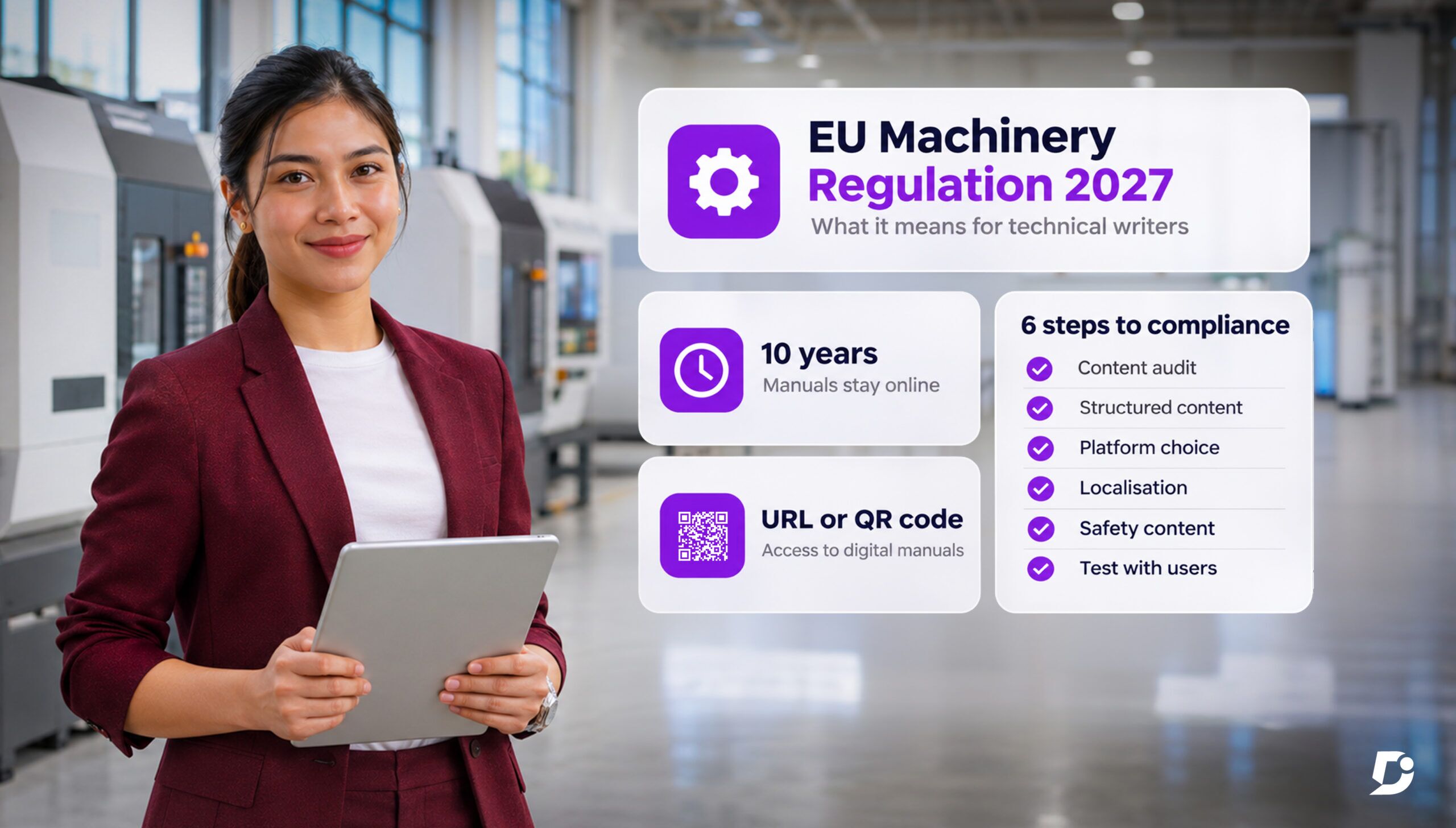
In the EU, many machinery manufacturers always supplied user manuals in paper form, while some manufacturers supplied both digital and printed user manuals. If manufacturers choose to supply manuals in digital form, they must show how to access them, for example through a URL or QR code, on the machinery itself or, where that isn’t possible, on the packaging or an accompanying document.
Digital manuals must be in a format where users can download and save to their own device in addition to accessing them via the web. EU Machinery Regulation 2027 mandates that online instructions must stay accessible for the expected lifetime of the machinery and for at least 10 years after it is placed on the EU market.
Digital manuals must be in the language understood by end users in the EU member state where the machinery is sold. Thus, digital manuals must be multilingual in nature. However, customers can request a free paper copy at the time of purchase, which must be provided within one month, and safety information for consumer (non-professional) machinery must still be on paper.
Many machines are configured based on customer needs; thus, each machine might have different versions. For example, if a CNC machine is shipped from a manufacturer, the customer might customize type of motor, operating conditions, software version, and other accessories to meet their needs.
So, the technical writing team may have to create and maintain different documentation versions of the same machinery for compliance requirements. When machinery relies on software, the correct software version associated with the right machinery configuration must also be documented with version control.
Technical writers need to be aware of the level of knowledge of intended readers and produce right content based on readers’ knowledge.
How to Build Compliant Digital Instructions
Many technical writing teams tailor their internal workflow and practices to printed manuals. Some steps to build a digital version of your documentation for compliance with EU Machinery Regulation are given below
- Undertake content audit: Technical writing teams should review existing manuals against the regulation’s content requirements. After the content audits, identify content gaps, understand residual risks and maintenance issues before starting on converting any information into digital form
- Move to structured content: Technical writers must break down documents into modular topics such as installation, operations, maintenance, safety and troubleshooting. Structured content is easy to search, update, translate, and reuse across product variants
- Platform consideration: Choose a knowledge base platform that keeps content online and accessible for at least 10 years. If URLs change, the platform should redirect users to the new URL so QR codes and links don’t break.
- Localisation: Identify the target market of machinery and translate the modular topics to the required language
- Safety content: Technical writers shall use consistent warning formats, clear headings, and visual cues so safety information stands out in a digital layout
- Test content with real users: Technical writers must check that operators and maintenance staff can find critical safety information quickly on mobile devices, often in noisy or gloved working conditions
Schedule a demo with one of our experts to take a deeper dive into Document360
Book A Demo
Difference between Digital Product Passport and Machinery Regulation
Both regulations push product information into digital form, but they serve different goals and place different demands on technical writers. Here’s how they compare.
| Parameters | Digital Product Passport | Machinery Regulation |
| Purpose | Sustainability and the circular economy | Safety: operating, maintaining and avoiding misuse |
| Content governance | A product data record covering material, origin, repairability, recyclability and so on | The instructions for use that ship with machinery |
| Legal basis | Ecodesign for Sustainable Products Regulation (ESPR) | Machinery Regulation, replacing the 2006 Directive |
| Products covered | Rolled out by product group (batteries first, from 18 February 2027) | All machinery and related products |
| Important dates | Registry live 19 July 2026 (ESPR); battery passports from 18 February 2027 (Battery Regulation) | Applies from 20 January 2027 |
| Technical writer responsibility | Structured data fields behind a QR code | The full manual, allowed in digital form from 2027 |
Conclusion
The Machinery Regulation applies from 20 January 2027, and documentation work should start now. Instructions can then be provided digitally via a URL or QR code, in a downloadable format that stays available for at least 10 years.
Technical documentation should be version-controlled for compliance with this regulation. The Technical documentation team can write for both EU machinery regulation and DPP rather than duplicating their work.
Given the 10-year availability requirement, the documentation team should choose the right knowledge base platform vendors who support version control, digital access in digital format, multilingual options and accessibility.
The Technical writing team can start with an audit of existing manuals against the regulation’s requirements and build a roadmap to reach compliance well before January 2027.


