 EN
 DE


AI Summary
- Technical writers’ expertise in simplifying complex information, organizing product knowledge, and supporting users increasingly applies to knowledge management, AI assistants, and content strategy.
- Knowledge Engineer maintains accurate, accessible organizational information through knowledge pipelines, content updates, automation, and governance.
- Context Engineer helps AI systems retrieve and use relevant information through chunking, RAG, embeddings, reranking, context management, and AI evaluations; additional skills include Python, vector search, and AI evaluation.
- Knowledge Architect designs organizational information architecture, taxonomies, content models, governance, and knowledge lifecycles. Content Strategist plans, maintains, and measures content across channels to meet user needs and business goals.
- Transition steps include building portfolios with taxonomy redesigns, RAG chatbots, AI answer evaluations, documentation audits, and launch content plans, while searching titles such as Documentation Engineer, Information Architect, and Knowledge Management Specialist.
AI-generated content. It may contain errors.
See Document360 in action
With over 22 years of experience in technology, I’ve seen how the role of technical writers has evolved. Technical writers have always done more than create documentation. They work with product and engineering teams, simplify complex information, organize product knowledge, and help users find the answers they need.
What’s changing is how companies use that knowledge. Documentation now supports not only customers and employees but also AI assistants that rely on accurate, well-organized information. Through my work developing AI-powered search systems, I’ve seen how the way information is structured and maintained can affect the quality of answers these systems provide.
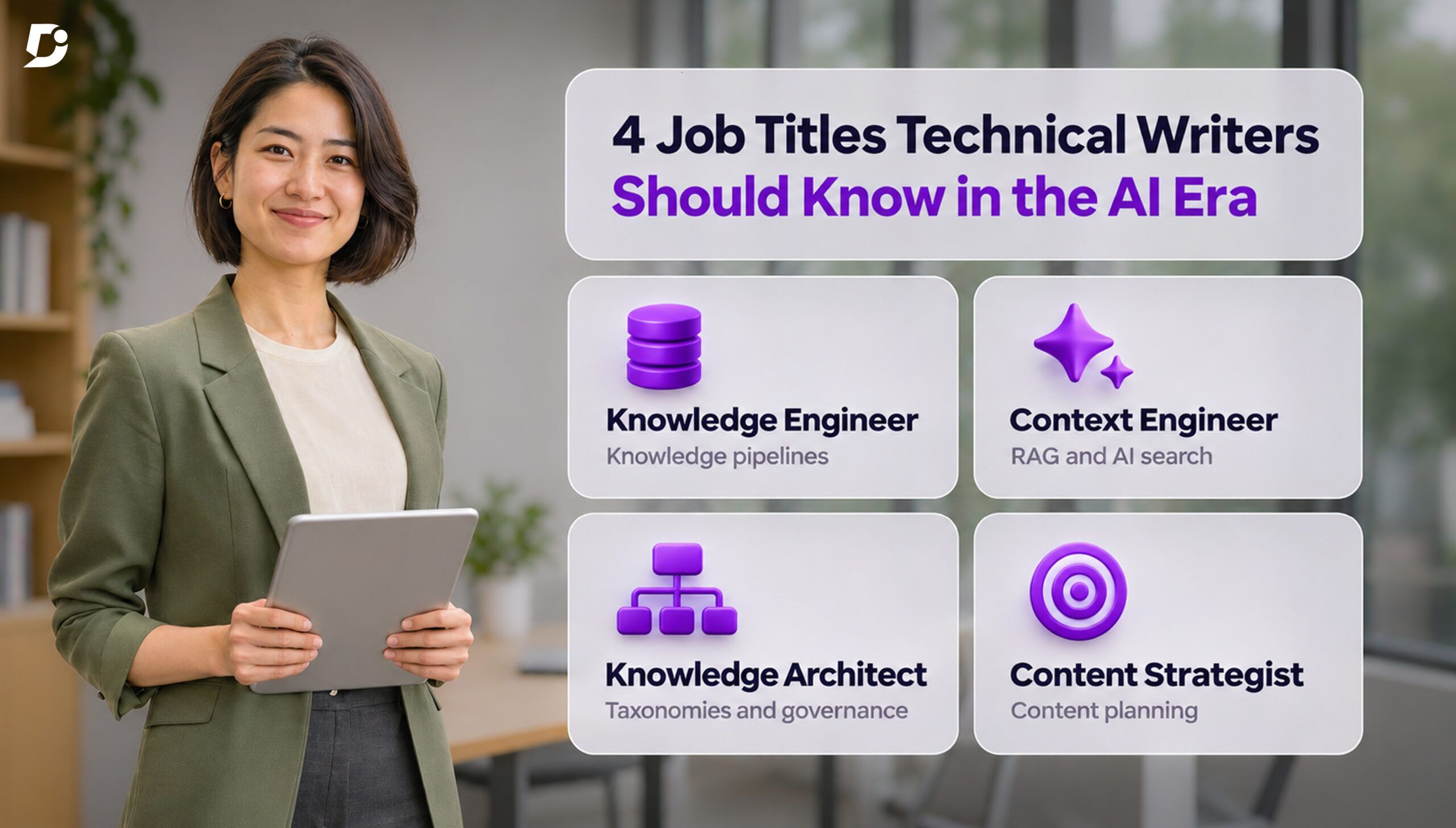
These changes are creating opportunities for technical writers to apply their existing expertise in new areas. In this article, I’ll explore four job titles, Knowledge Engineer, Context Engineer, Knowledge Architect, and Content Strategist, explain what each role involves and the skills technical writers can develop to pursue these opportunities.
4 Job Roles Technical Writers Can Explore
Here are four job titles that build on technical writing expertise, with a growing focus on knowledge management, content strategy, and AI-powered systems.
1. Knowledge Engineer
A knowledge engineer helps organizations keep their information accurate, organized, and accessible to employees, customers, and AI-powered tools. The role builds on technical writing skills but places greater emphasis on the systems and processes used to manage knowledge across an organization.
For example, when a product feature changes, the update may need to appear in user guides, support articles, internal documentation, and AI-powered assistants. A knowledge engineer helps establish processes to keep this information consistent and up to date.
Key responsibilities of a knowledge engineer include:
- Managing reliable information sources: Identifying where accurate product information lives, who owns it, and how it should be maintained.
- Keeping documentation up to date: Connecting product releases, engineering changes, support tickets, and customer feedback to documentation updates.
- Organizing content for different systems: Structuring information so it can be accessed through knowledge bases, APIs, and AI-powered tools.
- Maintaining content quality: Establishing terminology guidelines, review processes, access permissions, and standards for keeping information accurate.
- Improving knowledge accessibility: Identifying content gaps, analyzing unanswered questions, and measuring how effectively users and AI assistants find information.
Knowledge engineers work with both internal teams and customer-facing systems. While technical writers may already contribute to many of these activities, knowledge engineers typically take broader responsibility for the processes and technical integrations that keep information consistent across an organization.
2. Context Engineer
A context engineer helps AI assistants find and use the right information to answer questions accurately. The role combines technical writing expertise with AI search, focusing on how information is organized, retrieved, and presented to AI systems.
For example, PostHog renamed its technical writing team to context engineers, expanding their work to support its AI-powered onboarding assistant. It’s a practical example of how technical writing skills are being applied to AI systems.
Key responsibilities of a context engineer include:
- Preparing documentation for AI: Organizing content into meaningful sections (chunking) so AI systems can retrieve relevant information without losing important context.
- Improving search accuracy: Testing embedding models, semantic search, and reranking techniques to help AI systems find the most relevant content.
- Managing context: Selecting and organizing the information passed to AI models while working within their context window limits.
- Improving context quality: Identifying missing, outdated, or conflicting information before it is used by AI systems.
- Testing AI responses: Running evaluations (evals) to measure whether AI assistants retrieve the correct information and generate accurate answers.
Moving into context engineering requires additional technical skills, particularly in RAG, AI search, and evaluating AI-generated answers.
For technical writers interested in working more closely with AI systems, their understanding of content structure and user needs provides a useful starting point.
3. Knowledge Architect
A knowledge architect focuses on how information is structured and managed across an organization. Unlike a knowledge engineer, who often works on the systems that maintain and deliver information, a knowledge architect defines the broader structure, standards, and processes that help people and AI tools find and use knowledge consistently.
For example, when product information is scattered across documentation, support portals, and internal systems, a knowledge architect establishes how that information should be categorized, connected, and maintained.
Key responsibilities of a knowledge architect include:
- Designing information architecture: Creating taxonomies, content models, and relationships that organize product knowledge across different systems.
- Establishing knowledge governance: Defining content ownership, quality standards, review processes, and access policies.
- Managing the knowledge lifecycle: Setting guidelines for creating, updating, reusing, and retiring content across documentation and other channels.
- Improving knowledge workflows: Working with teams to standardize how information is collected, organized, and shared.
Knowledge architecture offers a natural career path for technical writers interested in information architecture and governance.
The main difference is the scope: rather than organizing documentation for a particular product, the role involves designing how knowledge is structured and managed across an organization.
4. Content Strategist
Content strategist isn’t a new job title, but the role is becoming increasingly relevant to technical writers as organizations rethink how they manage and deliver product knowledge. A content strategist plans what content is needed, who it’s for, and how it should be maintained across documentation, knowledge bases, training materials, and other channels.
For example, when a company launches a new product feature, a content strategist works with product, engineering, and support teams to identify the documentation, onboarding materials, and educational resources users will need.
Key responsibilities of a content strategist include:
- Planning content initiatives: Developing content plans around product releases, customer needs, and business priorities.
- Managing the content lifecycle: Planning content reviews around product releases, identifying outdated documentation, and prioritizing updates based on user needs.
- Managing content workflows: Defining processes and tools for creating, reviewing, publishing, and maintaining content.
- Collaborating across teams: Working with product, engineering, support, and marketing teams to keep information consistent.
- Measuring content effectiveness: Using search data, customer feedback, and content analytics to understand how well content meets user needs.
For technical writers interested in content planning and decision-making, content strategy offers an opportunity to influence what gets published, which information users need most, and how organizations measure the value of their content.
Schedule a demo with one of our experts to take a deeper dive into Document360
Book A Demo
How Do These Four Job Roles Compare?
| Job role | Primary purpose | Role type | Key focus | Skills to develop |
| Knowledge Engineer | Keep organizational knowledge accurate, current, and accessible | Primarily tactical | Knowledge pipelines, content updates, automation, governance | APIs, content modeling, workflow automation |
| Context Engineer | Help AI systems retrieve and use the right information | Primarily tactical (technical) | RAG, chunking, embeddings, reranking, AI evaluations | Python, RAG, vector search, AI evaluation |
| Knowledge Architect | Design how organizational knowledge is structured and governed | Primarily strategic | Taxonomies, content models, information architecture, governance | Knowledge architecture, taxonomy design, content governance |
| Content Strategist | Plan and improve content to meet user needs and business goals | Strategic and tactical | Content planning, lifecycle management, collaboration, performance | Content analytics, user research, content strategy |
How to Transition from Technical Writer to These Roles
Start with the skills listed in the comparison table above, then use practical projects and a broader job search to take the next step.
Build a relevant portfolio
Practical projects show employers you’re ready for these roles. Consider:
- Taxonomy redesign (Knowledge Architect): Reorganize an existing documentation library using a structured taxonomy and metadata.
- RAG chatbot (Context Engineer): Build a simple chatbot that answers questions using product documentation as its knowledge source.
- AI answer evaluation (Context Engineer): Create a framework to test the accuracy of AI-generated answers against your documentation.
- Documentation audit (Knowledge Engineer, Content Strategist): Identify outdated, duplicate, or conflicting information and propose a plan to fix it. See how a knowledge base audit works in practice.
- Launch content plan (Content Strategist): Plan the documentation, onboarding materials, and educational resources for a product launch.
Explore different job titles
Companies don’t always use the same titles for similar work. Look beyond traditional technical writer positions and search for titles such as Documentation Engineer, AI Documentation Specialist, Information Architect, Knowledge Management Specialist, and Developer Experience Writer.
Conclusion
Technical writing isn’t disappearing, but the opportunities around it are changing. We’re already seeing documentation teams take on responsibilities in knowledge management, AI search, and content strategy, sometimes under entirely different job titles.
Having worked closely with documentation and AI systems, I see these roles as an extension of the skills technical writers already bring to the table. Understanding products, organizing complex information, and making knowledge useful remain just as important.
If you’re considering a career move, start by choosing a role that interests you and developing one relevant skill, whether it’s AI search, content modeling, knowledge governance, or content analytics.


