EN
EN  DE
DE ES
ES FR
FR PT-BR
PT-BR


AI Summary
- Guru alternatives should support searchable, maintainable knowledge bases, stale-content controls, cited AI answers, and audiences including staff, customers, or both.
- Document360 is the top pick for internal and customer-facing documentation, offering Eddy AI, cited AI search, duplicate detection, review workflows, and an AI Style Guide; pricing is custom with a free trial.
- Slite provides verified wikis and agent fact-checking; Notion combines a wiki with an all-in-one workspace; Tettra delivers AI answers in Slack; Bloomfire supports company-wide knowledge programs; Glean searches 275+ connected apps; and Confluence integrates with Atlassian and Jira.
- Guru’s strengths include card-based verification, “Knowledge Everywhere” delivery, and cited AI answers. Limitations include rigid cards for long-form documentation, potentially irrelevant answers, accidental verification, no free plan, changing enterprise pricing, and no customer help desk.
- Choose based on maintenance, internal and external audiences, scattered information, guided troubleshooting, and published pricing requirements.
AI-generated content. It may contain errors.
See Document360 in action
The best Guru alternatives in 2026 help you keep your knowledge base easy to search and easy to keep updated. When you look for alternatives, look for solutions that mark old content, give cited answers to questions using AI, and are particularly made for your audience, be it your own staff, your customers, or both.
Our top pick for Guru alternatives in 2026 is:
- Document360: Made for those who need a self-maintaining knowledge base for both their internal staff and customers
- Slite: Made for SMBs that need a verified wiki with a fact-checking AI agent
- Notion: Made for teams that want to deliver answers in channels
- Bloomfire: Made for large organizations that want a company-wide knowledge base
- Glean: Made for companies who have knowledge scattered across various tools
- Confluence: Made for teams that use the Atlassian stack
Guru is well recognized for its verification engine, which ensures every piece of knowledge is presented as a “card” to the right owners to verify before users see the trust badge. But that same manual verification engine becomes a pain point because it requires constant maintenance. Plus, Guru’s recent shift from a predictable seat-based pricing model to a custom enterprise package means you’ll only know the cost once you talk with the strategy team.
So, for those looking for solutions to fill this gap, we’ve presented seven Guru alternatives, with features, price, and real user reviews.
Guru Knowledge Base Alternative at a Glance
Tool |
Best for |
Starting Price |
Standout AI feature |
| Document360 | Internal and customer-facing docs in one platform | Custom quote | Eddy AI, duplicate detection, AI Style Guide |
| Slite | Verified team wiki for SMB and mid-market | $10/user/month | Slite Agent fact-checks docs and suggests fixes |
| Notion | All-in-one workspace with a wiki | $10/user/month | Notion Agent and Enterprise Search |
| Tettra | Slack-first internal knowledge | $8/user/month | AI answers in Slack DMs and channels |
| Bloomfire | Company-wide knowledge programs | Price not disclosed | AI search across documents, video, and audio |
| Glean | Enterprise search across many tools | Price not disclosed | Permission-aware AI search across 275+ connectors |
| Confluence | Internal docs in an Atlassian stack | $5.42/user/mo | Rovo AI, metered by credits |
Why Teams Look for a Guru Alternative
Guru’s got a rating of 4.7 out of 5 on G2 with 2,323 reviews, and that says something about its strengths. So users usually don’t look for alternatives unless their needs outgrow the card model. Let’s look at its strengths and weaknesses before you decide you need to look for options.
Where It Delivers
- Card-based verification: Guru’s human-in-the-loop governance models force subject-matter experts to periodically verify the knowledge cards. If they don’t, the unverified content gets a highly visible flag. (Source)
- “Knowledge Everywhere” delivery model: While most other platforms require you to leave the active window, Guru lets users find answers right where they’re working, be it browser, Slack, or Microsoft Teams. (Source)
- Cited AI answers: Guru’s knowledge agent gives cited answers that are backed by verified sources. (Source)
Where It Falls Short
Cards aren’t made for long-form documentation: Cards work the best for short answers, so guides, technical references, and multi-step procedures are hard to record.
“The card-based UI/UX is overly rigid for long-form technical documentation, causing fragmentation. Additionally, onboarding new users is difficult because the advanced search requires highly precise keywords, often leading to initial navigation frustration and steep adoption curves.”
Answers aren’t always relevant: Some users complain they don’t always get relevant answers, especially when content tagging is poor. You need to use exact keywords, which can be difficult with newly onboarded staff members.
“Guru is a great tool, but there are a few areas where it can feel limited. Sometimes the options and search results don’t always bring up the most relevant cards, especially when content isn’t tagged properly or when there are many similar cards. For more detailed or long-form documentation, Guru’s card format can also feel a bit restrictive compared to tools like Confluence or Notion.”
“Guru works best when everyone on the team is consistent about updating and verifying cards. When some teammates don’t maintain their information, it affects the overall accuracy and usefulness for everyone.”
Accidental verification: A reviewer reported that if you edit a card for formatting or move it in the collection, it automatically verifies. This means you can’t always trust the green tick.
“The AI responses in Guru definitely need improvement. There are some small glitchy things, like needing to be part of the verification group to have edit access to a collection. This means when I edit a card, it automatically gets verified, even though I’m just editing for formatting and am not a subject matter expert. Also, if I move a card between collections, it automatically verifies it.”
The pricing model change: Guru doesn’t have a free plan, nor a free self-service tier. You need to pay for a platform + service package, which can be quite expensive for startups.
“All seems to be good but price perspective lil bit higher if any startup want to use ut its bit expensive acc to them”
No customer help desk: Guru is solely an internal knowledge base made for your team. If you need a customer service knowledge base, you need to pay for another tool.
7 Guru Alternatives to Know in 2026
We’ve compiled a list of seven tools, each solving a different problem that users face with Guru. Here’s a quick comparison of features for all seven tools:
Tool |
Customer-facing site |
Stale-content controls |
AI answers draw from |
| Document360 | Yes, public and private content in one project | Review reminders, duplicate detection | Your knowledge base |
| Slite | Public docs; custom domain on Pro | Doc verification, agent fact-checking | Slite docs; connected tools on Pro |
| Notion | Notion Sites | Page verification (Business plan) | Workspace; connected apps on Business |
| Tettra | External sites | Verification, stale and unowned page reports | Tettra pages and Google Docs |
| Bloomfire | No, built for internal communities | Moderation and audit trails | Bloomfire plus enterprise search sources |
| Glean | No, search layer only | Relies on source tools | 275+ connected apps |
| Confluence | Public links and anonymous access | Page insights and archiving | Rovo, metered by credits |
While features matter, we strongly urge you to pick a tool that solves your problem, not the one with the most features.
1. Document360
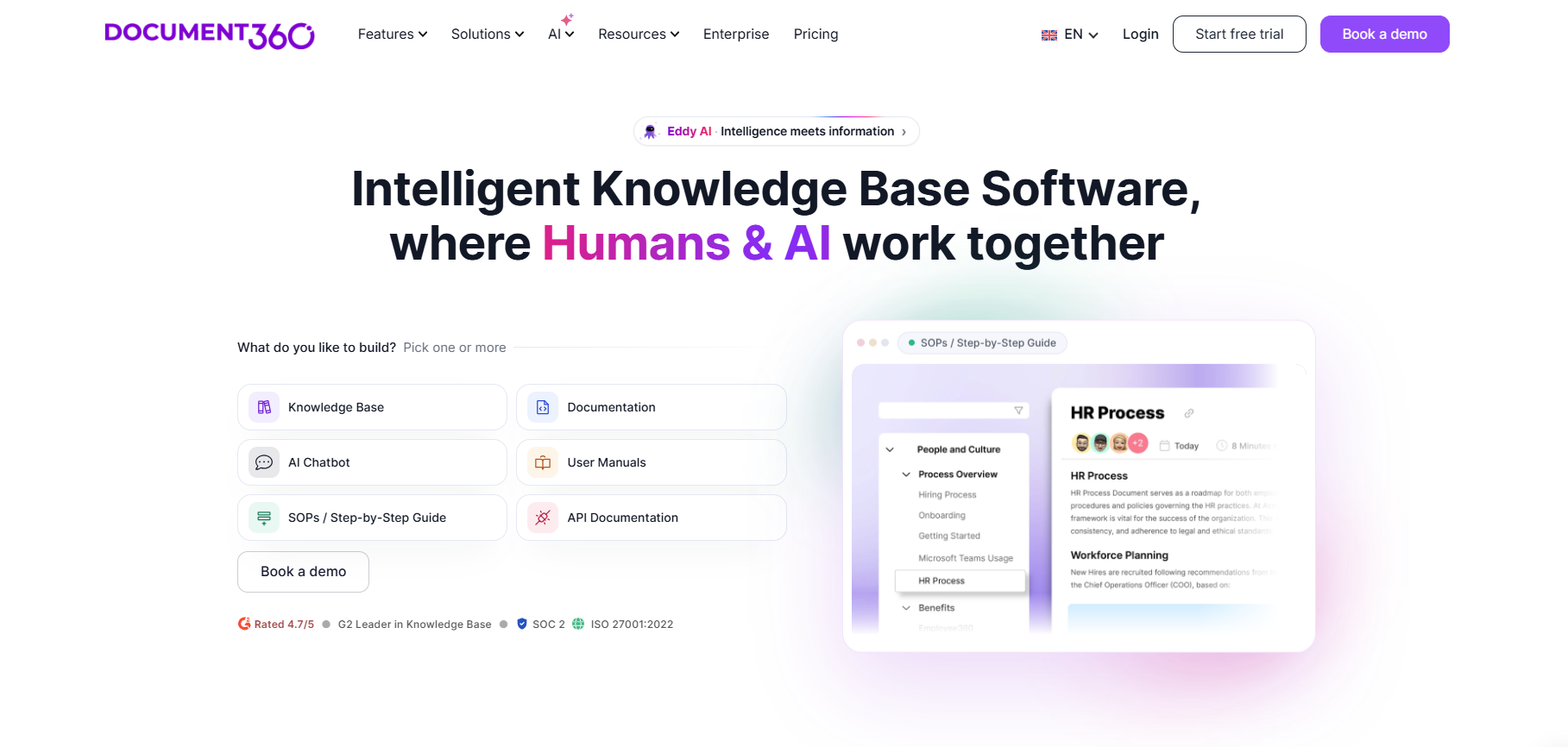
Unlike Guru, Document360 is a self-maintaining knowledge base that lets you build an internal knowledge repository and a customer help center from a single account.
Best for: Teams that want internal knowledge, a customer-facing help center, and strong content governance in the same knowledge base software.
Key features:
- Eddy AI: GPT-based AI assistance that helps writers create content and answers customers’ questions
- AI search: Gives a cited answer to the reader over a list of help documents
- Duplicate detection: Get notified whenever any article says the same thing more than once
- Savvy workflow features: What You See Is What You Get (WYSIWYG) editor, Markdown editors, versioning, and approval workflows
- AI Style Guide and Glossary Generator: Helps keep consistent style and terminology
Why consider it: Beyond AI-powered answers, Document360 puts AI to work on content upkeep: finding duplicates, generating glossary terms, and keeping tone consistent across writers.
Potential limitation: No published pricing; however, it offers a free trial to test it.
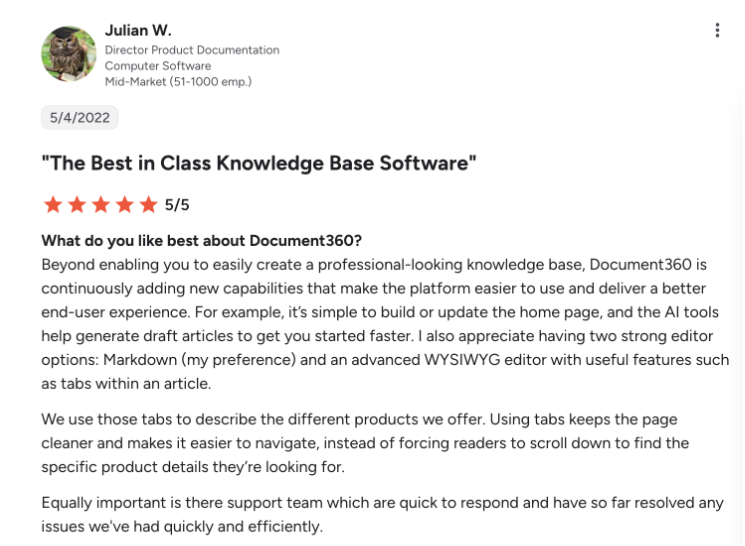
User’s opinion on Document360: It has a 4.7 out of 5 rating on G2, where users consistently praise its ease of use, powerful search, streamlined collaboration, and quick support from its team.
Looking for a Guru alternative that serves both your team and your customers? Try Document360 and see the difference.
Book A Demo
2. Slite
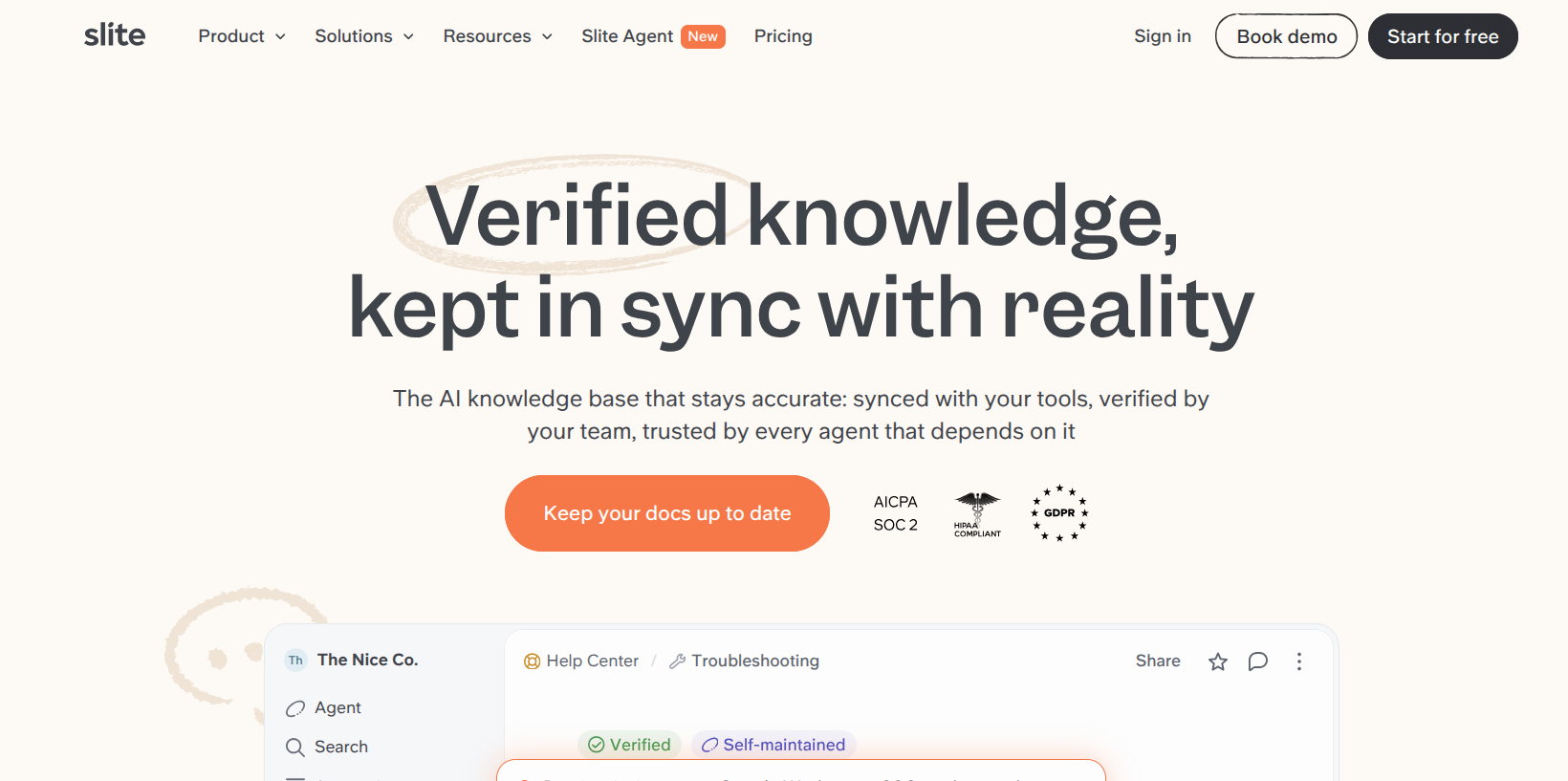
Slite originally started as a clean, easy-to-use wiki for teams, which has now upgraded to add an AI agent that checks your knowledge base information against other tools that you may use. According to us, Slite is the closest match to Guru’s verification model at a published per-seat price model.
Best for: SMBs that need a verified internal wiki without enterprise-grade pricing.
Key features:
- AI search: Ask questions and get answers from the knowledge base
- Human-in-the-loop verification: Subject matter experts confirm the documents for the most current information
- Slite agent: Verifies information against all connected tools and suggests any needed fixes
- Connect tools: Get answers from other tools in your workflow
- MCP and API access: Let AI tools access your knowledge base
Why consider it: You get published prices with prices as low as $10 per user per month.
Potential limitation: You need to pay for all readers per seat on the Basic and Pro plans.
User’s opinion on Slite: Slite has a 4.6 rating on G2. While users love that Slite is intuitive and productivity-friendly for SMBs, they find limitations with formatting in complex documentation.
3. Notion
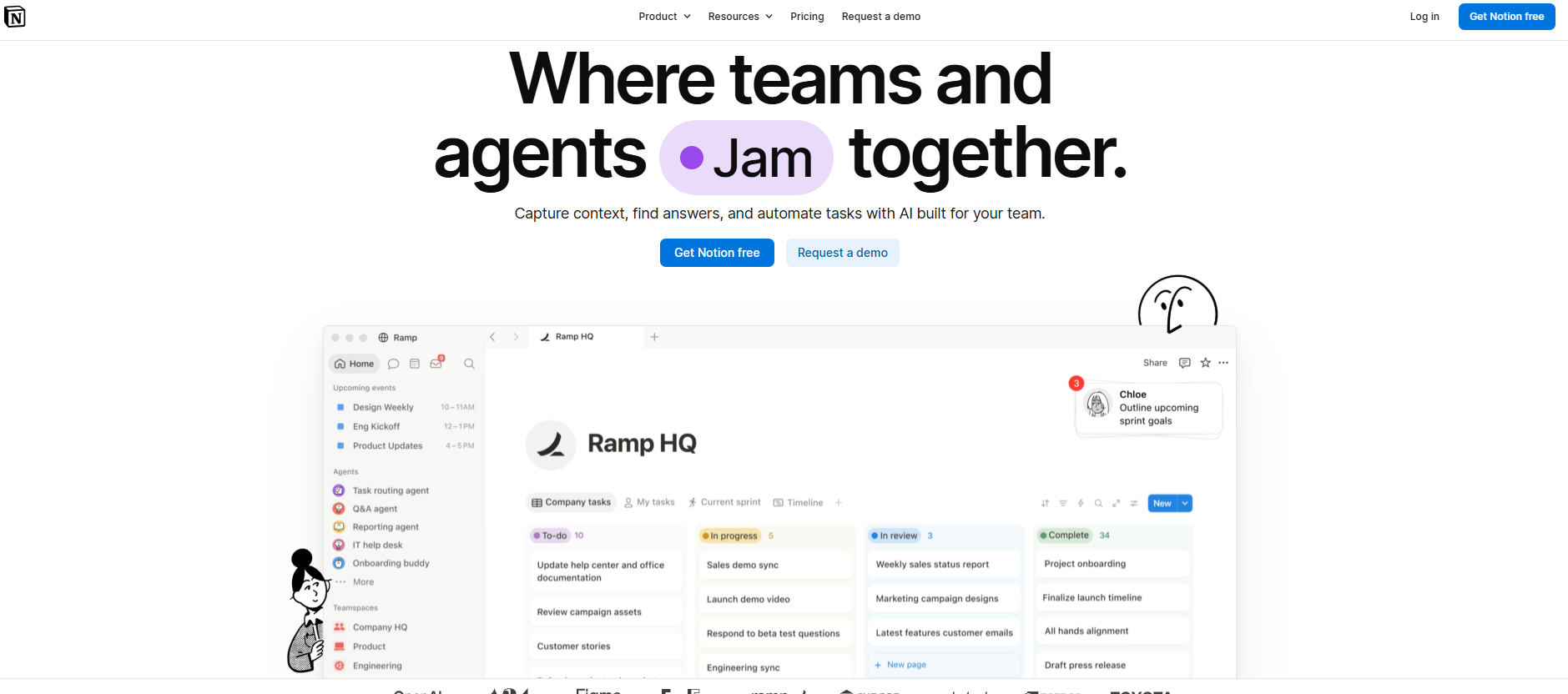
Notion is a popular workspace where the wiki sits alongside projects, meeting notes, and databases. Users often use it as a Guru alternative if they’re already using the platform for other functionalities.
Best for: Those who want an all-in-one workspace with a wiki
Key features:
- The Notion Agent: Built-in autonomous workspace assistant that can execute tasks on your behalf
- Search across apps: Get answers to queries from all connected tools
- Page verification: Mark pages with up-to-date information so readers know the information is current
- Databases: Add owners, properties, and filters to the pages in the wiki
- Automation agents: Create custom agents to automate repetitive tasks
Why consider it: Comes with a no-cost free plan.
Potential limitation: The features that replace Guru, like the Notion Agent and enterprise search, come with a business plan that costs $20 per member per month when billed yearly.
User’s opinion on Notion: With 13K+ reviews on G2 that give Notion a 4.6 rating, users commend Notion for its “flexibility and ease of use.” However, the commonly reported pain point is the learning curve that makes it challenging for new users.
4. Tettra
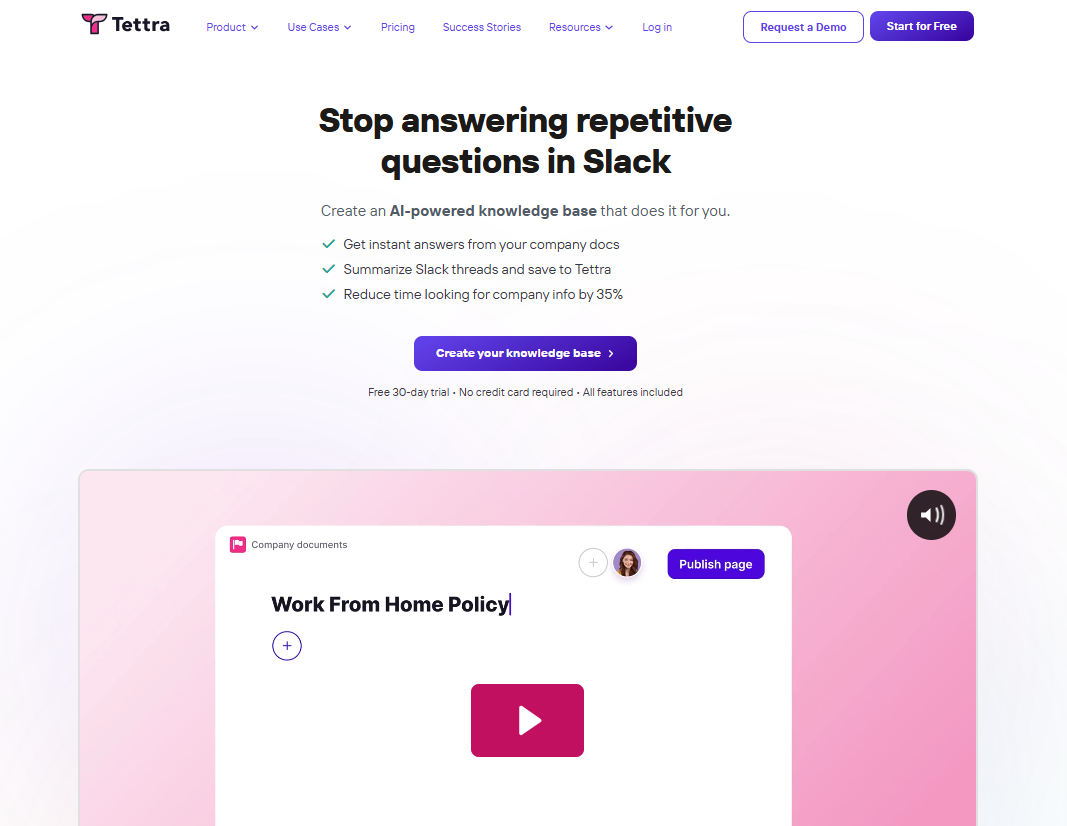
Just like Guru, Tettra is solely an internal knowledge base. It’s built around Slack, so when users ask questions in the workspace, Tettra answers from its pages.
Best for: Teams that use Slack and want to save time on repeated questions.
Key features:
- Answers in Slack: Get direct answers with AI in DMs and Channels
- Captures answers: Tettra captures answers that are already given in Slack threads
- Content verification: Any stale content gets flagged
- Request pages: Users can request missing information or pages for experts to address
- AI FAQ: Generates FAQs from existing content
Why consider it: One of the affordable options, starting at just $8 per user per month with a 30-day free trial.
Potential limitation: The Scaling plan with the $8 per user quote needs at least 10 users. SSO and SCIM are paid add-ons.
User’s opinion on Tettra: Rated 4.7 out of 5, 161 users on G2 praise Tettra for an effective search functionality that makes information easy to access. However, users note a lack of customization options.
5. Bloomfire
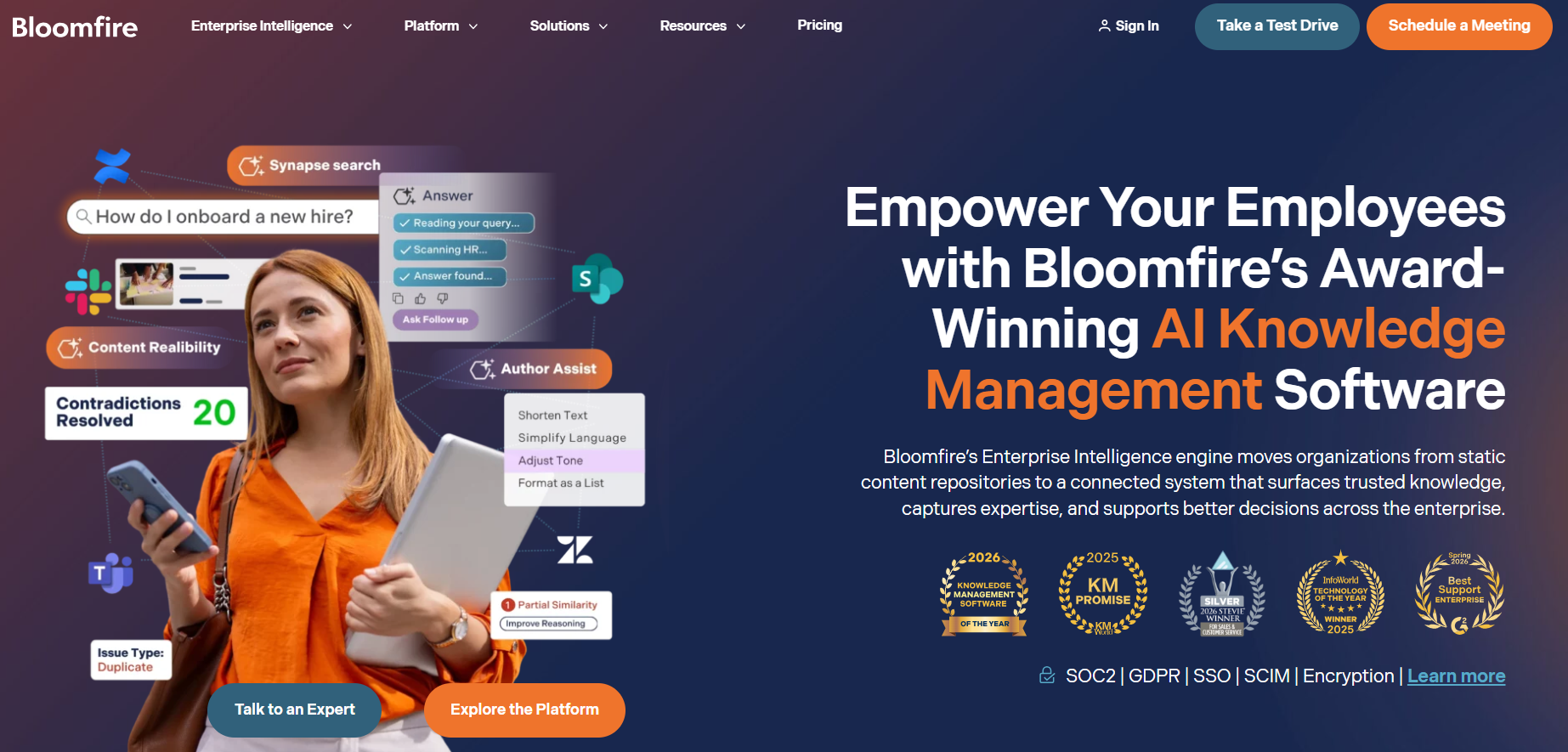
Bloomfire is an enterprise-grade knowledge management and intelligence platform that charges you for the scope of access rather than each seat.
Best for: Large organizations needing company-wide knowledge programs where per-seat pricing can prove to be expensive
Key features:
- Deep search: Within documents, videos, and audio
- AI tools: AI-powered search and generative authoring
- Governance: Provides audit trails and ensures content compliance
Why consider it: Charges a fixed annual cost for three different access scopes, so unlike Guru, adding readers won’t add to the bill.
Potential limitation: Separate fee for migration and implementation.
User’s opinion on Bloomfire: Users gave Bloomfire a 4.6 rating on G2, praising it for “enhancing the back office experience.” However, a common complaint is inconsistency in the search function, which affects overall UX.
6. Glean
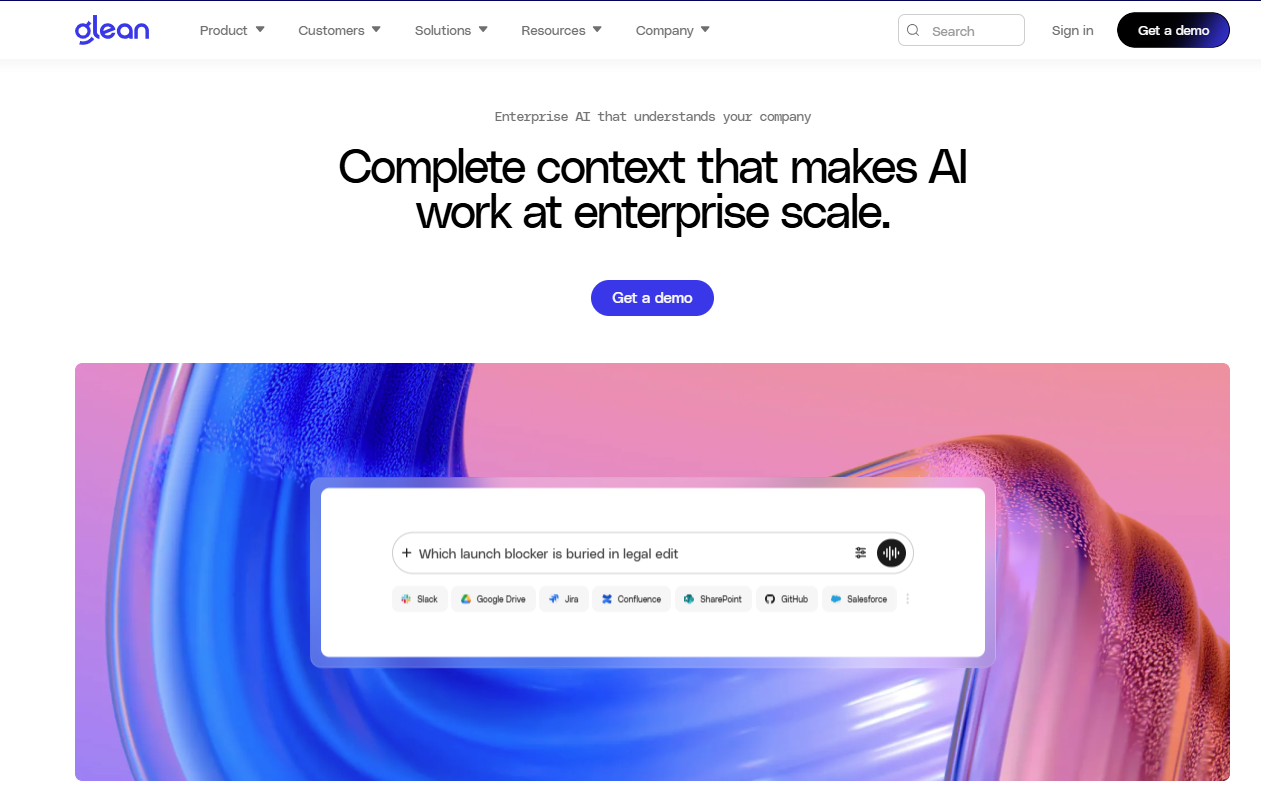
Unlike other knowledge base wikis here, Glean is an AI search and assistant that works on top of your tech stack to answer questions users may have.
Best for: Large teams with knowledge scattered across different apps.
Key features:
- Out-of-the-box connectors: Connect to over 275 apps in Glean
- Permissions for access: Users only see what they are allowed to
- Real-time syncing: Reflects changes in content and permissions as soon as they are made
- AI assistant: Glean assistant is a chat that responds based on the company’s data
- Automation agents: Build custom agents to automate repetitive tasks
Why consider it: Connects to more sources than any other tools on this list and doesn’t require you to carry out migration.
Potential limitation: Retrieves what’s already available on your tools, even if it is stale.
User’s opinion on Glean: With a 4.7 rating, Glean boasts praise for its powerful integrations. However, users criticize it for often providing unreliable results.
7. Confluence
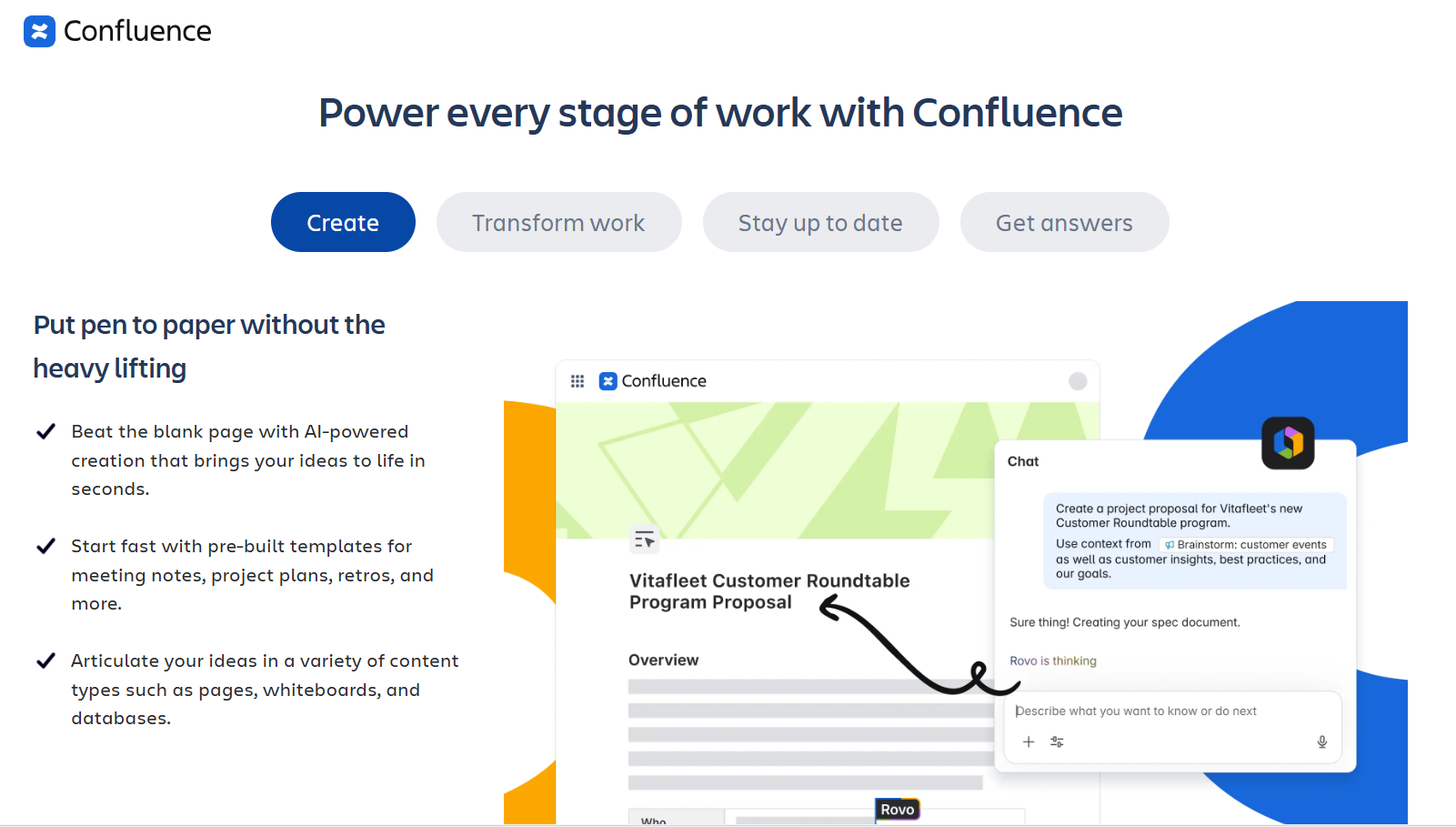
Confluence is Atlassian’s team workspace, designed to work in tandem with Jira. You can use it as an internal wiki, and it is an ideal option for teams already using Jira to manage work.
Best for: Internal documentation within the Atlassian workspace
Key features:
- Jira integration: Visual connection between project documentation and daily task tracking
- Spaces and page trees: A digital library for each department with its dedicated wiki
- Rovo AI: Chat and search agent for content
- Databases and whiteboards: Brainstorming board and structured tables on the same page
Why consider it: It’s the cheapest per-seat option here, starting at $5.42 per user per month.
Potential limitation: Can’t be a customer-facing help center. Plus, customers often complain about content rot and the need for a separate Atlassian Guard subscription below the Enterprise plan for SSO and SCIM.
User’s opinion on Confluence: Rated 4.1 out of 5 on G2, while users like that they can use it alongside Jira, they often express frustration with the search feature.
A Decision Framework: Which Guru Alternative Fits You
When choosing between the Guru alternatives that we’ve given, answering these five questions will help you pick the right tool for you and your team:
- Is your core problem that cards go stale and a person still has to rewrite them? If yes, then choose a tool that helps with maintenance, like Slite or Document360. The former has an agent that flags outdated docs and provides fixes, while the latter comes with review reminders, duplicate detection, and an AI style guide.
- Do you need to serve both internal agents and external customers from one system, not just an internal wiki? If yes, then Document360 is built for both. Panaya uses it to run its public documentation and private sales knowledge base.
- Is the real problem that answers are scattered across a dozen tools, not the wiki itself? If yes, you need a search layer and not a wiki. In that case, go for Glean or Notion.
- Do agents or customers need guided, branching troubleshooting rather than a static card? If yes, Document360’s Interactive Decision Trees (available on the Enterprise plan) let you build guided, branching paths that lead agents and customers to the right answer step by step.
- Is per-seat cost, or Guru’s shift toward enterprise-only pricing, the actual trigger? If yes, then choose a tool with published pricing, like Confluence, Tettra, or Slite.