 EN
EN 

AI Summary
- Jenna Ingersoll, Knowledge Program Manager at Aristocrat, has over 14 years of experience in technical writing and documentation management, progressing from technical support to technical writer and manager.
- Technical writers increasingly support strategy, knowledge sharing, audience development, information flow, and documentation frameworks—not only writing. Knowledge management includes identifying, creating, capturing, sharing, storing, and retaining information.
- Management challenges include reorganizing scattered systems such as Confluence, improving discoverability and consistency, and demonstrating benefits to companies and customers; projects may take years.
- AI and automation can gather information across sources, organize resources, and assist editing tools such as Grammarly, reducing review time and cost.
- Company-specific style sheets, terminology and acronym guidance, and regular one-on-ones help maintain consistent documentation; Jenna also emphasizes passion, prioritization, and learning to say no.
AI-generated content. It may contain errors.
See Document360 in action
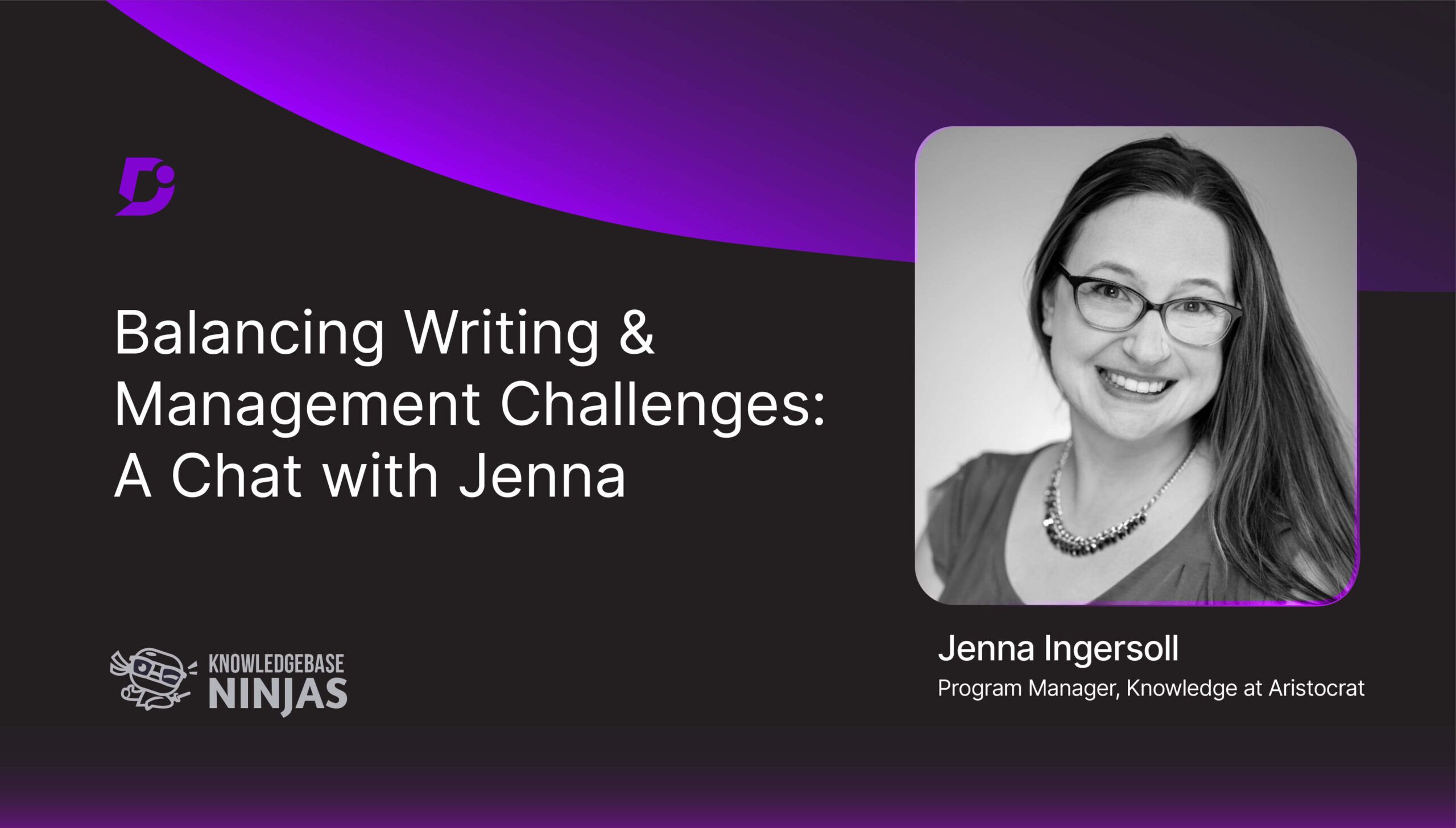
In this episode of the Knowledge Base Ninjas podcast, Jenna shares her insights on how the role of a technical writer is evolving into that of a knowledge manager. She talks about going beyond just writing to focus on strategy, knowledge sharing, and building stronger documentation teams. Jenna also discusses the real challenges technical writers face when moving into management – like reorganizing scattered content systems and maintaining consistency across teams. She highlights the importance of understanding information flow, creating effective documentation frameworks, and how AI and automation are starting to simplify everything from content gathering to editing.
Watch the full podcast episode video here
You can listen to the full episode on Apple, Spotify and YouTube.
About Jenna
-
Jenna’s LinkedIn
-
Jenna Ingersoll is the Knowledge Program Manager at Aristocrat with over 14 years of experience in technical writing and documentation management. Her journey into this field began unexpectedly while working in technical support, where her clear and structured communication caught her manager’s attention. What started as a simple writing test turned into a long-term career built on curiosity and adaptability. Over the years, Jenna has grown from being a technical writer to managing documentation teams across companies like High Fidelity, Big Fish Games, and now Aristocrat. Her background in philosophy helps her understand diverse perspectives and communicate effectively with different audiences.
Quick jumps to what’s covered:
4:14 – Transition to management as a technical writer
6:01 – Core skills beyond writing for technical writers
6:54 – Knowledge management practices for technical writers
8:00 – The broader concept: information vs. documentation
8:46 – Challenges when moving from writer to manager
11:00 – The role of AI and automation in knowledge & docs
13:06 – Processes & frameworks to maintain consistency and accuracy
Transcript:
-
-
Jenna’s Journey into Technical Writing
Gowri Ramkumar: Welcome, everyone, to the Knowledge Base Ninjas podcast. With me today, I’ve got Jenna Ingersoll, Knowledge Program Manager at Aristocrat.
Hi, Jenna. How are you doing today?
Jenna Ingersoll: I’m doing great. Thank you so much for having me.
Gowri Ramkumar: Yeah, the pleasure is ours. Because I should, again, highlight you’ve got over 14 plus years of experience in this space, and there must be a lot to talk about, but let’s just start with my usual question of how did you start this as your career? What inspired you? Please share your success story.
Jenna Ingersoll: Yeah. So I think I had an unusual one, and I think the thing to point out here is that technical writing is out there for everybody, and you may not even know it. So I started my career at a company called Seagull, and I was in the technical support department there. And so I was there for about nine months, and then I was called into my boss’s office, and they asked me, they said, hey, are you interested in a career in technical writing? And I was like, I don’t know what that is. I have no idea. Like, what are you talking about? And they’re like, oh, documentation. You just write for our software. And I’m like, I’m still not understanding. Like, yeah, tell me a little bit more.
And so ultimately, I ended up interviewing, a minor interview as just a little writing test. And part of the reason they asked me was because I had done they said, your writing is really good. When you’re writing to customers, you’re giving them instructions in your emails and things. And it just really impressed us. And so I said, okay, let’s give this a go.
Gowri Ramkumar: Yeah.
Jenna Ingersoll: I got a technical support. And from there it was just, I worked there for a number of years, and about after two and a half years, they said, hey, we need to expand our company because we’re doing more documentation on more products. And so we’re going to hire another technical writer. Well, you’re the only one, so we’re going to put them under you. So then I started learning technical writing management kind of off the cusp. So none of it was trained for I certainly had the skills from education. I have a degree in philosophy. I always say with my philosophy degree helps me understand people, helps me reach multiple audiences even if I don’t agree with them.
Gowri Ramkumar: Okay.
Jenna Ingersoll: Because I can understand, or at least maybe not understand, but I can at least see the different viewpoints and see where people are coming from. So after Seagull, I got a documentation manager position at High Fidelity, which was a startup company at the time, before moving to Big Fish Games in Aristocrat.
Gowri Ramkumar: Wow. Well, fantastic. What a great journey. And, yeah, so the team must be super impressed with the way you’ve been handling customer queries through the support channel, and, amazing, amazing Jenna.
-
How a Technical Writer Evolves into a Knowledge Manager
Gowri Ramkumar:
Now, you spoke about literally being put as a manager to manage the team.
Now, how do you see the role of a technical writer evolving into that kind of a knowledge manager position?
Jenna Ingersoll: Sure. The thing about it, technical writers are really focused on the actual physical skills of writing, so they want to make sure that they’re writing well. We always hear clear and concise.
Yeah. We’re all talking about those concepts of making sure, hey, your writing is clear, it’s well-organized. It’s written, well, in the sense of being concise and easy to understand and comprehend.
And then the job of a technical writing manager is to do two things. One is to build more expertise in your technical writers. So to help them, actually be able to reach out to different audiences, they think they can. Sometimes we need a little bit of help there along the way.
So one of those technical writers let them see where the different careers can take them. But then also you’re really responsible for the strategy and the knowledge sharing of your documentation. So a lot of the work I’ve done in the past has been what tools are we using, and how is that tool going to be formatted so that the person can actually engage with our content in a really good way? It’s identifying what technical writing actually needs to be added that’s going to be helpful, as opposed to just extraneous stuff that people are never going to read.
So it’s a lot of that kind of metrics, that strategy, how what are we going to write in the future to really help our company, but also help our users experience with whatever they are reading.
Gowri Ramkumar: Yeah.
-
Core Skills Every Technical Writer Should Master
Gowri Ramkumar: Now, in terms of core skills, beyond writing, what do you think should a technical writer focus on developing?
Jenna Ingersoll: I think that there are a couple of really core skills.
One is they have to have some technical knowledge, and I’m going to really say, like a lot of technical writers come in and they’re like, hey, just give me the information and I can write it up and that’s great. That’s a big skill you need to have. But how well can you actually interview technical people, get the information that you need yourself and then be able to write it. And that’s something that’s helped me.
So much of my career is that I’m just very, I just, I’m a sponge. I just take it all in. And, one of my unique things is that I actually can then take pieces out of it that don’t actually need to be done, or I can rewrite something in a way that someone’s like, oh, that’s a lot easier to read. And I understand it.
Gowri Ramkumar: Nice.
Jenna Ingersoll: And then beyond that, there’s really more to consider than just writing. And this is like where I talk about knowledge management practices that I feel like are very important for technical writers to learn. So you need to learn how to identify the information that you’re going to be writing about. You need to create it, which is the technical writing portion of it.
But how do you capture that information after you identify it? How do you share that information effectively? And I talk about formatting. I talk about the tools that you’re using. Are you going to do it online? Is this better done in an email? We’re really talking about not just official programs, but really, how do you get that information there? And then how do you store that? How does your company or your customer use the information, and then how do you retain or how does your customer retain that information? So they don’t have to keep coming back to it time to time again.
Gowri Ramkumar: Wow, that’s a lot, isn’t it?
Jenna Ingersoll: So it really is.
Gowri Ramkumar: I know as you start digging deep into it, there’s so many arenas and options that you can choose. Right. Yeah.
Jenna Ingersoll: Yeah. I think the most important or I shouldn’t say the most important thing, but taking all of this together and really thinking about what does the customer need? What information? And then we are, I’m talking about information rather than documentation because it’s a much broader concept than what we say, technical writing.
Gowri Ramkumar: Yeah.
Jenna Ingersoll: It’s information sharing. What makes this sharing of information easier and more accessible. That’s really at the core of it. That’s what documentation is. Documentation, it’s gathering information. It’s sharing information and it’s writing information so that our audience can retain it and stay engaged with it and know that it’s a really reliable resource in the future.
Gowri Ramkumar: Absolutely, absolutely.
-
The Challenges of Moving from Writer to Manager
Gowri Ramkumar: Just coming back to the manager role, right?
14 plus years of experience, you’ve done, well, when we look at your LinkedIn profile, number of places you’ve managed the team, so it’s all nice.
But what could be the biggest challenge as a technical writer you faced or somebody could face when they’re trying to move to this new management?
Jenna Ingersoll: Yeah, a big challenge is going into a company that doesn’t have anything or very much, they, like, I’ll go in, for example, to a company and they’ll have Confluence.
Gowri Ramkumar: Yeah.
Jenna Ingersoll: And I go in there, and their Confluence has 150 spaces in it. And I just sit here, and I’m like, I don’t know where to find this information. The search sometimes works, sometimes doesn’t. It’s not all correlated. It doesn’t all link to each other, that kind of thing.
Gowri Ramkumar: Yeah.
Jenna Ingersoll: So the biggest challenge is going in and a selling, hey, I need to take the time to reorganize this. And this is going to be the benefit to both the company and the customer. So we’re going to have cost savings. We’re going to have faster access to our knowledge or single service place where people can go without having to contact our developers.
Gowri Ramkumar: Yeah. Yeah.
Jenna Ingersoll: So it’s really, it definitely is selling that and then taking the time and these projects can take years sometimes and that’s, it gets a little bit mundane…
Gowri Ramkumar: And yeah.
Jenna Ingersoll: Okay…
Gowri Ramkumar: It’s been, they are used to it, right? And they don’t see any issues. But when somebody newly joins the team and can see from a different perspective. Yeah I understand.
Jenna Ingersoll: Yeah.
And I, when I talk to my friends are like what do you do? I’m like, that’s an interesting conversation. And I start going into all these other elements and they’re like, we need you at our company. And I’m like a lot of companies do. They just don’t recognize the need for that.
Gowri Ramkumar: Absolutely.
Jenna Ingersoll: Go beyond just the technical writer.
Gowri Ramkumar: Very, very well said Jenna.
-
The AI Shift in Writing and Management
Gowri Ramkumar: Now, I can’t stop talking about this topic to you, and you must have already started sensing and already started doing some of these elements.
Now, how do you see the role of AI and automation shaping the intersection of technical writing?
And because you’re into management, the knowledge management in the near future?
Jenna Ingersoll: Right. A big part of it, I think, is going to be how do we gather information.
And I was in a demo of Atlassian a couple of months ago. And they showed new features that they were doing that said, hey you can link this to Google Docs, you can link this to your private server, you can link this to all of these different elements. You can put a web page in there and will not only search Confluence for you, but will search all of these things, when that information and will organize it in such a way that you can understand it. Now. It’s still early in its conception, but that kind of thing, where you’re not just doing a single interview, but you have an easy way to type in and something and then get all these different resources and all this different information, is one way I definitely see AI helping.
Another way is that, you know, improving people’s writing is one way that we use it right now. And so there’s tools. Grammarly is one of the most common ones where we no longer have to have that perfect draft first thing and then get red marks over it. We can just type in whatever’s on our mind, type it in, and then Grammarly is like, hey, you meant to write it this way, and you say, yes, I was, and it means what that makes the review process so much faster because now someone’s not looking at for those really minute details of is your grammar right here? Or did you use, did you switch from you to they things like that.
Gowri Ramkumar: Very time consuming as well, isn’t it?
Jenna Ingersoll: Yes, is very time consuming.
So you save the time, you save the cost which is connected to that time of someone actually having to review it, and you’re hiring that person so that, that’s a time-cost savings. Really helps your technical writer be a lot happier. They’re not getting all the red marks, and they’re not…
Gowri Ramkumar: Absolutely, absolutely.
-
Building Consistency Through Process and Framework
Gowri Ramkumar: Now, in terms of processes and frameworks, having consistency and accuracy across documentation is a big pain, right?
Or we could call it as a big challenge. Do you have any suggestions, like what processes or framework do you use to maintain the accuracy?
Jenna Ingersoll: Yeah. So, what I definitely I have a style sheet that I create for each company. And it’s unique for each company. That’s a lot of people just say, hey, use the Chicago manual and you’re like, oh, it may not be appropriate for this company.
Gowri Ramkumar: Yeah.
Jenna Ingersoll: So I always write up like a list. These are the acronyms you use. This is when you use the acronyms, and when you use the terms.
Gowri Ramkumar: Right.
Jenna Ingersoll: These are the terms to use. And when you give that to everybody and they get very familiar with that. And your documentation among all your writers really becomes very consistent.
Gowri Ramkumar: Yeah.
Jenna Ingersoll: I have regular one-on-ones with all of my writers.
Gowri Ramkumar: Hmm.
Jenna Ingersoll: That allows me to be kind of that consistent line that they all have to meet, right?
Gowri Ramkumar: Yeah.
Jenna Ingersoll: Now, if you have 50 employees, it’s a little more difficult to do. But yeah, I’ve had five-ten employees, and it’s a lot easier to do that. And they get used to how I write, and then they start, and then I get used to how they write, and we kind of meet in the middle. And then it’s consistent framework going on. So those are a couple of ways that I do it. I definitely can see, you know, AI helping in the future with that tone of voice, too, with different writing styles.
Gowri Ramkumar: Fantastic. Yeah. Creating templates and sticking to the rules is the best approach, I would say. Thank you.
-
⚡Rapid Fire Round
Gowri Ramkumar: Now moving on to the Rapid Fire round questions, Jenna, I’m sure you must be reading a lot of contents out on the web or in the form of books or any other media. Anything that you can name to our audiences today?
Jenna Ingersoll: Audience today, I’ve got a book back here. It’s called Your Road to Yes! and it talks about having a very positive culture in your workplace.
Gowri Ramkumar: Alright.
Jenna Ingersoll: Oh, that’s nice. Thank you for that. So do you know the author to the book?
Jenna Ingersoll: I’ve got it right here.
Gowri Ramkumar: Sure, sure.
Jenna Ingersoll: It’s Justin Patton.
Gowri Ramkumar: Alright. Yes. Your Road to yes! Thank you.
Now, one word that comes to your mind when you hear “Documentation”?
Jenna Ingersoll: Knowledge. Information.
Gowri Ramkumar: Information, knowledge. yeah.
A piece of advice you would give to your 20-year-old self?
Jenna Ingersoll: Learn how to say no.
That’s the biggest one I, I’m that person that has to, like you say yes to every project coming in, and it leads to burnout.
So learning to say no and prioritizing correctly.
Gowri Ramkumar: Great. That’s great.
-
Finding Passion and Purpose in a Long-Term Career
Gowri Ramkumar: Now as I mentioned in the beginning of this podcast, 14 years, 14 plus years is not an easy task. I hope I made some justice to it by asking the right questions.
But Jenna, please feel free to add anything else if you think you would like to share with the audience today?
Jenna Ingersoll: This is a big passion of mine. And so it’s it sounds like 14 years is long, and it’s kind of slog in the end. Yes. It’s hard.
Yes, there are difficulties, but a big passion of mine is creating that content strategy and really engaging with the customer without engaging. So I really want to teach and I really want to educate people, and that I just love doing that. So I do that every day by talking to people. But when you’re remote from someone, it’s really more difficult to do that.
And I think when you’re sitting here for at a career that’s a long-term career, being passionate about what you do is make all the difference in the world. So trying to find that passion, and I didn’t realize I had this passion until high school when I was in an internship, and they just put me in front of a classroom and they said, hey, you know, let’s have you do the intro section. And I said, you know, I don’t, I’m not ready for this.
Like, I’ve trained, I’m not ready. And they said, yes, you are. And I got up on that stage, see the people’s interest. I said, you know what? That’s what I meant to do. And then that could do that through writing made all the difference for me and keeping my career for the 14 years I’ve been in it.
Gowri Ramkumar: Amazing. And I think with your permission, I would like to thank those people who identified the talent within you in the first place and, brought you into this career.
So thank you. I don’t know their names, but whoever it was. So thank you so much for that.
And, Jenna, that’s it. All the very best for your projects. And, I’m sure you’re doing amazing things as we speak, and, yeah.
Have a lovely day.
Jenna Ingersoll: Great. Thank you so much. I loved doing this with you. Thank you.
-
Disclaimer: This transcript was generated using AI. While we aim for high accuracy, there may be minor errors or slight timestamp mismatches.

Enjoyed this conversation?
Don’t miss listening to other episodes of our Knowledgebase Ninjas Podcast, where we invite documentation experts from all walks of the industry to share practical, real-world insights, experiences, and best practices. Subscribe for the latest episodes, and if you found this helpful, pass it to your colleagues!
Read Our eBook
Discover how AI is shaping the future of technical writing:
The Future of Technical Writing – AI’s Impact on Knowledge Management
Watch Webinars
Learn from experts and product specialists in our Webinar Library
Explore Case Studies
See how leading teams are using Document360 to build powerful knowledge bases: Customer Success Stories
Browse Resources
Access our full Resource Library — including blogs, videos, guides, and more
Try Document360 for Free
Experience how top teams create world-class documentation with ease.
Book a demo
Follow Us for Updates, Tips & Best Practices
LinkedIn | Twitter (X) | Facebook | Instagram | YouTube


