EN
EN  PT-BR
PT-BR FR
FR ES
ES DE
DE

AI Summary
- The Knowledge Base Ninjas podcast features Rachel Johnson, a Senior Technical Writer at Ripple with over 12 years of experience, discussing her transition from Health Administration and copywriting into technical writing.
- Documentation supports every customer-journey stage, including onboarding, adoption, and retention. Integrating it during product planning produces a higher-quality, integrated experience; the best documentation is integrated with the product.
- AI-powered documentation can close gaps when fully integrated into the product, but accuracy, trust, and adoption remain important considerations. Documentation effectiveness and gaps can be assessed through customer interactions and feedback.
- Self-service documentation provides 24/7 support while saving businesses money, customer time, and frustration by reducing support tickets.
- Customer feedback, especially unresolved questions after documentation is shared, helps improve content. Rachel advises technical writers to embrace AI and learn at least one new tool or process each year.
AI-generated content. It may contain errors.
See Document360 in action
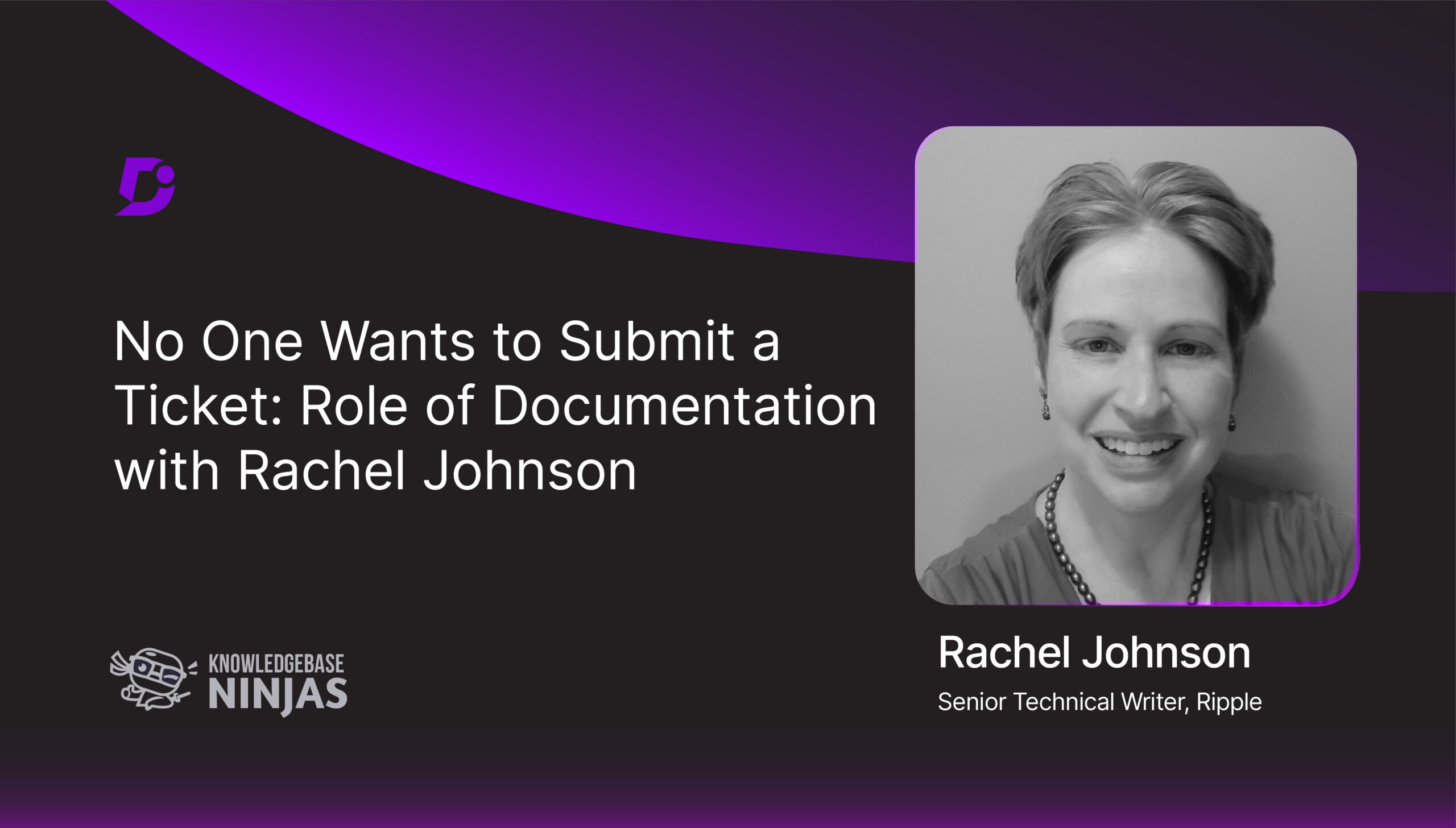
In this episode of the Knowledge Base Ninjas podcast, Rachel Johnson shares her journey into technical writing and how the role has evolved over the years.
The conversation explores why documentation is not just a support asset, but a core part of the product experience. Rachel talks about how it plays a role across the entire customer journey, from onboarding to long-time customers. She adds on why integrating documentation early in the product lifecycle makes a significant difference.
The episode also touches on the shift towards AI-powered documentation and how it is changing the way users find answers. She highlights both the opportunities and the challenges, including the importance of maintaining accuracy and trust. They also discuss how teams measure the effectiveness of documentation and what signals indicate documentation gaps.
Towards the end, Rachel shares her perspective on self-service documentation and why it benefits both businesses and customers when done right. She emphasizes the importance of how feedback helps in creating better content over time.
This episode offers a practical look at building documentation that is useful, accessible, and aligned with real user needs.
You can listen to the full episode on Apple, Spotify, and YouTube.
Watch the full podcast episode video here
Quick jumps to what’s covered
- 00:02 -The core question: cost-cutting vs customer support
- 06:40 – How AI documentation improves customer experience?
- 08:00 – Common gaps in documentation and their impacts
- 10:08 – Is self-service documentation about cost-cutting or providing 24/7 customer support?
- 11:02 – Customer feedback to improve documentation
About Rachel
- Rachel Johnson is a Senior Technical Writer with over 12 years of experience in customer-focused documentation and user assistance. She began her career in an unexpected way, transitioning from a background in Health Administration into technical writing through a copywriting role.
- What started as a temporary opportunity quickly turned into a long-term career path, leading her to grow into editorial and technical writing roles. Over the years, she has gained deep insights into how documentation shapes user experience and continues to be passionate about the evolving role of documentation in modern products.
Transcript
-
-
Rachel’s Journey into Technical Writing
Gowri Ramkumar: Good day, everyone. Welcome to the Knowledge Base Ninjas Podcast. With me today, I have Rachel Johnson, Senior Technical Writer at Ripple. Hi Rachel, how are you doing?
Rachel Johnson: Hi, Gowri. Doing well. How are you?
Gowri Ramkumar: I’m good, thank you so much for accepting to be a guest in this series. Very excited to hear about your story. Before we dive in, take us through your whole journey — where it started, who motivated you, and how you’re enjoying it so far.
Rachel Johnson: Like most people in technical writing, I didn’t start out planning to be a technical writer. I actually went to school for Health Administration. After I graduated, while I was looking for a job, I decided to get a supplemental part-time gig to help pay the bills. I ran into a posting for a contract position as a copywriter, and after I started, I quickly moved through the contract positions and became an editor. I decided this could be what I do for my career. I was with them for about a year and a half before I got my first full-time technical writer job, and I have never looked back. It’s been a great career for me.
Gowri Ramkumar: 13 years is not a joke. You must have seen a lot of changes in this field.
Rachel Johnson: Yes, I have, and I’ve learned a ton.
-
When Does Documentation Matter Most?
Gowri Ramkumar: At what point in the customer journey does documentation matter the most? Is it in the onboarding, the adoption, or is it for retention?
Rachel Johnson: Oh man, can I say all of them? We use documentation in every step of the way. I know some companies struggle to consider documentation — things go out, and documentation becomes an afterthought. I have worked for companies like that and pushed to get documentation more recognized. I’m lucky now that I work for a company that recognizes it as a vital part of our product.
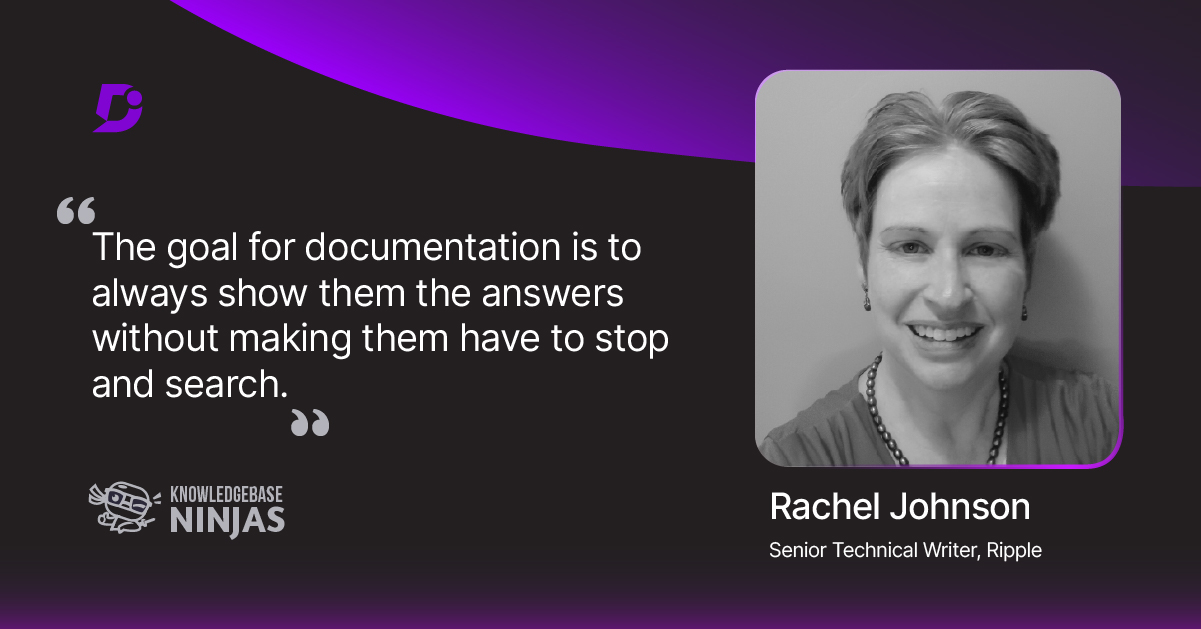
When we’re onboarding people, onboarding goes so much faster when you can walk them through everything they’re going to need to know using written documentation, videos, and training — giving them a path for their role using this product. We also use documentation to reach out to people who used to be strong users and are tapering off, to say, ‘What next task could we help you with in your role?’ And for retention, just making it really easy. The goal for documentation is to always show them the answers without making them have to stop and search. The best documentation is integrated with the product.
Gowri Ramkumar: Very true. We’ve also observed the documentation team getting involved not at the end of the feature release, but when the feature is being planned. Do you see that change in your organization as well?
Rachel Johnson: Absolutely. It’s night and day different. In my current organization, they keep us in the loop for planned product releases. We’re in on the ground level — helping design it, giving feedback, and documenting as the process rolls out. When it doesn’t happen that way, which I have experienced, it’s always a scramble on the back end trying to hurry and throw it together because the product has already been delivered to the client.
The quality of what they get is very different. Companies that have been able to see that documentation needs to be a part of the product get a much higher-quality, integrated experience.
-
How AI-Powered Documentation Improves Customer Experience
Gowri Ramkumar: At what point in the customer journey does documentation matter the most? Is it in the onboarding, the adoption, or is it for retention?
Rachel Johnson: Oh man, can I say all of them? We use documentation in every step of the way. I know some companies struggle to consider documentation — things go out, and documentation becomes an afterthought. I have worked for companies like that and pushed to get documentation more recognized. I’m lucky now that I work for a company that recognizes it as a vital part of our product.
When we’re onboarding people, onboarding goes so much faster when you can walk them through everything they’re going to need to know using written documentation, videos, and training — giving them a path for their role using this product. We also use documentation to reach out to people who used to be strong users and are tapering off, to say, ‘What next task could we help you with in your role?’ And for retention, just making it really easy. The goal for documentation is to always show them the answers without making them have to stop and search. The best documentation is integrated with the product.
Gowri Ramkumar: Very true. We’ve also observed the documentation team getting involved not at the end of the feature release, but when the feature is being planned. Do you see that change in your organization as well?
Rachel Johnson: Absolutely. It’s night and day different. In my current organization, they keep us in the loop for planned product releases. We’re in on the ground level — helping design it, giving feedback, and documenting as the process rolls out. When it doesn’t happen that way, which I have experienced, it’s always a scramble on the back end trying to hurry and throw it together because the product has already been delivered to the client.
The quality of what they get is very different. Companies that have been able to see that documentation needs to be a part of the product get a much higher-quality, integrated experience.
-
Common Gaps in Documentation
Gowri Ramkumar: We spoke about the benefits of AI-powered documentation. At the same time, what common gaps do you see in documentation that could negatively impact a customer becoming a successful customer?
Rachel Johnson: The biggest gap I see is the slow adoption of the latest tools. Every company is in a different spot with how much they embrace or are afraid of AI. If the AI experience is fully integrated and you don’t have to leave the product to ask questions and get help, I think we’re really closing those gaps. I’m sure in 50 years they’ll come up with something even better, but right now I think the biggest gap is for companies that are too afraid of AI and shy away from using it.
Gowri Ramkumar: Yeah, that’s true.
-
Measuring the Impact of Documentation on Customer Success
Gowri Ramkumar: We spoke about the benefits of AI-powered documentation. At the same time, what common gaps do you see in documentation that could negatively impact a customer becoming a successful customer?
Rachel Johnson: The biggest gap I see is slow adoption of the latest tools. Every company is in a different spot with how much they embrace or are afraid of AI. If the AI experience is fully integrated and you don’t have to leave the product to ask questions and get help, I think we’re really closing those gaps. I’m sure in 50 years they’ll come up with something even better, but right now I think the biggest gap is for companies that are too afraid of AI and shy away from using it.
Gowri Ramkumar: Yeah, that’s true.
-
Self-Service Documentation
Gowri Ramkumar: Do most companies see self-service documentation as a cost-cutting move, or as a way to genuinely support customers 24/7?
Rachel Johnson: My current company really focuses on giving customers the support they need, so I think the most emphasis is there. But at the same time, it is fully recognized as a cost-saving thing. Every time somebody can help themselves, they don’t have to submit a ticket, which is better for everybody. It saves us money, and it saves them time and frustration. As a customer, nobody wants to get stuck and have to submit a ticket. They would rather solve it themselves. So it’s a combination of both.
Gowri Ramkumar: Yes, great.
-
Using Customer Feedback to Shape Documentation
Gowri Ramkumar: Are there any particular kinds of feedback you look out for from customers in order to shape your documentation?
Rachel Johnson: Most of the feedback we get is the little thumbs up, thumbs down icon, which really doesn’t tell you much when you get a thumbs down. We review it to see if we can find a place to improve, but it doesn’t give us much detail.
When somebody actually submits a ticket, and the customer success person helping them sends the documentation — if the customer still has remaining questions — those are gold feedback moments. We can say, ‘Obviously, this didn’t fully answer their question. How can we improve it?’ That’s where we get a lot of our feedback.
We also get customers who reach out or fill in comments. Everybody has the option to leave comments, though they rarely do. When they do, it can be anything from ‘we found a typo’ to ‘this additional question wasn’t answered for us.’ We take any of that feedback as gold and try to fix it immediately. We figure if one customer says it, 20 others are thinking it.
Gowri Ramkumar: Absolutely. We experience the same — though many customers don’t bother to give feedback, we treat one piece of feedback as the voice of a thousand customers.
Rachel Johnson: Yeah, exactly.
-
⚡ Rapid Fire
Gowri Ramkumar: What valuable resources would you recommend, anything in particular for documentation?
Rachel Johnson: For conferences, I’ve enjoyed Write the Docs and LavaCon. For blogs, I follow Tom Johnson’s ‘I’d Rather Be Writing‘ — it’s a very valuable blog with a lot of resources and ideas. For podcasts, I follow yours of course, and also Grammar Girl. Grammar Girl is less about writing craft and more about the history of words and interesting things I find fascinating.
Gowri Ramkumar: Tom Johnson’s name keeps coming up in most of my episodes. Nice to know you follow him for documentation resources.
One word that comes to mind when you hear ‘documentation’?
Rachel Johnson: Enablement.
Gowri Ramkumar: I’m not going to ask for anything more.
A piece of advice you would give to your 20-year-old self?
Rachel Johnson: My 20-year-old self wasn’t in documentation yet, but I would say to anyone starting their technical writing journey — every year, learn at least one new tool or process. Never get stagnant. Keep learning.
-
Closing Thoughts
Gowri Ramkumar: Rachel, it’s very hard to condense 13 years of experience into 20 or 30 minutes. I hope I’ve done justice to your experience. Anything else you’d like to add to the audience today?
Rachel Johnson: Just one last thought on AI. The need for documentation is never going to go away. The way people consume it changes, but it’s always going to be important. The writers who embrace AI as a tool that helps them deliver more and higher-quality work are going to be the ones sticking around. It’s the writers who are afraid of it — who try to push AI out of the picture, saying ‘I’m still important, don’t steal my job’ — those are the ones who will find it becomes a self-fulfilling prophecy. When you won’t work with a new tool, you make yourself less relevant.
Gowri Ramkumar: True. Very true. Embrace the change. Thank you so much, Rachel. I wish you all the very best in the upcoming projects and many more to come. Let’s stay in touch — take care, and thank you very much for being a part of this journey.
Rachel Johnson: Thank you.
-
Disclaimer: This transcript was generated using AI. While we aim for high accuracy, there may be minor errors.
Enjoyed this conversation?
Don’t miss listening to other episodes of our Knowledgebase Ninjas Podcast.
Read Our eBook
The Future of Technical Writing – AI’s Impact on Knowledge Management
Watch Webinars
Webinar Library
Explore Case Studies
Customer Success Stories
Browse Resources
Resource Library
Try Document360 for Free
Book a demo