 EN
EN 

AI Summary
- Knowledge Base Ninjas features Gowri Ramkumar and Steev Kundukulangara, Senior Technical Content Strategist at Teradata, discussing AI’s impact on technical writing.
- AI has increased technical writers’ productivity, but technical expertise, audience awareness, accurate input, and human-in-the-loop review remain essential. Organizations reducing writing teams may see long-term effects.
- Documentation is moving beyond static, long pages toward shorter, clearer, contextual help and in-product guidance suited to shorter attention spans.
- AI-ready documentation requires clear headings, defined audiences, organized relationships, and chunked sections for systems to consume effectively. Steev found that five or six accurate, clear lines outperformed an entire style guide.
- Steev’s career progressed from technical support and system analysis to technical writing; he recommends exploring AI tools, sharing work publicly, and continuing to learn.
AI-generated content. It may contain errors.
See Document360 in action
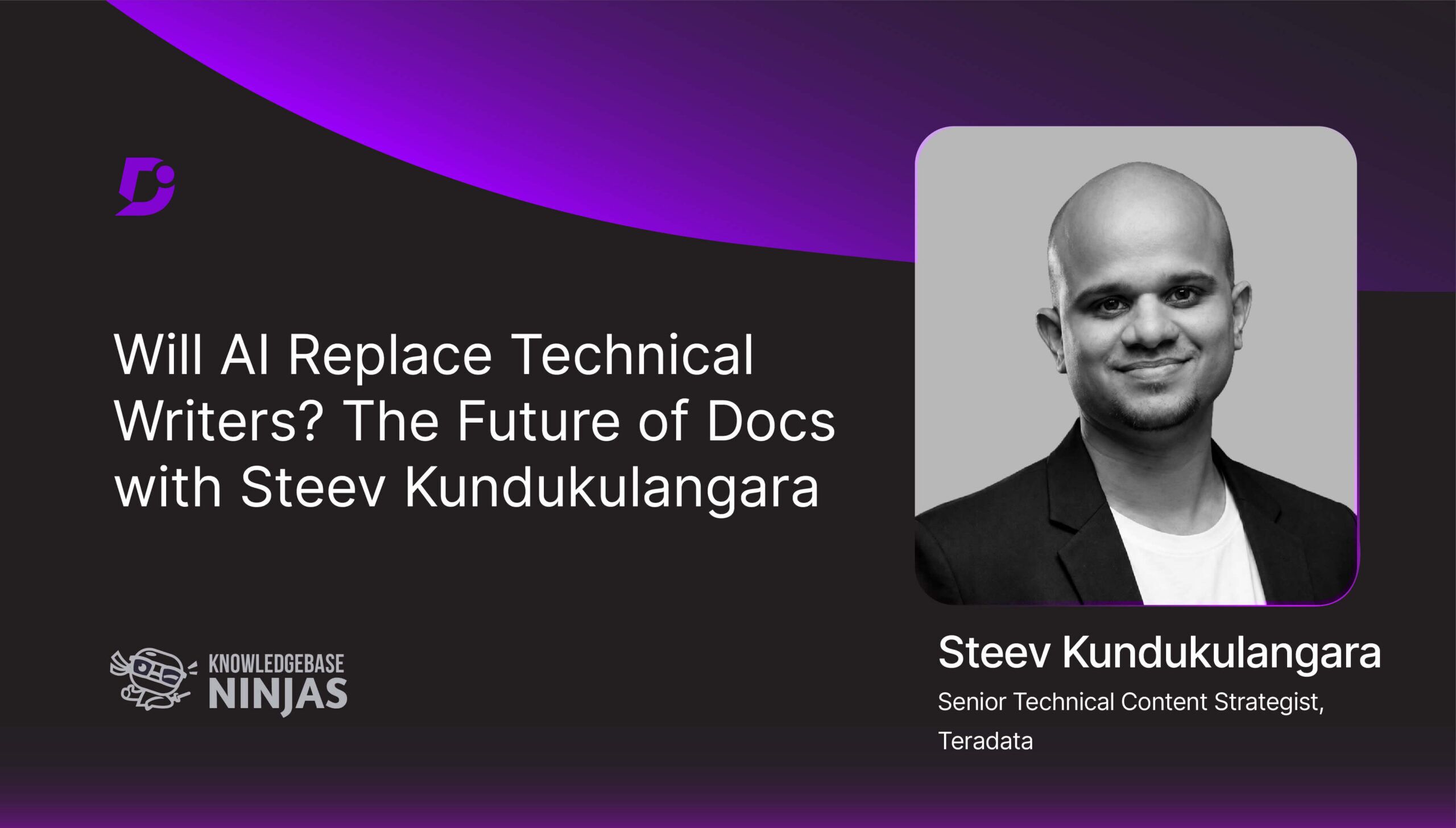
In this episode of Knowledge Base Ninjas, Gowri Ramkumar sits down with Steev Kundukulangara from Teradata to talk about how AI is reshaping the world of technical writing. The conversation explores whether AI will replace technical writers, why accuracy still depends on human expertise, and how shrinking attention spans are pushing documentation to become shorter and more contextual.
Steev shares his honest take on the changing role of technical writers in an AI-driven world, why human-in-the-loop review remains essential, and how organizations that cut writing teams too early may feel the impact only in the long run.
The episode dives into what AI-ready documentation actually looks like, why structured and chunked content matters more than volume, and Steev’s own experience experimenting with AI tools for documentation — including a surprising lesson about why less information, not more, produced better results.
You can listen to the full episode on Apple, Spotify, and YouTube.
Watch the full podcast episode video here
Quick Insights
- 01:48 – Steve’s journey from technical support to technical writing
- 05:07 – Will AI replace technical writers?
- 07:25 – What is the hardest part of documentation?
- 08:50 – The future of documentation: contextual, concise, and in-product help
- 10:30 – Building AI-ready documentation with structured content
About Steev Kundukulangara
- Steev is a Senior Technical Content Strategist at Teradata, with a career that began in technical support and system analysis before moving into technical writing.
- That early experience gave him a strong technical foundation — one that continues to shape how he approaches documentation today.
- His work focuses on building structured, AI-ready content systems that support product adoption, developer enablement, and customer success.
- Steev is recognized among the Top 50 Influential Technical Writers globally by Document360. Also, he is a regular speaker at industry conferences, covering topics such as API documentation, Docs-as-Code, and AI-assisted documentation workflows.
- He is an active contributor to the technical writing community, sharing insights and frameworks that help teams build documentation that scales with their products.

Transcript
-
-
Introduction
Gowri Ramkumar: Welcome, everyone, to the Knowledge Base Ninjas podcast. Today, we have Steev Kundukulangara, Senior Technical Content Strategist at Teradata. Hi, Steev. How are you doing today?
Steev Kundukulangara: Hi, Gowri. Good evening. I’m doing great. I’m excited to be on the podcast. This is my first podcast, so I’m looking forward to seeing how this interaction goes.
Gowri Ramkumar: Fantastic. Thank you so much for taking the time. We are excited to hear about your experience in this space.
-
Career Journey: From Technical Support to Technical Writing
Gowri Ramkumar: Before we start talking about the current topics, I’d like to understand how it all began. Can you share a little background about yourself and what inspired you to move into technical writing?
Steev Kundukulangara: When I started my career, I was in the technical support domain. Later, I moved into a system analyst role.
During my time in technical support and system analysis, I was already creating documentation for the companies I worked with. However, it was not officially categorized as technical writing. It was one of the many responsibilities I handled.
Over time, I realized that technical writing was something where I could contribute more and become a better writer. The reason was the technical knowledge I had gained through my system analysis and technical support experience.
I already had the technical know-how, so my focus was to improve my writing skills. That is how I decided to transition into technical writing.
There is a reason why there is the word “technical” in technical writing. It is not the same as general content writing. Technical writing requires a combination of technical understanding and communication skills.
With the experience and knowledge I gained through my previous roles, I wanted to put that into practice. That is how I transitioned my role into technical writing.
Gowri Ramkumar: That’s great to know. It is quite different from what I usually hear from other guests. How are you enjoying the journey so far?
Steev Kundukulangara: Initially, there were a lot of challenges because I was transitioning from a technical role into a writing space.
There were also feedback and concerns from colleagues that this was a role where people might not get enough recognition within the organization or have less visibility in the industry.
However, I did not focus much on the negativity. I focused more on whether the role would be useful for me and whether I would enjoy the work.
After transitioning into this role, my visibility has increased. When I attend technical writing conferences, people recognize me and connect with my work.
People also look forward to my LinkedIn posts. I have been a little inactive recently because of work commitments, but whenever I share something, people engage with it.
That motivates me to continue sharing knowledge, contributing, and participating in the community. That is what I genuinely enjoy.
-
AI and the Future of Documentation
Gowri Ramkumar: Now, I want to start with AI as your first topic because you actively participate in social media and conferences.
Do you think AI will reduce the need for documentation, or will it increase the need for better-structured documentation?
Steev Kundukulangara: There are two aspects to this. One is whether AI will replace technical writers, which is something everyone talks about.
From what I have seen, I am not in a position to say whether technical writing is going away or not.
However, the number of technical writers required to work on a particular product has reduced significantly. With AI, the amount of work a technical writer can complete has increased because many tools are already available.
The important thing is having the technical expertise to make the best use of these tools.
If you look at current LLM models like ChatGPT, Claude, and Gemini, the data used to train these systems comes from information created by people with strong language and communication skills.
The reason this information is valuable is because the quality of input matters. If you put poor information into an AI system, the output will also be poor.
Similarly, if an organization wants to integrate a chatbot, technical writers are in a strong position to create that knowledge because of the expertise they have built over the years.
Technical writers understand how to write for the right audience. They understand whether information will be useful for end users and how information should be structured and chunked.
There is much more involved than just writing content.
Organizations should continue investing in technical writers so they can expand their skills and contribute more value through AI-driven systems.
-
Human Expertise in the AI Era: Why Technical Writers Still Matter
Gowri Ramkumar: With AI, everyone can produce content much more easily now. Creating content is not as difficult as before.
So, what becomes the hardest part of documentation when everyone is relying on AI for writing?
Steev Kundukulangara: Everyone should understand by now that whatever you create with the help of AI is not 100% accurate.
There is always a human-in-the-loop aspect that we need to consider. When AI generates an output, how do you know whether the information it provides is accurate or not? For that, you need strong domain knowledge. You need to be well-versed with the product you are working on. Those are areas where AI cannot work independently. That is where the human aspect becomes important. Human-in-the-loop is something we need to consider, not only as technical writers but also as organizations.
I have seen organizations completely reduce their technical writing teams because they believe AI can handle the work. They may not see the impact immediately, but in the long run, they will understand what kind of decision it was.
-
The Future of Documentation: Moving Beyond Traditional Content
Gowri Ramkumar: Do you think today’s documentation will survive the next three to five years?
What needs to change to make documentation continue creating value in the future?
Steev Kundukulangara: From my understanding and what I have seen in the industry, we have moved beyond the stage where we only create static documents and long pages for customers.
If you look at the current generation, people have a shorter attention span because of social media and the way we consume information today. Even I am affected by that because I cannot focus on something for a very long time.
In the future, people may have even shorter attention spans. So when creating documentation, the focus should be on compressing a lot of information into shorter and clearer formats.
For example, if I am using a product and I face an error, there should be contextual help available inside the product. There should be a message that explains why the issue happened and helps the user understand what they need to do next.
This is more like contextual help and in-product guidance. Instead of asking users to read long documents, documentation should live inside the product itself.
-
Building AI-Ready Documentation
Gowri Ramkumar: The next question connects to what we discussed earlier.
How do you think AI-ready documentation is structurally different from regular documentation?
Steev Kundukulangara: In AI-ready documentation, technical writers are writing not only for users but also for systems.
Systems require clear structures, clear headings, and a defined audience. Information needs to be properly organized, and there should be relationships between different sections of the documentation. The content should also be chunked and divided into smaller sections. This helps AI systems consume the documentation effectively and make better use of the information.
Recently, I have been working on implementing AI agents for writing and reviewing documentation. Initially, I uploaded my entire style guide into AI, but the output was not useful. It was hallucinating and providing incorrect answers. Later, I compressed the entire style guide information into five or six clear lines.
When I checked the output, I was surprised because I realized that adding more information does not always improve AI performance. It is not about dumping information. It is about providing limited information that is accurate and clear.
Gowri Ramkumar: I think everyone has a long way to go in this space.
-
⚡ Rapid Fire
Gowri Ramkumar: Let’s move on to the rapid-fire round.
I’m sure you read and explore a lot of resources. What would you recommend to our audience, especially in the documentation space?
Steev Kundukulangara: For me, I mainly rely on AI tools. I use Gemini, DeepSeek, Claude, and ChatGPT. These are my go-to resources.
As I mentioned, I have a short attention span, so I prefer getting information quickly. AI tools help me find information faster. I can ask questions, explore ideas, and learn without hesitation.
My suggestion is to keep exploring AI tools and find the best ways to use them. That is how you can improve your productivity.
Gowri Ramkumar: One word that comes to your mind when you hear documentation?
Steev Kundukulangara: Clarity.
Gowri Ramkumar: My last question — what is one piece of advice you would give to your 20-year-old self?
Steev Kundukulangara: If I were 20 years old, I would say: keep exploring. Be present, but also look toward the future.
Always understand where your domain or your work is heading because that is how you create opportunities and build your value in the industry.
-
Closing Thoughts
Gowri Ramkumar: Before we close, is there anything else you would like to share with our audience?
Steev Kundukulangara: The same advice applies to all technical writers around the world. Keep exploring. Keep trying new things. Keep looking for new inventions and discoveries.
Also, share your work publicly. Do not keep everything to yourself. You never know how useful or valuable your contributions can be until you share them with others. I experienced this in my previous organization as well. I was working in the fintech domain, and most of my contributions were only known internally.
When I started sharing my work publicly, people started recognizing the kind of work I was doing. So, do not keep everything to yourself. Keep exploring, keep learning, and let people know the value technical writers bring.
Gowri Ramkumar: Fantastic. Please continue the wonderful contributions you are making to the community. I wish you all the very best for your future projects.
Steev Kundukulangara: Thank you, Gowri. See you all again.
Gowri Ramkumar: Thank you. It was a pleasure having you.
-
Disclaimer: This transcript was generated using AI. While we aim for high accuracy, there may be minor errors.
Enjoyed this conversation?
Don’t miss listening to other episodes of our Knowledgebase Ninjas Podcast.
Read Our eBook
The Future of Technical Writing – AI’s Impact on Knowledge Management
Watch Webinars
Webinar Library
Explore Case Studies
Customer Success Stories
Browse Resources
Resource Library
Try Document360 for Free
Book a demo


