EN
EN  DE
DE ES
ES FR
FR PT-BR
PT-BR

AI Summary
- Knowledge Base Ninjas features Gowri Ramkumar and Ramesh Aiyyangar discussing technical communication’s evolution, AI, content strategy, information architecture, structured authoring, and customer-centric thinking.
- Ramesh says technical writers need knowledge of APIs, endpoints, developer documentation, Docs-as-Code, GitHub, open-source workflows, AI tools, leadership, project management, and cross-functional collaboration.
- Structured content, XML, DITA, information architecture, content audits, and unified content strategies are essential because weak or unstructured content limits AI output and can contribute to hallucinations.
- Technical communicators increasingly serve as the reliability layer, reviewing AI-generated content while maintaining writing, editing, structure, audience understanding, accuracy, trust, and usability.
- Ramesh founded TechWritePro and the Institute for Technical Communicators of India and advocates continuous learning, mentorship, community participation, empathy, and leadership beyond titles.
AI-generated content. It may contain errors.
See Document360 in action
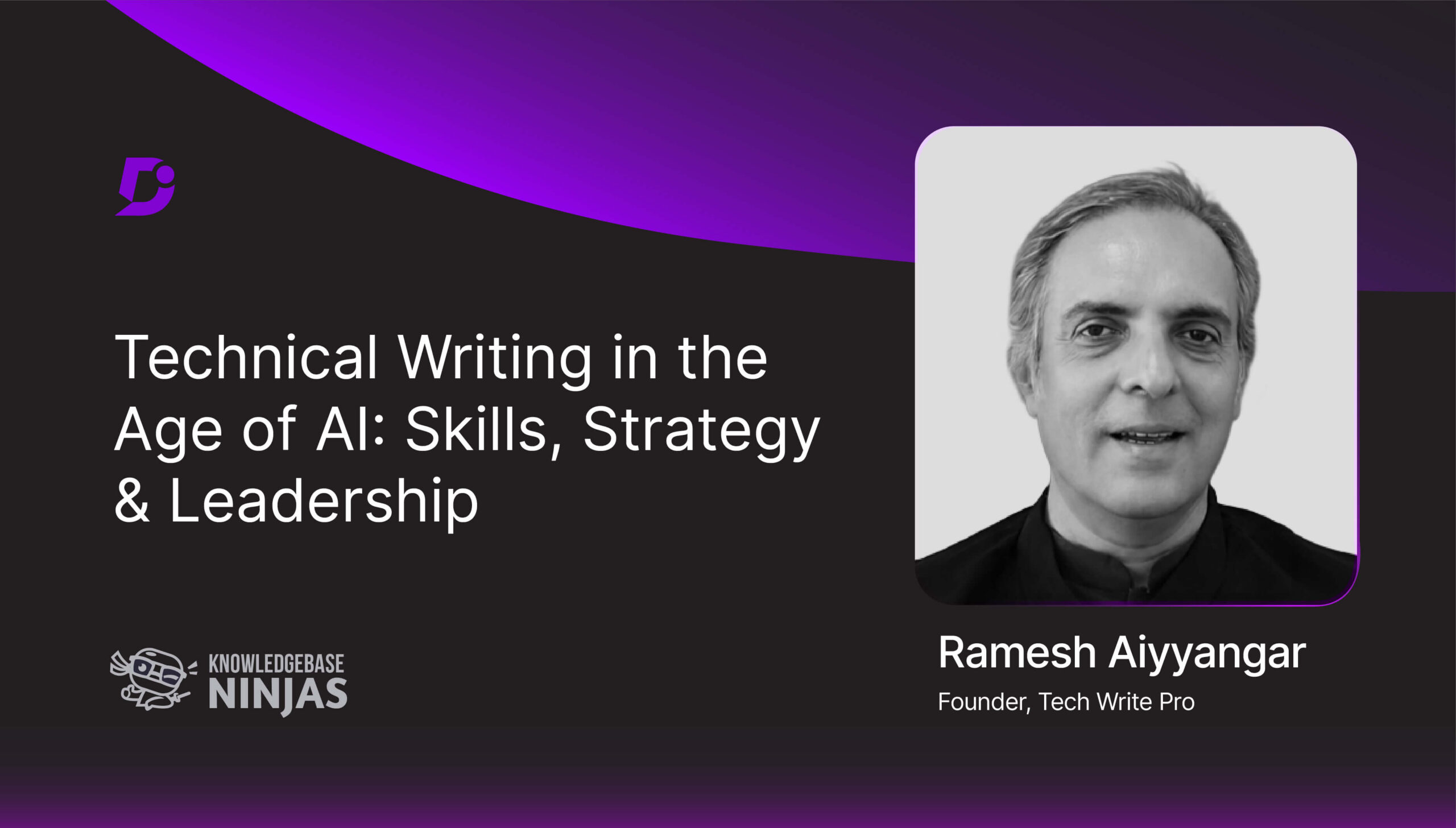
In this episode of Knowledge Base Ninjas, Gowri speaks with Ramesh Aiyyangar about the evolution of technical communication, the growing influence of AI, and why technical writers must move beyond traditional documentation roles. The conversation explores how content strategy, information architecture, structured authoring, and customer-centric thinking are becoming essential skills for modern technical communicators.
Ramesh shares why technical writers today need to understand APIs, Docs-as-Code, AI workflows, and cross-functional collaboration to remain relevant in rapidly evolving organizations. He also discusses the importance of leadership, empathy, mentorship, and building influence across teams.
The episode dives into how AI is changing documentation workflows, why structured content matters more than ever, and how technical communicators are becoming the “reliability layer” responsible for ensuring accuracy, trust, and usability in AI-generated content. It’s an insightful discussion on the future of technical writing and the skills needed to thrive in the industry.
You can listen to the full episode on Apple, Spotify, and YouTube.
Watch the full podcast episode video here
Quick Insights
- 05:47 – Leadership beyond titles and influencing through value
- 13:45 – Earning trust and gaining a strategic seat at the table
- 15:30 – Why content strategy matters more than ever
- 23:42 – Information architecture and structured authoring in the age of AI
- 24:17 – How AI is reshaping technical writing roles and responsibilities
- 27:40 – Skills technical writers need to stay future-ready
About Ramesh Aiyyangar
- Ramesh Aiyyangar is the Founder of TechWritePro, a technical writing company and training provider focused on advancing technical communication excellence in India.
- Founder of the Institute for Technical Communicators of India (ITCI), a community initiative dedicated to mentoring, enabling, and supporting technical writers across the country.
- Has nearly four decades of experience in technical communication, leadership, mentoring, content strategy, and technical documentation across product and services organizations.
- Actively mentors technical writers through customized mentoring programs focused on career growth, problem-solving, leadership, and industry readiness.
- Passionate about helping technical communicators adapt to emerging trends in AI, structured authoring, content strategy, and modern documentation practices.
Transcript
-
-
Introduction
Gowri Ramkumar: Good day, everyone. Welcome to the Knowledge Base Ninjas podcast. Today with us, we have Ramesh Aiyyangar, founder of Tech Write Pro, one of the leading technical writing providers and trainers in India. Ramesh, welcome to the podcast. I would also like to thank you for being one of the esteemed judges of the Global Tech Writer Awards recently organized by Document360.
We truly appreciate all your support in this space.
Ramesh Aiyyangar: Thank you so much, Gowri. First of all, I would like to thank you for giving me this opportunity to appear on the podcast. It’s a great pleasure to be here again. I do recall that I was here on the podcast earlier, and that was a wonderful experience.
Through the years, it’s been a great opportunity to collaborate with you and your team, including the recent Global Tech Writer Awards where I was a judge. It was an extremely satisfying experience as a technical communicator to really look at the amazing work of writers across the globe.
So thank you once again, and I’m really looking forward to an interesting discussion today on this podcast.
-
From Journalism to Technical Communication: Ramesh’s Journey
Gowri Ramkumar: Ramesh, having been in technical communication for decades and having seen the industry evolve closely, could you now take us back through your journey into technical writing and some of the key experiences that shaped your perspective on the profession as it stands today?
Ramesh Aiyyangar: Absolutely, Gowri. To begin with, as I reflect on my journey, I must tell you it has been an enriching and rewarding experience for me. It has been a sense of accomplishment and fulfillment because it’s nearly four decades that I’ve been in this profession, and I’ve loved each and every moment of it, and I still do.
I think I’ll be doing only technical writing, nothing apart from that, because my heart is in it and I love every moment of it.
To briefly tell you about my journey, I would rather say it’s in two parts — one before technical writing and one after technical writing. The single thread throughout has been communication.
The moment I completed my graduation in journalism and communication, I started working as a reporter and editor. I also worked as a copywriter, in corporate communications, public relations, and so on.
During the early nineties, computers started becoming common, along with computer training, and that’s how I acquired my computer skills and software knowledge.
The second phase began when I started my first stint as a technical writer with very little clue about what technical writing actually was.
My first role was with a software company called Ascendant Consultancy, where my first assignment was related to ISO documentation. During those days, services companies were competing heavily through ISO certification.
Technical writing was a completely different domain from journalism and copywriting, and I had to learn a lot right from day one. Even today, I believe learning continues because the technology and IT world keeps evolving continuously.
Professionally speaking, over three to four decades, I’ve worked with nearly 12 to 15 companies.
Gowri Ramkumar: Wow.
Ramesh Aiyyangar: I’ve worked with product companies and services companies. For the last two decades, I’ve mostly been in leadership positions.
But every minute has been a learning experience. As a technical writer, the art of simplification and enriching customer lives has given me immense satisfaction.
Over the last two decades, I’ve also been actively involved with STC. I received the Fellow Award in 2019. I’ve also been mentoring technical writers for more than two decades.
During the pandemic, many writers felt uncertain about the future. That’s when I started the Technical Communicators Mentoring Program.
It became a very unique, customized mentoring initiative focused on understanding individual writers, their aspirations, strengths, and challenges.
Later, I realized there were many writers in India who genuinely needed support. That inspired me to formally launch TechWritePro.
Earlier, the community existed as a social media initiative called the Institute for Technical Communicators of India (ITCI). But TechWritePro was officially incorporated in June 2023.
It gives me immense pride — not just personally, but on behalf of the entire technical communication community.
-
What Leadership in Technical Writing Really Means
Gowri Ramkumar: When you talk about leadership in technical writing, what does that actually mean to you beyond having a managerial title?
Ramesh Aiyyangar: Leadership for me was never about the title. It’s more about servant leadership — influencing your profession, your community, and your area of work.
Leadership is about long-term vision. Leaders influence people, innovate processes, and make things happen.
Managers often focus on operations and short-term goals, whereas leaders think strategically and futuristically.
Empathy is one of the most important qualities today because unless you genuinely connect, engage, and listen, you cannot influence people.
Leaders create roadmaps for the future. They are willing to take risks, learn from failures, and inspire teams to work toward broader organizational and customer goals.
Technical writers sometimes work in isolation. They stay within traditional processes and fail to see the bigger picture or collaborate effectively with cross-functional teams.
As communicators, we need to engage with stakeholders across teams, customers, and users to communicate our value clearly.
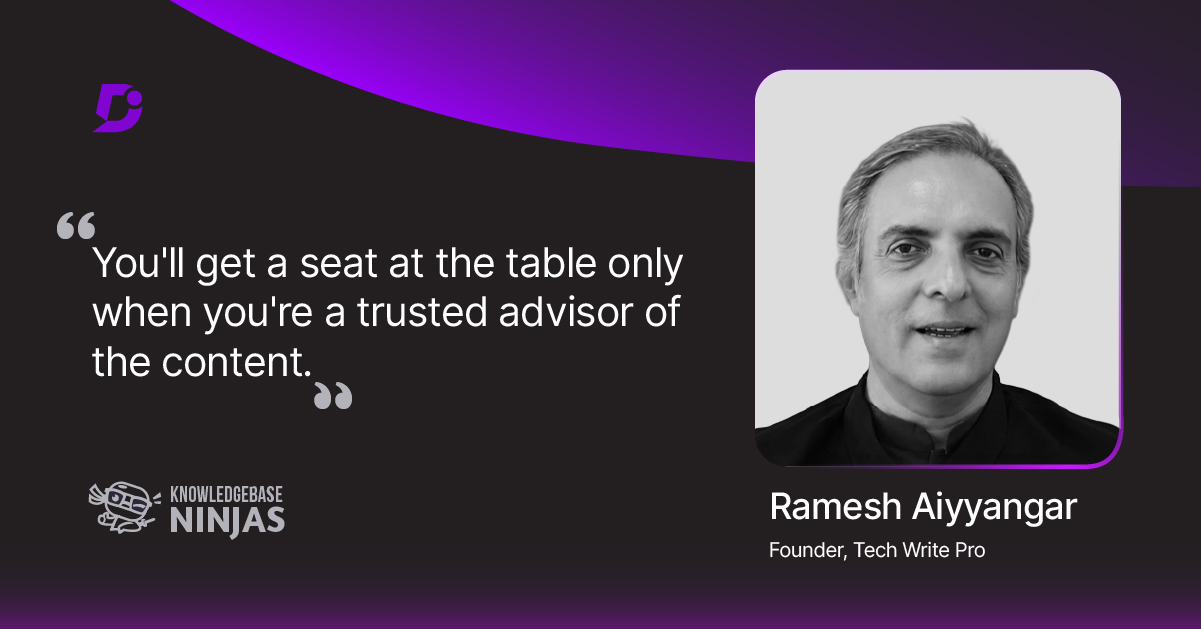
Technical communicators add tremendous value, but often fail to articulate it. We always talk about getting a “seat at the table.” That only happens when you become a trusted advisor for content.
-
From Documentation to Strategic Influence
Gowri Ramkumar: In your view, what separates a good technical writer from someone who can truly influence teams, products, and business decisions?
Ramesh Aiyyangar: A good technical writer is known for the value they add.
The first and most important thing is customer-centric documentation. Technology and customer expectations have evolved drastically over the years.
Technical writers cannot simply create documentation anymore. They need to understand content management and content strategy.
Strategy is only possible when you deeply understand customers, users, and business needs.
With AI entering the picture, this becomes even more critical.
Many organizations still don’t know what content they have. Content audits are often ignored, and customers end up consuming outdated information.
Even AI cannot produce quality output if the underlying content is weak or unstructured.
Gowri Ramkumar: Exactly. Tools can’t magically improve poor content.
Ramesh Aiyyangar: Absolutely. That’s where hallucinations happen.
One of the most ignored areas has been information architecture and structured authoring.
Going forward, every technical writer needs to understand structured authoring, XML, DITA, and information architecture.
Unless your content is properly structured, even advanced AI tools cannot deliver meaningful results.
Technical communicators also need leadership skills — building consensus, mentoring teams, and influencing cross-functional stakeholders.
Organizations need unified content strategies where all stakeholders understand what content exists, what is valuable, and what should be delivered.
Writers must also understand how to leverage AI tools effectively. AI is not about replacing writers — it’s about taking them upstream.
Writers today must understand APIs, endpoints, developer documentation, Docs-as-Code, GitHub, and open-source workflows.
At leadership levels, project management, scheduling, planning, and resource management also become important.
Broadly speaking, strategic leadership, technical skills, project management, and content strategy are the four major pillars writers need to master.
-
Why Technical Writers Must Think Beyond Deliverables
Gowri Ramkumar: Many technical writers focus primarily on documentation deliverables. How can writers start thinking more strategically and position themselves as valuable contributors within organizations?
Ramesh Aiyyangar: It’s no longer just about creating documentation — it’s about managing content.
Writers need to expand their horizons beyond tools and traditional workflows.
Today’s users consume information differently. They expect mobile-first experiences, interactive help, bots, in-app guidance, and dynamic FAQs.
Technical writers cannot simply depend on SMEs and deliver secondhand information.
They need stronger technical skills, deeper domain expertise, and a strong understanding of terminology and systems.
Information architecture is now critical because we are no longer writing only for humans — we are writing for machines, bots, and agents too.
We need to understand how machines interpret and retrieve information.
AI tools can improve productivity, but the fundamentals remain unchanged.
Core skills like writing, editing, reviewing, structure, audience understanding, and quality remain essential.
Today, writers spend more time reviewing AI-generated content than creating first drafts.
Earlier, organizations had dedicated substantive editors. Now writers themselves must take on that responsibility.
That’s why technical communication increasingly becomes the reliability layer.
-
⚡ Rapid Fire
Gowri Ramkumar: One word that comes to your mind when you hear “documentation.”
Ramesh Aiyyangar: Love. I love documentation.
Gowri Ramkumar: A couple of valuable resources you would recommend in the documentation space?
Ramesh Aiyyangar: Earlier, I used to follow authors like JoAnn Hackos, Ann Rockley, and Tom Johnson, who has written extensively on API documentation.
Ann Rockley has written a lot about content management and unified content strategy. JoAnn Hackos also talks extensively about content strategy, structured authoring, and information development.
I’ve also interacted with Don Day, who is associated with the OASIS DITA initiative and structured authoring standards.
Earlier, we also had mailing lists. One of the most popular was TECHWR-L — T-E-C-H-W-R-L — a very active technical communication mailing list where many writers learned from one another.
Nowadays, of course, there are plenty of online resources. But I still believe the best learning comes from interacting with fellow writers and participating in webinars, conferences, and community events.
Many writers work in isolation. To truly grow, you need to engage with the community and continuously upskill.
Gowri Ramkumar: What advice would you give your 20-year-old self?
Ramesh Aiyyangar: Keep exploring and keep learning.
Learning is ongoing and continuous. That’s what I did decades ago, and that’s what I continue to do today.
We work in the knowledge sector, and the only way to grow is to explore, research, and learn continuously.
-
Closing Thoughts
Gowri Ramkumar: Amazing, Ramesh. Your contribution to this field is truly commendable. I honestly don’t know how the time flew by.
I’m sure you’re producing great technical writers through your institution. Thank you for all the support you’ve given this community, and we hope to continue hearing more from you.
Ramesh Aiyyangar: Thank you so much, Gowri. Thank you once again for giving me this wonderful opportunity to share my thoughts and experiences.
I would also like to thank Document360 and Knowledge Base Ninjas for this podcast and wish you all the very best for your future endeavors.
You’re doing a wonderful job interviewing technical communicators across the globe and bringing that knowledge to the community. It’s an extremely valuable resource.
So thank you for doing that.
Gowri Ramkumar: All the credit goes to guests like you who make every episode interesting. I keep hearing from people at conferences who regularly listen to these podcasts.
Thank you once again, Ramesh.
Ramesh Aiyyangar: Thank you, and have a great day and a great week as well.
Gowri Ramkumar: Thank you. Take care. Bye-bye.
-
Disclaimer: This transcript was generated using AI. While we aim for high accuracy, there may be minor errors.
Enjoyed this conversation?
Don’t miss listening to other episodes of our Knowledgebase Ninjas Podcast.
Read Our eBook
The Future of Technical Writing – AI’s Impact on Knowledge Management
Watch Webinars
Webinar Library
Explore Case Studies
Customer Success Stories
Browse Resources
Resource Library
Try Document360 for Free
Book a demo