EN
EN  PT-BR
PT-BR FR
FR ES
ES DE
DE

AI Summary
- Cody Deitz, Senior Technical Writer and Proposal Specialist at Tonkean, discusses his transition from academia into technical writing and his current role as Tonkean’s sole technical writer.
- He defines “down-to-earth” documentation as human, approachable, readable, and audience-aware, avoiding unnecessary formality or assumptions while using expert terminology when required.
- Technical writers commonly share a passion for clarity, continuous learning, simplifying complex information, and creating useful content. Their collaborative role enables communication across teams.
- AI tools reduce manual work such as parsing specifications and notes, but foundational questions about audience, needs, and explanation remain essential. Cody recommends initially learning by starting from scratch, then embracing AI effectively.
- Cody recommends I'd Rather Be Writing by Tom Johnson and Passo Uno by Fabrizio Ferri Benedetti. His advice is: “Trust the process and stay the course.”
AI-generated content. It may contain errors.
See Document360 in action
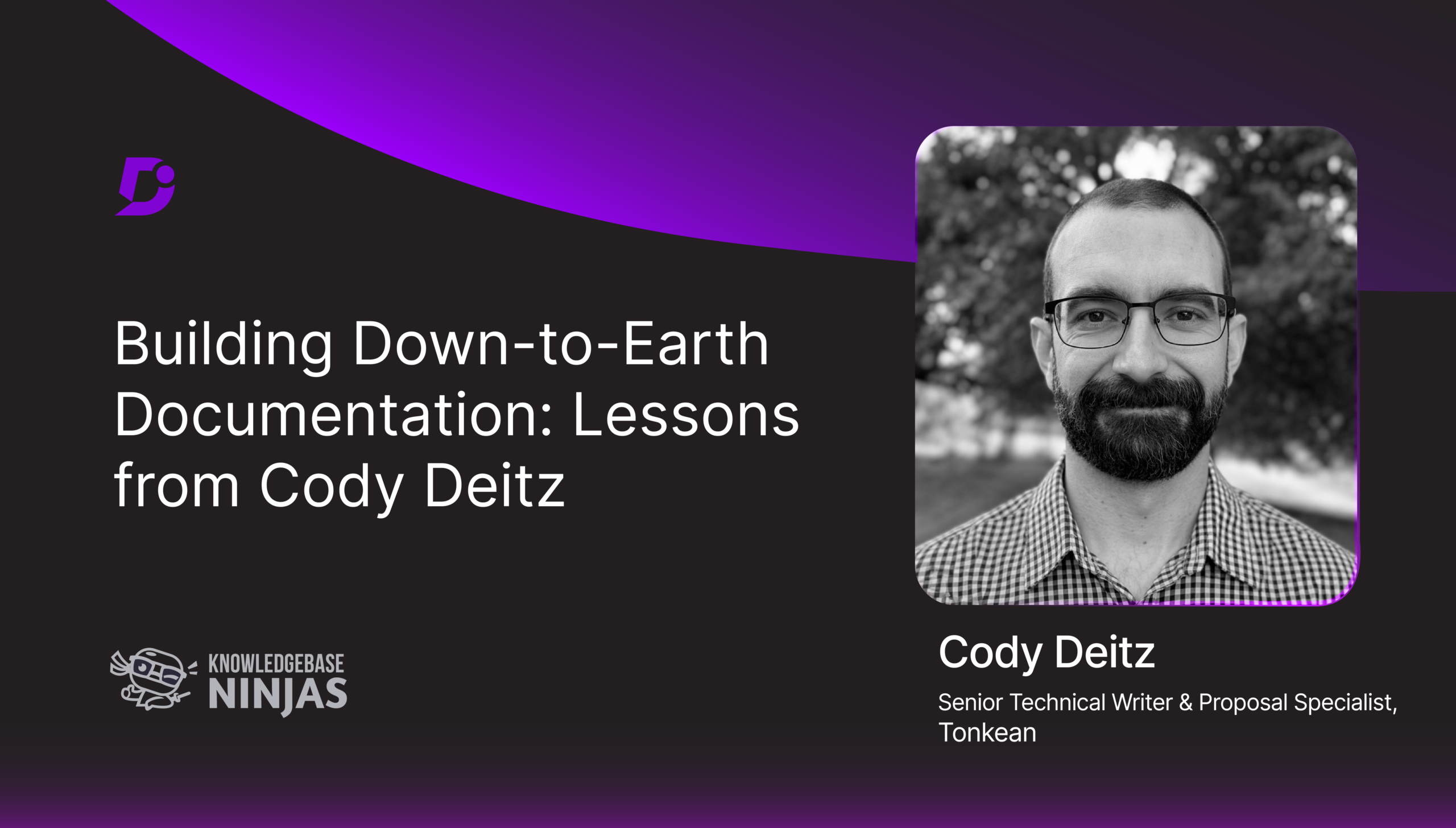
In this episode of Knowledge Base Ninjas, Gowri Ramkumar speaks with Cody Deitz about his unconventional journey into technical writing and how the field is evolving in the age of AI.
Cody shares how he transitioned from academia into technical writing, discovering along the way that his passion for language and technology could come together in meaningful ways. He emphasizes the importance of creating “down-to-earth” documentation—content that meets users where they are, rather than overwhelming them with unnecessary complexity or rigid formality.
The conversation dives into what draws people to technical writing, highlighting a shared passion for clarity, continuous learning, and simplifying complex ideas. Cody also reflects on the collaborative nature of the role, describing technical writers as key enablers of cross-team communication.
A key focus of the episode is the impact of AI on documentation. While AI tools are improving efficiency and reducing manual effort, Cody points out that foundational skills—like understanding the audience and structuring information—remain essential. He encourages writers to embrace AI while still valuing the learning that comes from starting from scratch.
The episode concludes with practical insights, resources, and advice for aspiring technical writers navigating a rapidly changing landscape.
You can listen to the full episode on Apple, Spotify, and YouTube.
Watch the full podcast episode video here
Quick jumps to what’s covered
- 2:40 – Cody’s journey into technical writing
- 4:52 – Understanding “down-to-earth” documentation
- 6:28 – Traits of effective technical writers
- 7:42 – Why people choose technical writing
- 9:07 – AI’s impact on documentation
- 10:33 – Learning fundamentals vs AI reliance
About Cody Deitz
- Cody Deitz is a Senior Technical Writer and Proposal Specialist at Tonkean, where he leads documentation strategy and enables users to build powerful workflows without code. With a background in academia and a passion for language, he brings a unique blend of clarity, creativity, and technical depth to modern documentation.
- Leads end-to-end documentation and proposal strategy, empowering users to automate complex workflows.
- Specializes in developer documentation, APIs, and no-code/low-code platforms.
- Combines academic writing, creative expression, and technical expertise to make complex concepts accessible.
Transcript
-
-
Introduction
Gowri: Good day, everyone! Welcome to the Knowledge Base Ninjas podcast.
Today, I’m joined by Cody Deitz, Senior Technical Writer and Proposal Specialist at Tonkean. Welcome to the show, Cody!
Cody: I’m doing very well. Thanks for having me.
Gowri: The pleasure is ours! You have many years of experience in this field. Let’s start by going back a few years—how did your journey into technical writing begin? Who or what inspired you?
-
Journey into Technical Writing
Cody: My background before technical writing was primarily academic. I was training to become a writing professor. While finishing my doctorate and dissertation, I started exploring job opportunities and came across technical writing roles.
It wasn’t intentional at first, but I ended up really enjoying it. I’ve always been interested in technology and mechanical systems, so it aligned well with my writing background.
Over time, I moved more into developer-focused documentation, grew through a few roles, and eventually landed at Tonkean, where I’m currently the sole technical writer. It’s been a great experience leading strategy while also contributing individually.
Gowri: That’s interesting—especially when something you were already passionate about turns into a career.
Cody: Exactly. I initially thought I’d pursue a tenure-track academic career, but I got a bit burnt out from teaching. Things just aligned at the right time.
-
“Down-to-Earth” Documentation
Gowri: On your LinkedIn profile, you mention that your documentation style is “down to earth.” What does that mean?
Cody: Over the past decade, documentation, especially in enterprise settings—has become more approachable and readable. It’s moved away from being overly formal.
As technical writers, one of our strengths is meeting users where they are. While some scenarios require expert-level terminology, many documents suffer from being too formal or assuming too much knowledge.
I prefer documentation that feels more human, less rigid and easier to engage with. It’s simply more enjoyable to read and write.
Gowri: Absolutely. Keeping the audience in mind is key.
Cody: Exactly—it’s all about audience awareness.
-
Common Traits in Technical Writers
Gowri: People enter technical writing from many different backgrounds. What do you think is the common thread among them?
Cody: Great question. I think it’s a passion for clarity—helping make complex or opaque information easier to understand.
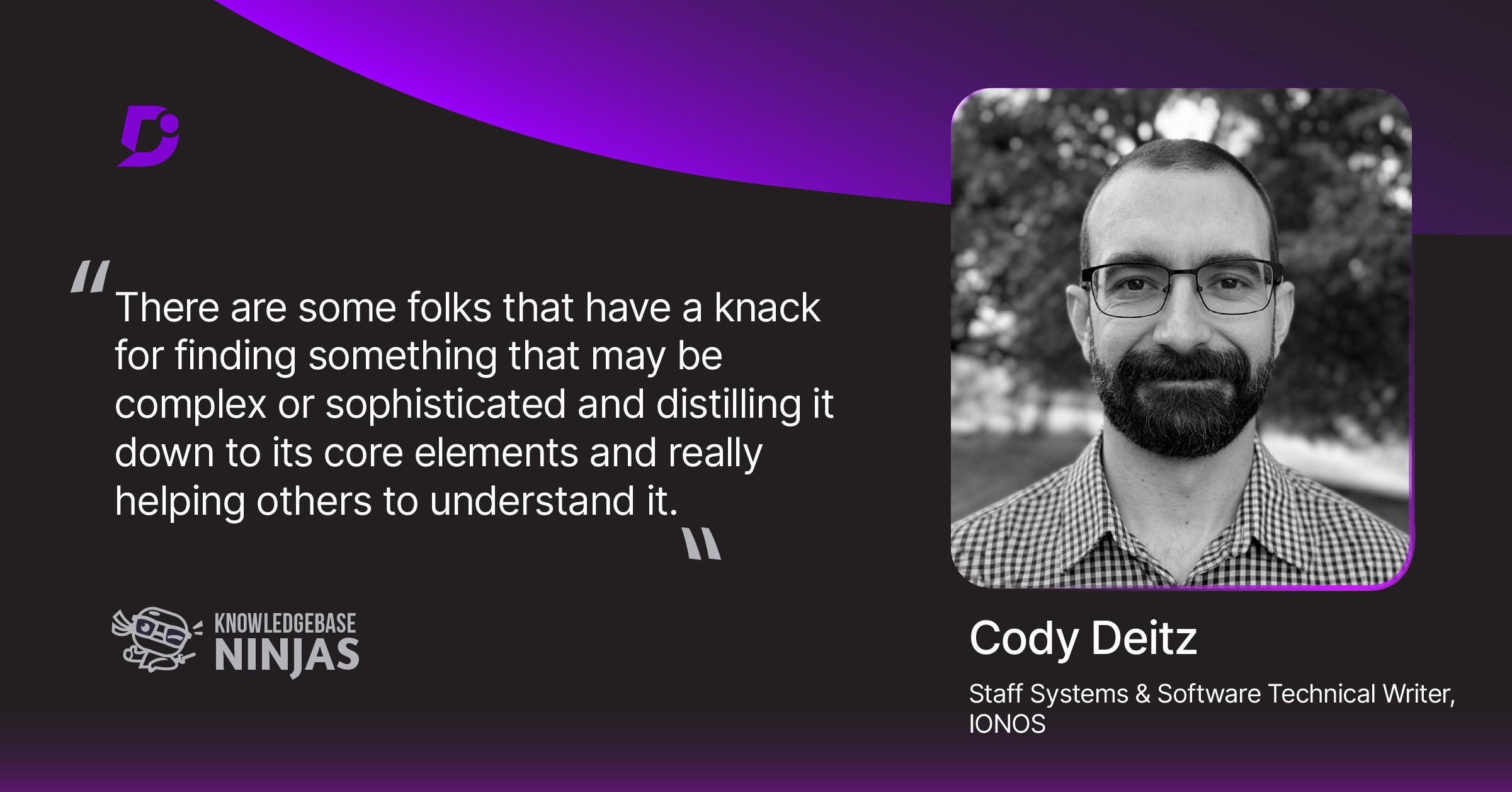
Many technical writers have a knack for breaking down sophisticated concepts into their core elements. It’s also rewarding to create something genuinely useful.
We often see people coming from engineering or writing backgrounds—academia, marketing, etc. What they share is a passion for learning and simplifying complexity.
-
Why Choose Technical Writing?
Gowri: What draws people to this field? Is it the writing itself or the problem-solving aspect?
Cody: It’s usually a combination. People enjoy writing, but also working with interesting subject matter—whether it’s software, hardware, or processes.
There’s also a collaborative aspect. A former manager of mine used to say, “Communication solves 99.9% of problems.” Technical writers play a key role in enabling that communication across teams.
That facilitative role is very rewarding.
-
AI and the Future of Technical Writing
Gowri: If someone enters technical writing today with AI tools available from day one, what might they miss out on?
Cody: We’re at an interesting—and sometimes challenging point in this field. AI tools are reducing the need to start from a blank page and handle tedious manual work like parsing specs or notes.
But one thing people might miss is the experience of starting from zero. That process forces you to think deeply:
- Who is my audience?
- What do they need?
- How should I explain this?
Even with AI, those questions remain the same. The difference is whether you’re writing everything manually or refining AI-generated content.
There’s still value in doing things the hard way, at least initially. But ultimately, we should embrace these tools and use them effectively.
Gowri: Absolutely—adapting to technology is essential.
-
⚡ Rapid Fire
Gowri: Can you share a few resources you recommend?
Cody:
– I’d Rather Be Writing by Tom Johnson is a must-read for anyone in technical writing.
– Passo Uno by Fabrizio Ferri Benedetti offers excellent perspectives, especially on how technical writing is evolving in the AI era.
Both are highly valuable resources for staying current and improving your craft.Gowri: One word that comes to your mind when you hear “documentation”?
Cody: Clarity.
Gowri: What advice would you give your 20-year-old self?
Cody: Trust the process and stay the course.
Gowri: We may not have covered everything from your experience, but I hope I’ve done justice to your journey.
Cody: Absolutely. It’s an interesting time in technical writing; many things are changing, but many fundamentals remain the same. It’s been great chatting with you.
Gowri: Thank you, Cody. It was wonderful speaking with you. All the best for your upcoming projects!
Cody: Thank you, you too!
-
Disclaimer: This transcript was generated using AI. While we aim for high accuracy, there may be minor errors or slight timestamp mismatches.
Enjoyed this conversation?
Don’t miss listening to other episodes of our Knowledgebase Ninjas Podcast, where we invite documentation experts from all walks of the industry to share practical, real-world insights, experiences, and best practices. Subscribe for the latest episodes, and if you found this helpful, pass it to your colleagues!
Read Our eBook
Discover how AI is shaping the future of technical writing:
The Future of Technical Writing – AI’s Impact on Knowledge Management
Watch Webinars
Learn from experts and product specialists in our Webinar Library
Explore Case Studies
See how leading teams are using Document360 to build powerful knowledge bases: Customer Success Stories
Browse Resources
Access our full Resource Library — including blogs, videos, guides, and more
Try Document360 for Free
Experience how top teams create world-class documentation with ease.
Book a demo
Follow Us for Updates, Tips & Best Practices
LinkedIn | Twitter (X) | Facebook | Instagram | YouTube