 EN
EN 

AI Summary
- Abhishek Sahoo, Cybersecurity Documentation Specialist at Tetra Pak, discusses how technical documentation evolved from a support function into a strategic business function across fintech, enterprise applications, and cybersecurity.
- Well-structured documentation can reduce onboarding time, support dependency, repetitive queries, and incident-response delays while improving compliance readiness, consistency, knowledge transfer, governance, and operational efficiency.
- Poor or outdated documentation can cause failed audits, delayed incident responses, inconsistent processes, miscommunication, weakened compliance posture, and reduced customer trust, partner confidence, and business continuity.
- AI supports efficiency, summarization, research, and content assistance, but human expertise remains essential for judgment, validation, contextual understanding, compliance nuances, risk assessment, decision-making, and accountability.
- Documentation success can be measured through reduced support tickets and repetitive queries. Abhishek emphasizes clarity, continuous learning, communication skills, emerging technologies, and resources including Write the Docs, Microsoft Learn, NIST, and ISO 27001.
AI-generated content. It may contain errors.
See Document360 in action
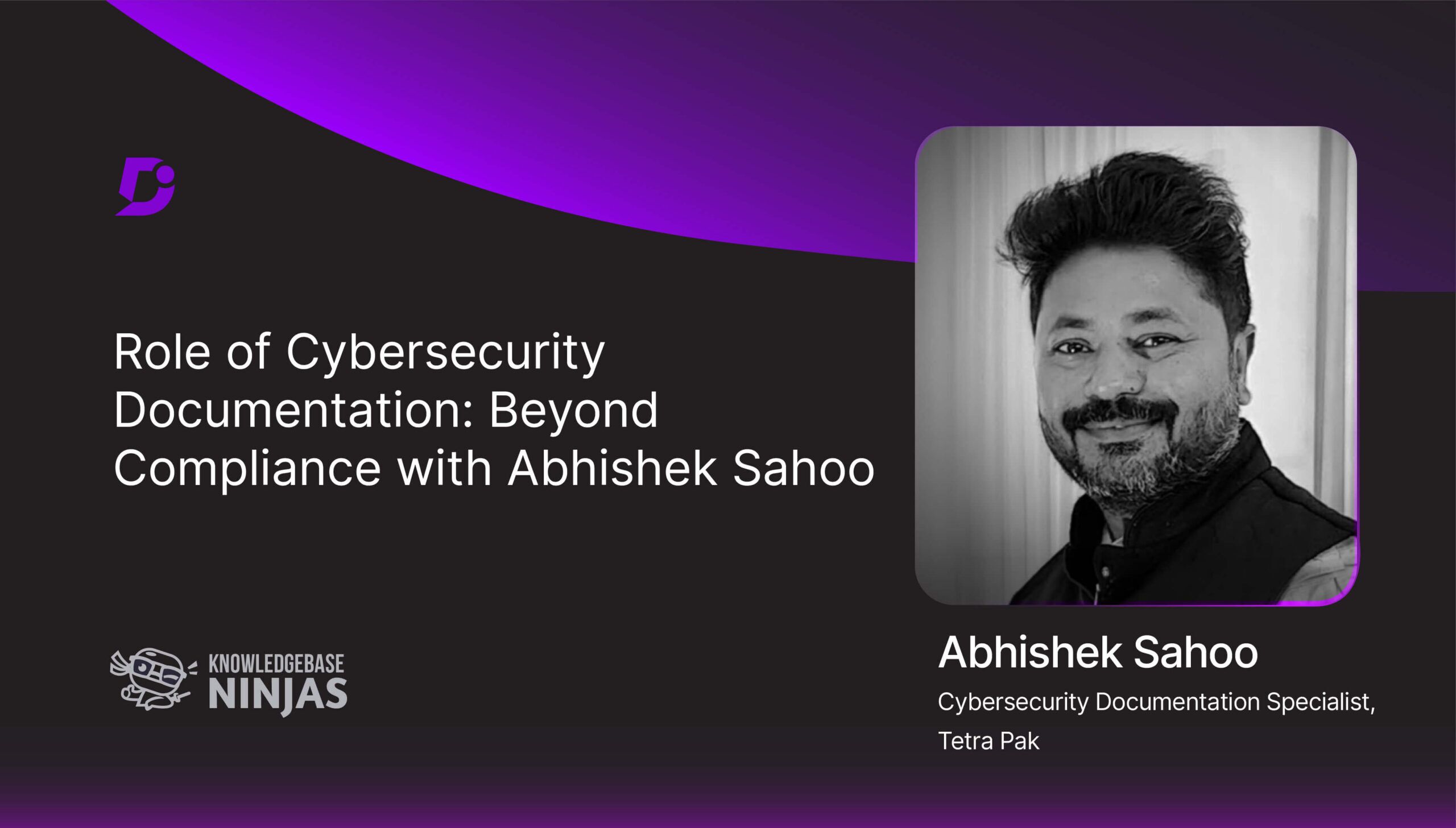
In this episode of Knowledge Base Ninjas, Gowri speaks with Abhishek Sahoo, Cybersecurity Documentation Specialist at Tetra Pak, about the evolving role of technical documentation in modern organizations. Drawing from over 13 years of experience across fintech, enterprise applications, and cybersecurity, Abhishek shares how documentation has transformed from being viewed as a simple support function into a strategic business asset.
The conversation explores how well-structured documentation can reduce onboarding time, improve compliance readiness, minimize support dependency, and strengthen operational efficiency — especially in high-risk environments like cybersecurity. Abhishek also highlights the hidden costs of unclear or outdated documentation, including failed audits, delayed incident responses, miscommunication, and loss of customer trust.
A major part of the discussion focuses on AI’s growing role in documentation. While AI can assist with efficiency, summarization, and research, Abhishek emphasizes that human expertise remains critical for judgment, validation, contextual understanding, and accountability.
The episode also touches on measuring documentation success, the importance of clarity in communication, continuous learning, and why technical writers play a crucial role as the bridge between complex technology and end users.
You can listen to the full episode on Apple, Spotify, and YouTube.
Watch the full podcast episode video here
Quick jumps to what’s covered
- 00:01 – Why documentation is more than content creation
- 03:30 – When documentation becomes a strategic business asset
- 06:10 – The business risks of poor cybersecurity documentation
- 09:00 – What AI still cannot reliably handle in documentation
- 11:22 – How documentation reduces repetitive support queries
- 16:00 – Why clarity is the foundation of technical writing
About Abhishek Sahoo
- Abhishek Sahoo is a Senior Technical Writer and Cybersecurity Documentation Specialist with over 13 years of experience in technical documentation, specializing in cybersecurity and API documentation.
- Based in Bangalore, he has worked across domains such as fintech, enterprise applications, and cybersecurity, building expertise in translating complex technical concepts into clear, user-friendly content.
- Passionate about simplifying complexity, Abhishek combines strong analytical thinking with practical communication strategies to create documentation that improves stakeholder understanding, enhances process efficiency, and delivers measurable business value.

Transcript
-
-
Abhishek’s Journey into Technical Documentation
Gowri Ramkumar: Good day, everyone! Welcome to another episode of the Knowledge Base Ninjas Podcast. Today, I’m joined by Abhishek Sahoo, Cybersecurity Documentation Specialist at Tetra Pak. Welcome to the podcast, Abhishek! How are you doing today?
Abhishek Sahoo: Thank you so much, Gowri, for the invite. I’m doing well. How about you?
Gowri Ramkumar: All good, all good, very busy as always, Abhishek! I’ll try to do justice to your experience in the next 15 to 20 minutes. You’ve spent more than 13 years in this space, so there’s definitely a lot to talk about. Before we begin, I’d love for you to help our audience understand how you got into technical documentation and how that journey shaped your expertise.
Abhishek Sahoo: That’s a wonderful question to start with, Gowri. Honestly, no one really plans to enter technical writing as a career from the beginning. It certainly wasn’t my first choice either. My career journey has been quite a rollercoaster before I eventually became a technical writer.
What initially drew me to technical writing was my interest in simplifying complex information, breaking it down into a form that both technical and non-technical audiences can easily understand. Early in my career, I noticed that even strong products often struggled because communication wasn’t clear, documentation wasn’t complete, or information wasn’t organized properly. That’s when I realized documentation was the missing piece.
Over the last 13 years, I’ve worked across multiple domains: fintech, enterprise applications, and now cybersecurity. Each domain taught me how documentation needs to adapt based on industry requirements and audience expectations. Today, I don’t see documentation as mere content creation. I see it as a strategic business function that supports both organizations and end users in the long run.
-
Documentation as a Strategic Asset
Gowri Ramkumar: Absolutely. Very well said, Abhishek. Congratulations on choosing such an impactful field. Many people stay within a single domain, but you’ve explored multiple industries, which definitely brings a broader perspective. You touched upon an important point: documentation is no longer viewed as just a support function. When do you think this transition happens, where documentation becomes a strategic asset?
Abhishek Sahoo: Documentation becomes a strategic asset when it starts influencing business outcomes. For example, reducing onboarding time, improving compliance readiness, decreasing support dependency, accelerating incident response, and helping teams make faster decisions.
Support teams especially depend heavily on documentation. If documentation is clear and structured, it becomes easier for them to resolve customer queries efficiently at the first level itself, rather than escalating issues unnecessarily. In my experience, documentation has evolved into an operational strategy and a major business enabler.
-
The Cost of Poor Documentation
Gowri Ramkumar: That’s a great point. We often discuss how fixing software bugs earlier reduces costs, and similarly, good documentation lowers customer support costs. What’s the real cost of documentation that isn’t up to the mark, especially in cybersecurity and compliance environments?
Abhishek Sahoo: That’s a very important question. In cybersecurity and compliance environments, poor or outdated documentation can create serious operational and business risks.
For example, it can lead to failed audits, delayed incident responses, inconsistent processes and major miscommunication.
In high-risk environments, unclear documentation directly impacts customer trust, partner confidence, and overall business continuity. It can also weaken an organization’s compliance posture and affect future collaborations or mergers. So documentation being “up to the mark” becomes absolutely critical.
-
AI in Documentation
Gowri Ramkumar: We can’t have a podcast these days without talking about AI! Many people believe AI can replace almost everything. But in high-stakes environments like cybersecurity, what are some things AI still cannot reliably handle in documentation?
Abhishek Sahoo: That’s a very interesting question. We are definitely in the AI era, and AI has become a huge advantage for technical writers. It helps tremendously with efficiency, summarization, research, and content assistance. If we’re unfamiliar with a topic, AI can help us gather initial information quickly.
However, AI still struggles with judgment, business-critical accuracy, contextual understanding, compliance nuances, operational intent, and accountability. AI generates responses based on existing web information. But cybersecurity documentation often requires organization-specific context, risk assessment, and regulatory interpretation. AI can support the process, but human expertise remains essential for validation, decision-making, and accountability. Maybe AI will evolve further in the future, but currently, those gaps still exist.
Gowri Ramkumar: Absolutely. That’s why we always emphasize keeping a “human in the loop.”
Abhishek Sahoo: Exactly.
-
Documentation Beyond Reference Material
Gowri Ramkumar: Can well-structured documentation become more than just reference material? Can it actually become an operational advantage for security and compliance teams?
Abhishek Sahoo: Absolutely. Well-structured documentation improves consistency, speeds up incident response, reduces dependencies, and increases efficiency during high-pressure situations. For security teams, especially, documentation acts as an operational framework. It supports audits, governance, knowledge transfer, and organizational security maturity. So yes, documentation can absolutely become a strategic operational advantage.
-
Measuring Documentation Success
Gowri Ramkumar: We spoke earlier about how documentation becomes strategic. What’s one business metric that truly shows documentation is adding value?
Abhishek Sahoo: For me, one of the strongest metrics is the reduction in support tickets and repetitive queries. If users, whether internal teams or customers, can independently solve problems using documentation, it shows that the content is effective, accessible, and valuable. Good documentation built from real customer issues, FAQs, and support cases significantly reduces repetitive support effort. That’s a very strong indicator of business value.
Gowri Ramkumar: Absolutely. I recently had a conversation with another customer where we discussed how AI chatbots are only as good as the underlying knowledge base. If the foundational documentation isn’t strong, no AI layer can compensate for it effectively.
Abhishek Sahoo: Absolutely, Gowri. No matter how advanced a chatbot is, there are still situations where a human understanding the query and responding thoughtfully provides a far better experience. That’s something I’ve personally experienced.
-
⚡ Rapid Fire
Gowri Ramkumar: What are some documentation-related resources, blogs, or communities you’d recommend?
Abhishek Sahoo: For anyone entering this field, I highly recommend Write the Docs, Microsoft Learn, the Google Developer Documentation Style Guide, and the Microsoft Style Guide. For cybersecurity-focused writers, frameworks like NIST and ISO 27001 are extremely valuable. I also encourage people to continuously learn AI tools because they definitely provide an advantage in today’s documentation landscape. Most importantly, stay grounded, keep learning, and keep upgrading yourself with emerging technologies and tools.
Gowri Ramkumar: One word that comes to mind when you hear “documentation”?
Abhishek Sahoo: Clarity. If you’re clear about what you’re writing, and your audience clearly understands it, then you’re doing a good job.
Gowri Ramkumar: What advice would you give your 20-year-old self?
Abhishek Sahoo: I would say: focus less on titles and positions, and focus more on building skills and expertise. Keep learning, continuously improve communication skills, stay updated with market trends, understand new tools and technologies, and stay relevant. That’s the most important thing.
-
Closing Thoughts
Gowri Ramkumar: That’s fantastic advice and honestly, it applies to every profession, not just documentation. Abhishek, it’s very hard to condense 13 years of experience into 15 to 20 minutes. I hope I’ve done justice to your experience. Anything else you’d like to add to the audience today?
Abhishek Sahoo: Just stay grounded, keep learning, and keep upgrading yourself with emerging technologies and tools. The field of documentation is evolving rapidly, and those who embrace change and continue to grow will always find their place in it.
Gowri Ramkumar: Absolutely. Embrace the change. Thank you so much, Abhishek. I wish you all the very best in the upcoming projects and many more to come. Let’s stay in touch, take care, and thank you very much for being a part of this journey.
Abhishek Sahoo: Thank you.
-
Disclaimer: This transcript was generated using AI. While we aim for high accuracy, there may be minor errors.
Enjoyed this conversation?
Don’t miss listening to other episodes of our Knowledgebase Ninjas Podcast.
Read Our eBook
The Future of Technical Writing – AI’s Impact on Knowledge Management
Watch Webinars
Webinar Library
Explore Case Studies
Customer Success Stories
Browse Resources
Resource Library
Try Document360 for Free
Book a demo


