 EN
EN  PT-BR
PT-BR FR
FR ES
ES DE
DE

Imagine you are an IT administrator at a fast-growing organization, handling large teams. Fifty new employees have joined the team, and each one needs access to 10 different applications. That is a total of 500 provisioning tasks that you need to manually complete by the end of the day, at least. You peek over your screen, and you see the new joiners sitting at their desks, eagerly waiting to get started. But their screens are blank, and their access is denied. They are all waiting on you. This process of onboarding takes hours or even days to complete when done manually.
But this is just the beginning. Several weeks later, employees are moved to new teams; that means updating their roles and permissions across the system, again. Then someone gets promoted, someone turns in their paper, and it‘s you who has to make changes across the system all over again. This cycle keeps repeating. The clock is ticking, but the tasks keep piling. It is exhausting, error-prone, and at scale, it is nearly impossible to get them done precisely.
This is not a bad day. But rather an ordinary Monday at every organization.
Somewhere in this chaos is a drawback that costs the company thousands of productive hours. This creates multiple security vulnerabilities, pushing back deadlines, and extinguishes the motivation in every employee. The good news is, there is a fix. SCIM is the hero that saves the day. Once you know about SCIM, you will wonder how any organization survived without it.
SCIM: Your Security Safety Net
There’s a dangerous side to manual identity management that slowly creeps up before it’s too late. They are the orphaned accounts.
When an employee leaves, due to the manual and slow process, their accounts are not immediately deactivated or removed. Those accounts and credentials continue to exist across every application they had access to in the system. This could be an idle login to a work email or an access still linked to a critical business tool. These are all open doors into your organization, and attackers are waiting to strike.
With SCIM, those doors are guarded and closed automatically. The moment an account is deactivated in your IdP, every connected application reflects that change instantly. No more orphaned accounts, no more delays, and no more security risks.
SCIM: The Game Changer
Now with SCIM, it is no longer a battle.
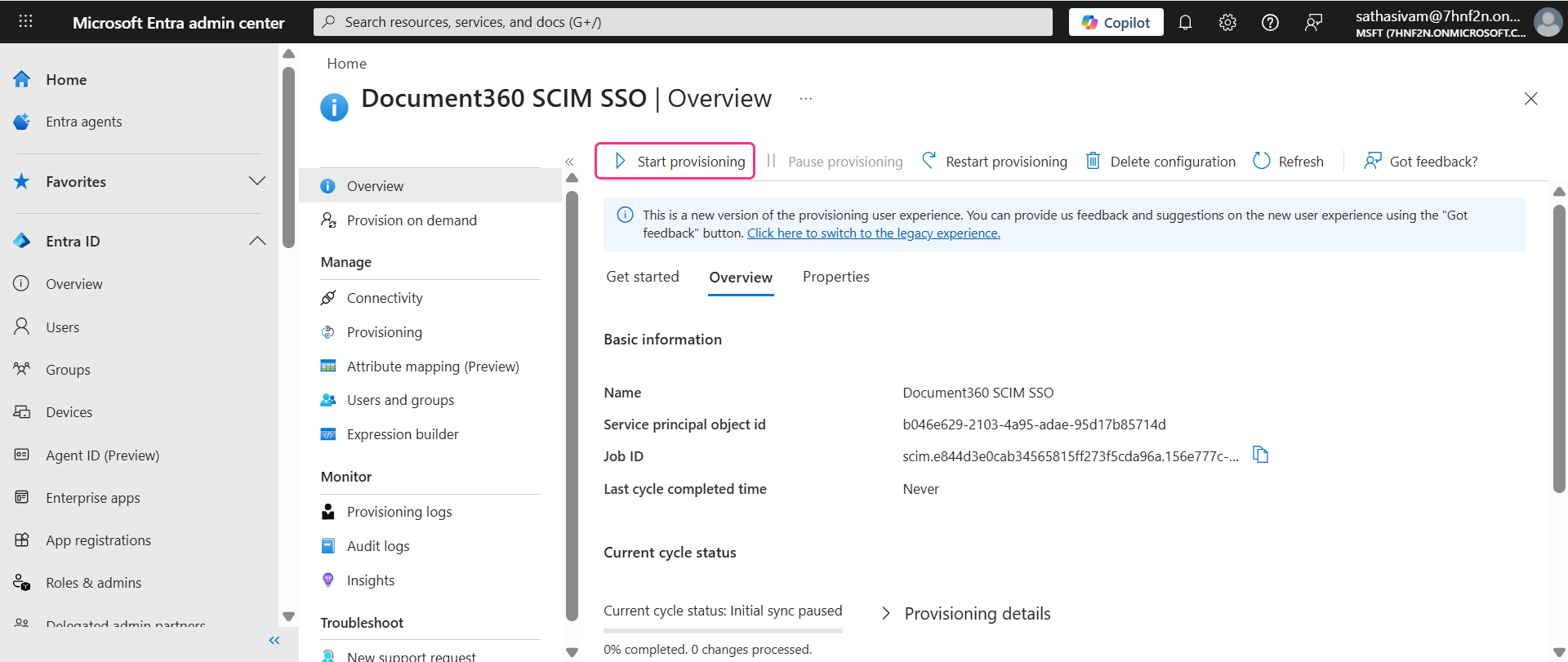
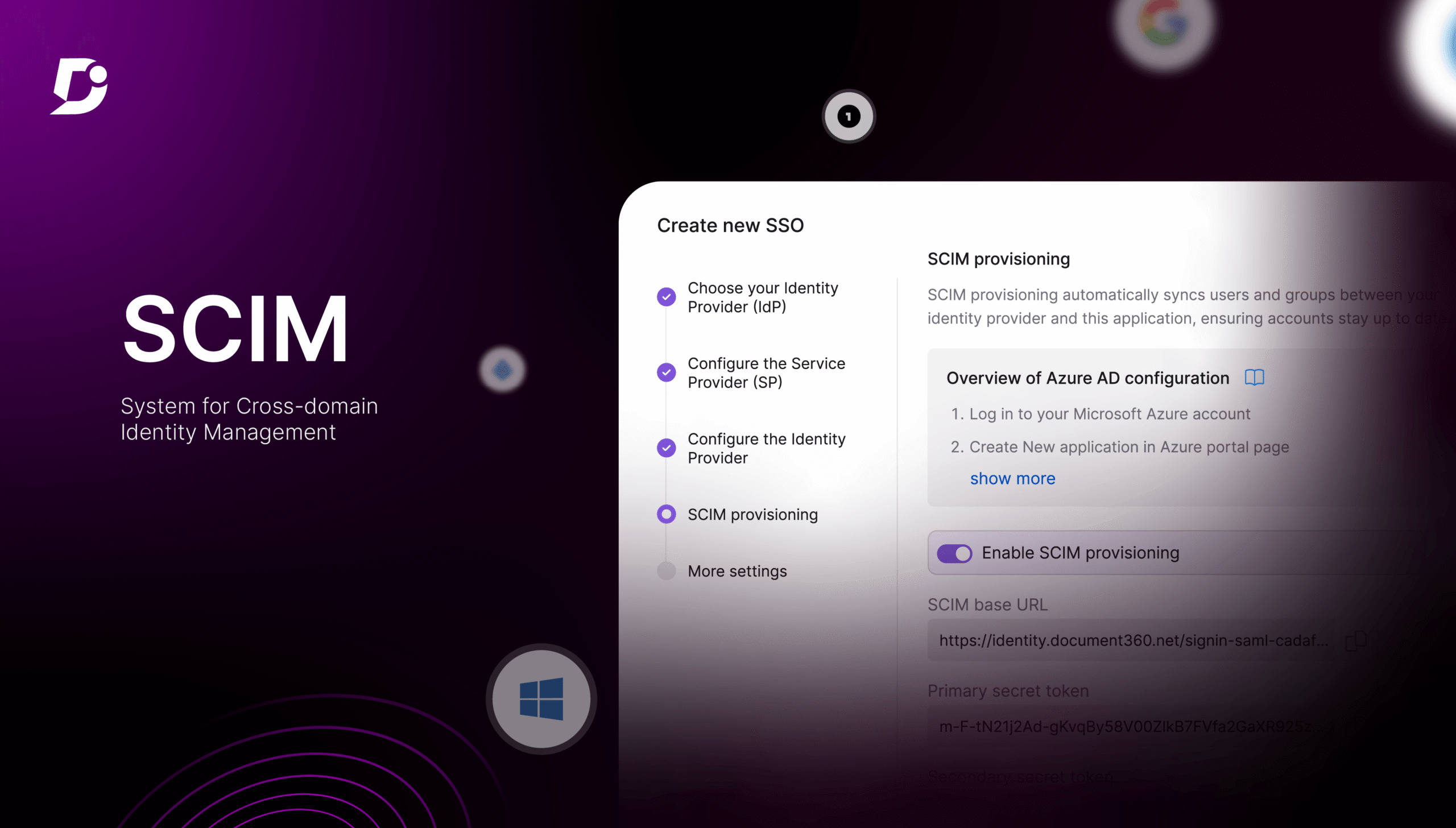
SCIM, also known as System for Cross-domain Identity Management, is exactly what the name implies. It is an open standard protocol that allows enterprises to automate user management across various applications they use, only with the help of Identity Providers (IdP) such as Okta, Entra, OneLogin, etc. SCIM allows you to perform CRUD operations, such as creating, updating, deactivating, and deleting users and groups, allowing every action to be conducted at a single place, your IdP.
All changes made to users and groups in your IdP will automatically reflect in the connected application. When you add a new employee to your IdP, that single action automatically provisions their account across every connected application. All at the same time. When their role changes, you update it once. When they leave, you deactivate it once. Only once do you have to perform an action, and across every connected application, this change will be reflected. No more logging in and managing users with 10 various tools in 10 various applications. You manage the user once, and SCIM will take care of the rest.
Think of it like your HR management and business applications are finally speaking the same language. Fluently and automatically, without any manual intervention. SCIM does not just reduce administrative workload and time; it eradicates an entire category of user management problems.
One platform to manage your knowledge base and automate user provisioning with SCIM. Give Document360 a try!
GET STARTED
How Document360 Helps in Supporting SCIM
Setting up SCIM can seldom feel intimidating or even overwhelming due to its various steps and back-to-back switching tabs between the IdP and the Service Provider. Every different IdP has its own configuration, its own steps, and its own quirks. For many, that complexity alone makes them abandon SCIM setup completely.
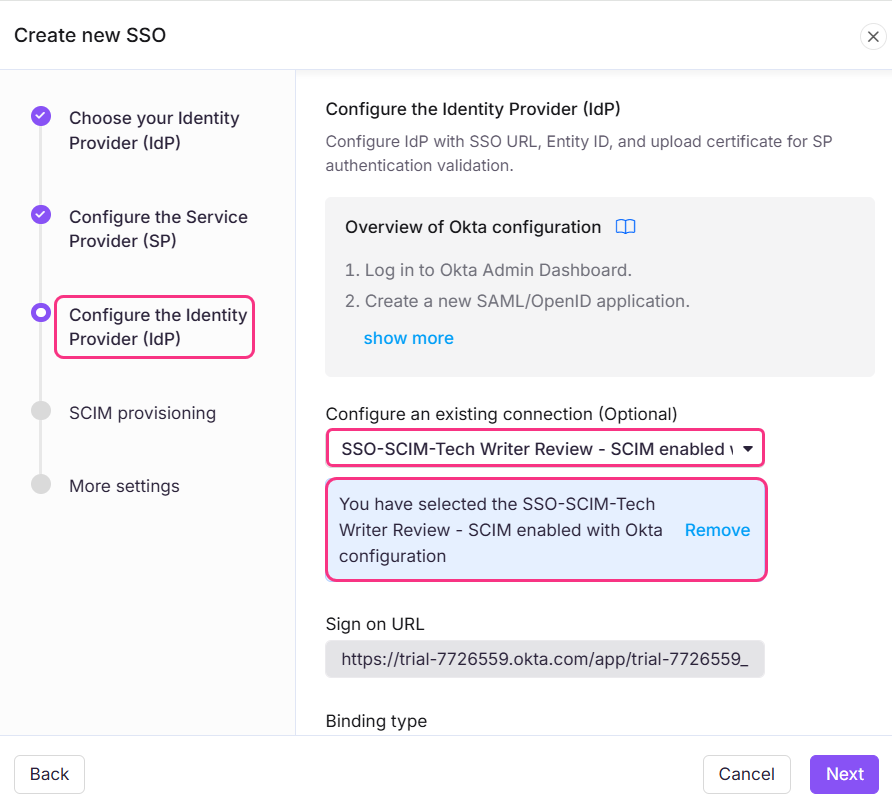
But with Document360, it does not need to feel that complicated. By providing a straightforward and detailed documentation on each IdP, setting up SCIM with SSO configuration is made much easier to follow. Designed from the administrator’s point of view, Document360 removes the friction from setting up SCIM. While setting up SSO configuration, you can simply configure SCIM as well on the go. Document360 helps in SCIM provisioning with various IdPs and not just one.
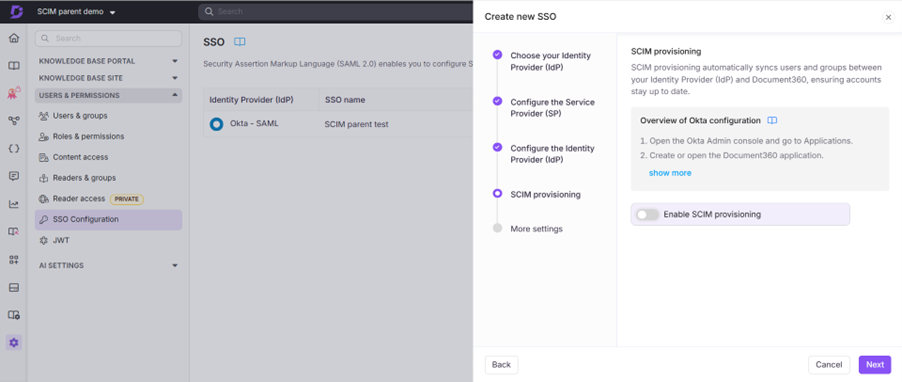
Supported actions may vary depending on the IdP, but Document360 is built to support various actions that allow you to manage users and groups.
Actions made in IdP |
What happens in Document360 |
|
Create user |
New users are automatically created in Document360. |
|
Create group |
Groups are created automatically when group sync is enabled. |
|
Add user to group |
Users are assigned to desired groups. |
|
Update roles & permissions |
Content access & permissions are managed from the IdP. |
|
Deactivate user |
Access is revoked |
|
Delete user |
User is deleted from the system completely. |
Document360 and your IdPs work hand in hand, quietly and automatically as they should.
Check Out How to Automate User Access in the Knowledge Base Using Document360 SCIM
Back to Day One, Life with SCIM
The minute HR finalizes a new employee’s profile in the system, their accounts are provisioned automatically. By the time they sit at their desks, their email is ready, and all the applications they need are active and waiting for them. No more tickets to raise, no more delays, and no more manual provisioning tasks to be handled.
This is no fairy tale. But an ordinary day with SCIM is working as intended.
SCIM is not merely a “nice-to-have” feature for organizations, but a necessity. The world is growing, rapidly advancing with the use of technology, and the organizations that thrive are the ones that remove the friction and do not add to it. SCIM is one step towards that, turning an IT team that is exhausted, struggling up the mountain, into one that finally stands at the top. Free to focus on moving their business forward and putting the customer first.
The protocol that nobody pays attention to is quietly making sure everything works seamlessly, so you can focus on the job you came to do.
Identity management does not need to be burdensome, and with SCIM, it doesn’t need to be manual either.


 –
–