 EN
EN  PT-BR
PT-BR FR
FR ES
ES DE
DE
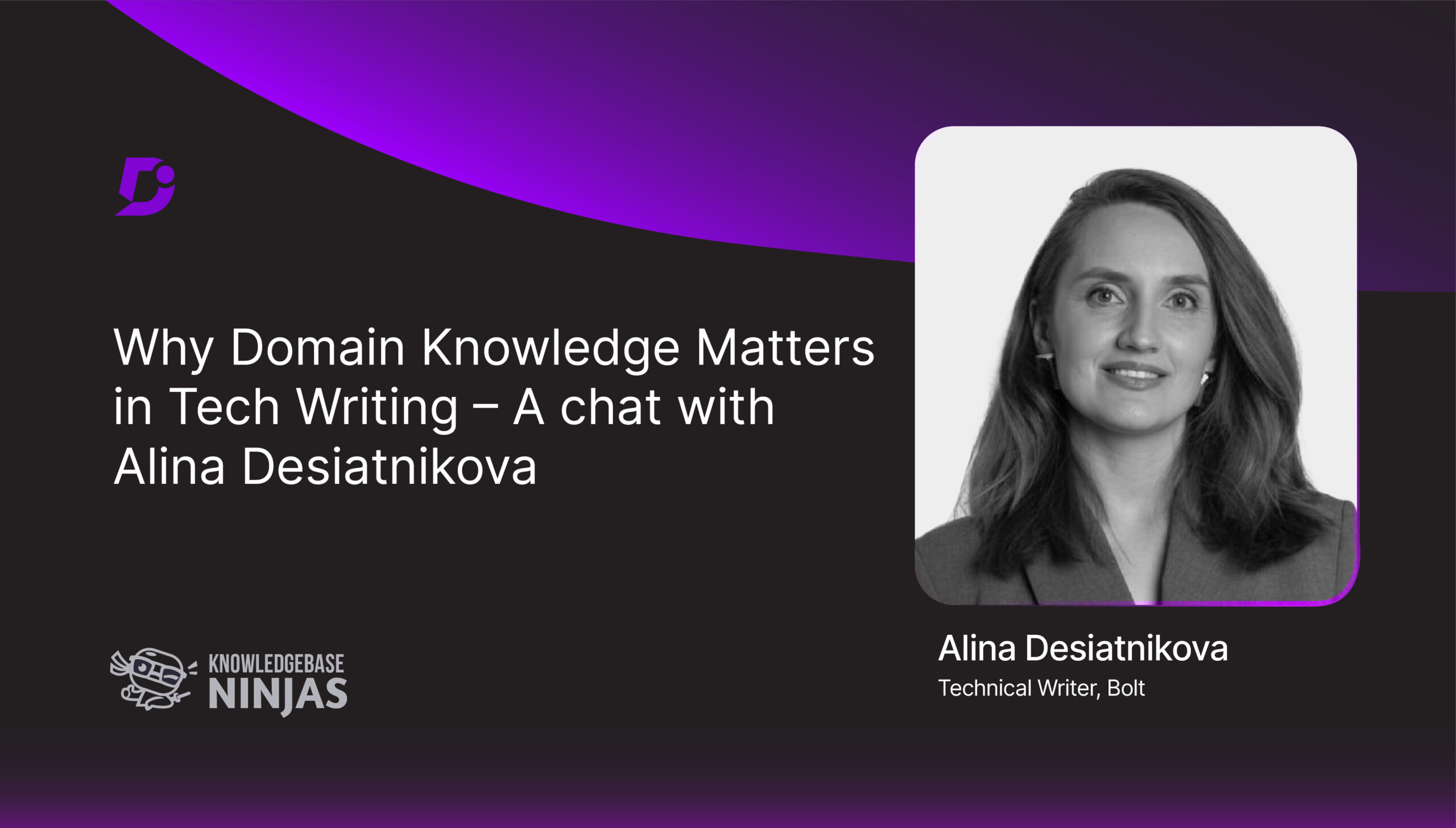

In this episode of the Knowledge Base Ninjas podcast, Alina discusses the importance of strong domain knowledge in technical writing, highlighting how clarity, structure, and understanding the product are essential to creating accurate documentation. She explains how AI brings both opportunities and challenges, helping with proofreading, drafting, and even code-related tasks, while still requiring careful validation and human oversight. The conversation also touches on adapting writing styles for different audiences and how collaboration with product teams and developers strengthens content quality. Overall, she emphasizes that technical writers should stay open, creative, and intentional in how they use AI, ensuring it complements, not replaces their expertise.
Watch the full podcast episode video here
You can listen to the full episode on Apple, Spotify and YouTube.
About Alina
-
Alina’s LinkedIn
-
Alina Desiatnikova began her career 11 years ago as a technical support engineer, where she discovered her interest in writing clear and helpful customer tickets. Her attention to detail and passion for documenting solutions caught the eye of the knowledge base team, who invited her to join them. This became her first step into technical writing. Since then, Alina has continued to grow in the field, working as a technical writer for multiple companies and building on her hands-on product knowledge and communication skills.
Quick jumps to what’s covered:
3:21 – Domain knowledge vs. writing skill
4:38 – How AI helps and challenges technical writers
6:12 – The importance of human-in-the-loop review
6:46 – Adapting documentation for different audiences
8:27 – How technical writers should position themselves with AI
9:53 – Using AI for technical problem-solving and support tasks
Transcript:
-
-
-
01:16 – 03:21 Alina’s Journey into Technical Writing
Gowri Ramkumar: Good day, everyone. Welcome to Knowledge Base Ninjas Podcast. Our guest today is Alina Desiatnikova.
Alina Desiatnikova: That’s right.
Gowri Ramkumar: Technical Writer at Bolt. How are you, Alina?
Alina Desiatnikova: Hi, Gowri. Hi, everyone. I’m doing great. And thank you very much for inviting me today. I’m like very excited to have this chat. So I hope that we will learn something new and that it will be useful for everyone.
Gowri Ramkumar: Absolutely. Absolutely. Pleasure is ours too.
So yeah, just before we talk a lot more about your writing side of things, just fill us how did you get into this career and who motivated you? Where did it all start?
Alina Desiatnikova: Well, that’s a great question because basically it all started like around 11 years ago when I was working as a technical support engineer. And basically, that was my first employment. And besides technical support, we had like various teams within this company. And, I was like very excited to write tickets for the customers because for me, it was important basically to reflect our conversation and to ensure that customer has some sort of reference where they can go to understand what have been done and how they can proceed in the future.
Gowri Ramkumar: True.
Alina Desiatnikova: And I guess that some of the people from their knowledge base team, they noticed that I’m very excited about this ticket writing. And they basically invited me to join the knowledge base team. I was, like, very happy about that because being a support engineer and knowledge base also actually works great together because you have hands on experience. And basically, that’s how I started as a technical writer.
That was like, my first touchpoint with technical writing. And, after I left this company, basically, I already started working as a technical writer for various companies.
Gowri Ramkumar: Right, right. And how interesting. Great.
-
03:21 – 04:36 Domain Knowledge vs Writing Skill
Gowri Ramkumar: Now, as you rightly said, being in the technical support is a very much added advantage, right? Because you’ve got the product knowledge as well, and then the customer side of things.
So from your opinion, how important is domain knowledge versus the writing skill?
Alina Desiatnikova: Well, I think that’s actually very important because, in my opinion, technical writing is mainly about clarity and structure. Because yeah, our goal is to deliver the technical or product knowledge to the customers, to developers, or any other audience who’s going to read the doc.
So basically, I think that it’s like very important to understand what you are working with, what you’re writing about. And I know that a lot of technical writers who are not working for technical support, which is like, obviously, okay, but all the time we have our colleagues from product teams, we have software engineers, we have other colleagues with product knowledge.
So I think it’s important basically to collaborate with them to understand what the product does, what is it about, which kind of use cases we have. So yeah, I think it’s important to be aware of the product.
Gowri Ramkumar: Understand, understand.
-
04:36 – 06:18 Opportunities and Risks of Using AI in Documentation
Gowri Ramkumar: Now, we can’t be without talking AI, right?
So, from your perspective again, how are AI tools and large language models currently helping, or let me say challenging, the technical writers?
Alina Desiatnikova: Well, I like your question because, yeah, I also see both sides, where the tools can help us and where they are actually challenging us as technical writers. Because, to start with, there are a lot of, you know, articles, people are talking, saying that writers, technical writers are not needed anymore.
Gowri Ramkumar: Yeah.
Alina Desiatnikova: Which kind of definitely adds some pressure and stress. Though, in fact, I guess it’s like a great tool. It’s a great opportunity to advance their workflows, starting with proofreading or, for example, even drafts. So you can use AI, like, no problem with that.
But definitely there are a lot of challenges. And, we as technical writers have to be like very accurate because AI tools also want to be creative. Wants somehow to change parameter names, even though if you are clear and exact with your prompts. So yeah, basically, it’s a great tool though, it requires a lot of attention to the detail and a lot of, actually, double-checking and proofreading to ensure that your materials that you are creating together with AI is clear and…
Gowri Ramkumar: We can call it as human in the loop, isn’t it?
Alina Desiatnikova: Yes. Exactly. Right.
-
06:18 – 08:25 Writing Documentation for Different Audiences
Gowri Ramkumar: Now, I’m sure you said 11 years ago your journey started as a technical support, and then gradually into the technical writing space, you must have created contents for developers and users, internal teams and whatnot.
Now, how do you adapt your voice and the style or the structure, depending upon who the audience is?
Alina Desiatnikova: Well, it’s also a great question. Because basically is this kind of technical documentation is like very different. When we are talking to the end users, we want to be like simple, straightforward, and we don’t want to add any complexity. We want to ensure that what we deliver is exactly what we deliver. When we are talking to developers, it’s also important not to be the captain evidence to ensure that we are talking on the same level, that people will basically understand, and they feel that we are experts in what we are saying.
Gowri Ramkumar: Yeah, yeah.
Alina Desiatnikova: So basically, I guess that’s another challenge of technical writing. Because you really have to learn, adapt, check, and see how, for example, this different audiences they want to see the documentation, if they want to see like really simple step-by-step instruction or if they want to see code samples.
Gowri Ramkumar: Yeah.
Alina Desiatnikova: So basically, I guess that is also like a challenge and maybe even some skill to adapt your writing to different audiences. And I guess that it comes with experience, and especially if you have opportunity of working with different stakeholders, that really helps to understand how basically to adapt your writing.
But another part, again, as we already touched AI it’s also a great helper with that because basically, you can test your documentation against, various, stakeholders and ask your AI tool to help you to adjust the tone and to ensure that basically your documentation meets the goal.
Gowri Ramkumar: Yeah. Yeah, absolutely.
-
08:25 – 10:58 Using AI Without Losing Human Expertise
Gowri Ramkumar: Now, let’s talk about the AI again. So how do you think the technical writers should position themselves in order to use the AI effectively?
And, you said, okay, there’s already some apprehensions that it could replace the technical writers.
So how can we make sure that they don’t get that feeling?
Alina Desiatnikova: Well, I think it’s important basically to learn and to test to be like creative and open to analyze where actually AI can join the game and where you can benefit from it.
Gowri Ramkumar: Yeah.
Alina Desiatnikova: Because I mean, AI it’s not only about proofreading and I know that teams are saying, okay, we will just use some AI tools to generate computation. Okay. Maybe sounds great. So AI might not have enough of product knowledge about the product that you are developing within the company.
Gowri Ramkumar: Yeah.
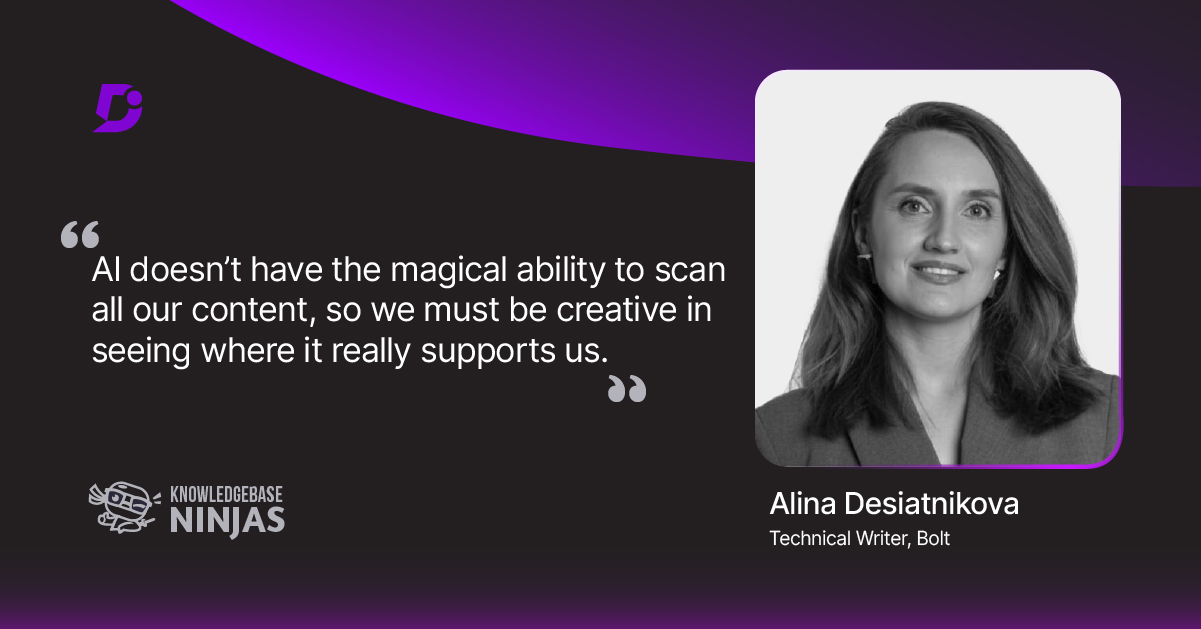
Alina Desiatnikova: Because technical writers still need to collaborate and to ensure that the knowledge is delivered correctly. The use cases are covered and so on, so forth that AI right now doesn’t have this magical opportunity to analyze all Confluence articles, PDF files, or maybe some Word files that are stored locally on somebody’s computer. So…
Gowri Ramkumar: Yeah.
Alina Desiatnikova: I guess it’s important, yeah, to be creative to see where you can benefit from it. Because for example, in my case, I also use AI tools in order to help me to create some code. I’m not a software engineer myself, but I also have a lot of technical tasks that are related to the help side support and maintenance. And basically I need to look for some technical solutions because we are using an open source tool.
So I need to ensure that basically our help site experience is improving, that everything is appearing in its place. And it’s my goal basically to find technical solution, how to make it happen. So why not to use AI for that? But I also want to note is that if I find some technical solution, I will test it. And of course I will ask for feedback from my colleagues to ensure that this solution that I found and I want to propose to the team, it basically aligns with the way of things and doesn’t go like against the company policy. For example.
Gowri Ramkumar: Understand, understand.
-
10:58 – 14:47⚡Rapid Fire Round
Gowri Ramkumar: Now let’s move on to some Rapid Fire round questions, Alina.
So any resources or documentation-related content that really grabbed your attention that you can share with the audience today?
Alina Desiatnikova: Well, basically you are talking about some inspiration sources, right?
Gowri Ramkumar: Yeah, it could be books or blogs or anything. You know, any podcasts or anything.
Alina Desiatnikova: Okay. So, well I all the time recommend everyone to check blog from Tom. I think the last name is Johnson, senior technical writer from Google. Because Tom has like an excellent blog where you can find like a lot of information, especially about API documentation. That’s like a great resource.
Another great thing that I really recommend to everyone it’s blog from Scott Abel because basically Scott is covering different topics about technical writing. And it’s like very useful to listen to this podcast from time to time.
And another thing, that I basically I recommend is to look around and to find the companies where you really like documentation and to see how they are doing. I mean, we don’t have the goal to copy somebody’s content, but just to get some ideas and inspiration, for example, how these companies are outlining their documentation, how they write the articles and so on, so forth. So basically, to find your own benchmarks.
Gowri Ramkumar: Understand. Understand. That’s quite a lot. But let’s see how that goes.
Now, one word that comes to your mind when you hear “Documentation”?
Alina Desiatnikova: Well, for me documentation is about clarity. Because I think that when we don’t have clarity, we don’t have, like, documentation that can help a user or any other stakeholder.
Gowri Ramkumar: True, very true. So I did ask only one word so you did answer that question.
My last question to you is, one piece of advice that you would give to your 20-year-old self?
Alina Desiatnikova: Well, that’s a good one.
I think that my advice will be, to ensure that technical writer is not shy and ready to present themself to the team. Because sometimes, what is happening is that a lot of companies don’t have a technical writing team. They have one technical writer, for example, like I am myself right now. And the advice here is to ensure that basically, if, for example, your team didn’t present you to everyone, yeah, it’s your own chances to talk to people and to explain what exactly you’re going to do, who is technical writer and how they can approach it, approach you if they have some sort of technical writing requests, why it’s important?
Because actually a lot of people, they don’t have previous experience working with technical writers and they might have very wrong expectations of technical writing career. And they might expect that, for example, you are just a developer who writes something or for example, some person from marketing team or something else. So it’s like important to position yourself to ensure that team exactly understands why you are here, what you are going to work with and how to sorry, approach you.
Gowri Ramkumar: Understand. Understand. That’s really great to hear this.
-
14:47 – 16:57 Conclusion
Gowri Ramkumar: Now, anything else that I must to cover in this episode, Alina?
Alina Desiatnikova: Not so sure. I think that we basically covered, like, a lot of topics. Yes, but, I know that actually, even though, again, there are like a lot of there is like a lot of buzz, the technical writers are not necessary anymore. I just want to say that’s not exactly true. We still have a lot of work to do. And probably, when we are need not needed anymore in the market, we will see that all companies have like, excellent documentation. But that’s not the case as we know.
So I just want to tell everyone that if you are a technical writer or you would like to join the field.
Gowri Ramkumar: Yeah.
Alina Desiatnikova: Don’t feel bad about it. And be sure that basically you will be able to find work, you know, think if you would like to create documentation for the end users or you would like to work on some technical stuff. But, be sure that your skills are necessary and that basically, the technical world still needs us.
Gowri Ramkumar: Okay. That’s great. So it’s been a great pleasure to connecting with you. And I know the amount of years you have experience, it’s very hard to condense in this 20 minutes, but you did help us understand exactly where you started, how the journey is going, and particularly on the AI part, has been really, really a good conversation, Alina. So all the very best for your projects and, stay safe. And take care.
Alina Desiatnikova: Thank you very much, Gowri. I appreciate again, that you basically reached out and invited me. So. Yeah, let’s stay in touch. Thank you.
Gowri Ramkumar: Thank you, take care.
-
-
Disclaimer: This transcript was generated using AI. While we aim for high accuracy, there may be minor errors or slight timestamp mismatches.
Enjoyed this conversation?
Don’t miss listening to other episodes of our Knowledgebase Ninjas Podcast, where we invite documentation experts from all walks of the industry to share practical, real-world insights, experiences, and best practices. Subscribe for the latest episodes, and if you found this helpful, pass it to your colleagues!
Read Our eBook
Discover how AI is shaping the future of technical writing:
The Future of Technical Writing – AI’s Impact on Knowledge Management
Watch Webinars
Learn from experts and product specialists in our Webinar Library
Explore Case Studies
See how leading teams are using Document360 to build powerful knowledge bases: Customer Success Stories
Browse Resources
Access our full Resource Library — including blogs, videos, guides, and more
Try Document360 for Free
Experience how top teams create world-class documentation with ease.
Start Your Free Trial
Follow Us for Updates, Tips & Best Practices
LinkedIn | Twitter (X) | Facebook | Instagram | YouTube



 –
–