 EN
EN  PT-BR
PT-BR FR
FR ES
ES DE
DE
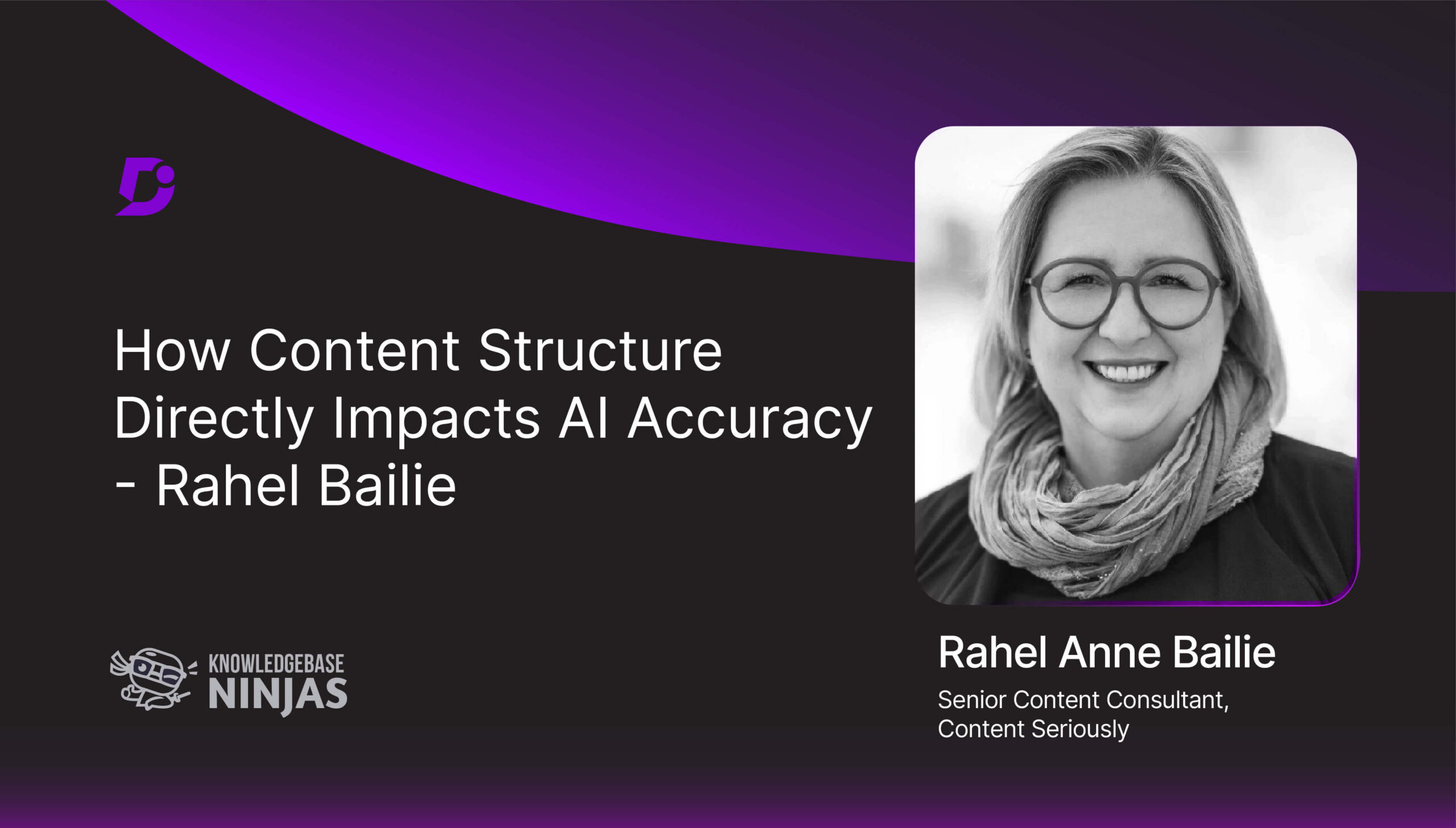

In this episode of the Knowledge Base Ninjas podcast, Rahel reflects on how organizations are currently approaching AI and where they often miss the mark at a strategic level. She highlights that many companies are in a panic to “do AI” without really knowing why.
She then turns the focus to existing content and what it really means to be AI-ready. While AI has long been used in content optimization tools, Rahel notes that this area is already well established. The bigger challenge today lies in delivering large volumes of existing content effectively through AI-enabled chatbots.
Rahel emphasizes that AI performs far better with structured content. Although unstructured content can still be used, it often leads to lower accuracy. Because AI needs sufficient context to return reliable answers, even when using advanced approaches. She also stresses the need for human involvement, pointing out that AI can support content cleanup and restructuring but cannot work independently.
She closes the conversation by touching on evolving content standards and how to think about ROI. Rahel shares a practical perspective on measuring the value of AI-ready content, underscoring the importance for content professionals of understanding how LLMs work. The episode concludes with insightful recommendations and responses from the rapid-fire round.
Watch the full podcast episode video here
You can listen to the full episode on Apple, Spotify, and YouTube.
About Rahel
Rahel’s LinkedIn
- Rahel Anne Bailie is a Senior Content Consultant at Content Seriously, with over 30 years of experience in technical communication and content strategy. Her journey began with a strong interest in working with content, even before she knew technical writing was a profession.
- She worked on production coordination and other supporting tasks before moving into technical writing itself, including deep technical work such as API documentation in the telecommunications domain.
- Over time, Rahel transitioned into content strategy. This shift was driven by her interest in taking a more structured and intentional approach to content. Today, her work brings these experiences together, combining content strategy with technical communication.
Quick jumps to what’s covered
- 3:12 – What companies misunderstand about AI at a strategic level
- 4:59 – How to assess whether existing content is AI-ready
- 6:32 – AI chatbots, structured content, and accuracy challenges
- 9:35 – Improving AI accuracy: structure, context, and human oversight
- 12:00 – How content preparation standards will shift with AI
- 15:43 – Where teams can see the fastest ROI from AI-ready content
Transcript
-
-
Rahel’s Path into Technical Communication
Gowri Ramkumar: Good day, everyone. Our guest today is Rahel Anne Bailie, Senior Content Consultant at Content Seriously. A very warm welcome to the Knowledge Base Ninjas podcast, Rahel. How are you doing today?
Rahel Anne Baile: I’m fine, thank you. And thank you for having me on your podcast.
Gowri Ramkumar: Fantastic. Rahel, you have plenty of experience in this space, but let’s start at the beginning. How did you get into technical writing, and what motivated you? Who inspired you? Could you share some insights from your early days?
Rahel Anne Baile: I originally worked with numbers, but I wanted to work with content. I started exploring what I could do in that space and came across an advertisement in a newspaper, back when newspapers were still commonly used, for a proofreader role. I applied, and it turned out to be in a technical writing department.
At the time, I didn’t even know technical writing existed. I didn’t realize that jobs working with content were actually a thing. I landed in the technical writing group and worked on activities related to tech writing, though not writing itself initially. I was involved in production coordination and related tasks.
Eventually, I moved into technical writing more deeply, working on APIs for telecommunications. From there, I transitioned into content strategy because I was always looking for a more patient, more thoughtful way to do things.
In a way, my career has come full circle. Today, I work in content strategy, but firmly within the technical communication space.
Gowri Ramkumar: That’s great.
-
When “Doing AI” Replaces Clear Strategy
Gowri Ramkumar: Let’s move straight into AI. Given your experience, I think you’re the right person to ask this. When companies talk about preparing content for AI, what do you see them misunderstanding most at a strategic level?
Rahel Anne Baile: What I find interesting is that there’s not enough consideration at the strategic level. What I see instead is panic, a rush to “do AI” without a clear understanding of why or how.
At the C-suite level, leaders are being told that if they don’t use AI, they’re missing the boat or being inefficient. That pressure gets pushed down to managers, who then have to figure out how to use AI without clear guidance. Meanwhile, the people actually doing the work find isolated ways to use AI in their specific contexts.
What’s missing is coordination. I don’t yet see AI being used consistently across departments, let alone across organizations, to improve content operations or quality. We’re very much in a transition phase, and there isn’t enough strategic thinking yet about how AI should be used.
-
The Reality of Making Existing Content AI-Ready
Gowri Ramkumar: Let’s talk about existing content, because there’s already so much of it being used today. What criteria do you see for assessing whether existing content is AI-ready?
Rahel Anne Baile: In our industry, we’ve actually been using AI for about 25 years in tools like Acrolinx, Congree, Grammarly, and similar applications. AI has been used for decades to detect duplication, identify when something is said five different ways instead of one consistent way, and reduce issues that affect things like translation costs. This has traditionally fallen under what we call content optimization.
So we’ve been optimizing existing content using AI for a long time, and that’s a mature technology with a mature process. We understand what this type of AI can do and how it can improve existing content. What’s new now is the push to deliver existing content through AI-enabled chatbots.
Earlier, we had chatbots and conversation designers who worked with conditional logic—essentially “if-else” statements—using keywords and predefined rules. But we’ve moved beyond that to AI-enabled chatbots that are expected to go into large content repositories and pull out exact answers.
These repositories can include PDFs, HTML pages, XML content, Excel spreadsheets, Word documents—large volumes of product-related content such as user guides, maintenance manuals, troubleshooting documentation, and more.
Across industries and verticals, organizations provide content so customers can do what they need with the product. Now this content is often delivered through content delivery platforms, whether CMS-integrated or search-style systems.
Customers are expected to interact with these systems using natural language. They ask a question, and the chatbot is supposed to return a precise piece of information. This creates a completely new level of expectation for existing content.
We know that the more structured your content is, the better AI can interpret it. If your content is unstructured, a content delivery platform can still work with it—but the accuracy won’t be where you want it to be. So the key question becomes: how do you increase that accuracy?
Large Language Models can hallucinate and sometimes get things wrong. But you can’t entirely fault them if you haven’t done what’s necessary on your side, such as implementing retrieval-augmented generation (RAG) and providing enough context.
That means remediating existing content so it can function effectively in this new environment. Can AI help remediate content? Yes and no. There are certain things AI can do well, and other things that still require human oversight.
This is why the idea that you can simply “run a script” creates false expectations. AI needs supervision. AI is like a gifted English major masquerading as a business consultant — you have to treat it like an intern.
There are tasks AI can handle, such as converting content to active voice or extracting instructions from a 1,500-page document and turning them into numbered steps. But you still need to verify that it’s done correctly and that the result actually makes sense.
If you’ve ever used AI note-takers in meetings, you’ve probably seen how they sometimes latch onto a throwaway remark and turn it into the main focus of the meeting summary. The same thing can happen with AI in content work. That’s why human oversight is essential.
Gowri Ramkumar: Very well said.
-
Choosing the Right AI Tools for the Right Content Work
Gowri Ramkumar: As AI systems evolve, how do you expect content preparation standards to shift, and how should teams prepare for the shift?
Rahel Anne Baile: At a bigger picture, it’s essential for content professionals to understand how Large Language Models work. The more familiar we are with their mechanics and how different models behave, the better we can leverage them.
Different models excel at different tasks — some are better at analysis, while others are stronger at data-heavy processing. Understanding these differences helps teams make informed choices.
At a tactical level, teams must define their goals clearly. For example, if a company acquires multiple brands and wants unified messaging, AI can help — but only if you break the task down strategically and tactually.
Problems arise when companies assume one tool can do everything. That’s like using a whisk for chopping, dicing, and stirring. Tools have limits, and content professionals must advocate for the right tools for the right tasks.
It’s your advocacy that moves the argument forward — knowing when one tool is needed versus another, and recognizing that they are not the same.
Gowri Ramkumar: Because you are the owner. So let’s say people take all these efforts and make their existing content AI-ready, or prepare to create content using AI technologies, so that they get the right results.
-
Understanding ROI Beyond Content Metrics
Gowri Ramkumar: Where do you see the fastest ROI when teams optimize content for AI?
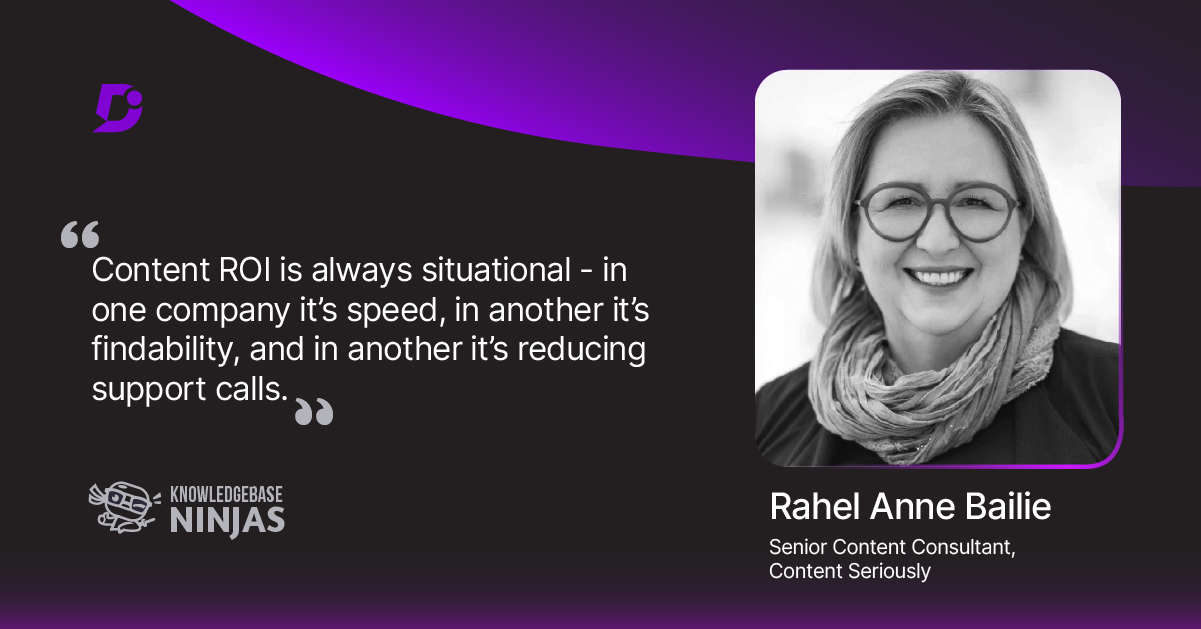
Rahel Anne Baile: ROI is tricky because it’s usually defined at the strategic level, and content is rarely considered directly. In life sciences, for example, ROI often means time to market — every day of delay costs millions.
Content contributes indirectly. You have to think far out and work backwards. Content itself may not be the ROI, but it contributes to outcomes that eventually drive ROI.
For example, improved content accuracy and findability can reduce onboarding time significantly, helping employees become productive faster and allowing products to reach the market sooner.
In other cases, ROI may come from reduced support calls, better compliance across regions, or reduced liability from incorrect instructions.
The key is understanding the broader business context and how content supports those outcomes.
Sometimes teams focus on the wrong metrics, like punctuation, when what really matters is whether the content enables users to do their jobs effectively.
-
⚡Rapid Fire Round
Gowri Ramkumar: What are some valuable resources you’ve consumed recently, especially around documentation?
Rahel Anne Baile: I took a free AI basics course by Anthropic, which is a good starting point. For more advanced insights, I recommend Tom Johnson’s blog, I’d Rather Be Writing. Dr. Lance Cummings is also worth following — he’s a professor who uses AI extensively in education and curriculum development.
I’d also suggest following Michael Ian Tosca on LinkedIn for insights into structured content and knowledge graphs. I recently shared a curated list of AI thought leaders on LinkedIn and am currently running an “AI-ready content advent calendar,” posting one concept per day.
Gowri Ramkumar: One word that comes to mind when you hear “documentation”?
Rahel Anne Baile: Content. I mentally remove the word “document” and think in terms of content components. Documents are just one output format; content is what people actually consume.
Gowri Ramkumar: One piece of advice you’d give your 20-year-old self?
Rahel Anne Baile: Don’t take jobs that don’t play to your strengths. Identify your strengths early and lean into them. In my case, that was content. And keep learning — things change faster than you can imagine.
-
Looking Ahead in Technical Communication
Gowri Ramkumar: Is there anything else you’d like to share?
Rahel Anne Baile: There’s a book coming out in February 2026 called Women in Technical Communication, published by XML Press and edited by Sharon Burton. It features stories from women in the field and how they found their way into technical communication.
Gowri Ramkumar: That sounds wonderful. Thank you so much, Rahel. This has been an insightful conversation, and I truly appreciate your time and perspectives.
Rahel Anne Baile: Thank you. It’s been a pleasure.
-
Disclaimer: This transcript was generated using AI. While we aim for high accuracy, there may be minor errors or slight timestamp mismatches.
Enjoyed this conversation?
Don’t miss listening to other episodes of our Knowledgebase Ninjas Podcast, where we invite documentation experts from all walks of the industry to share practical, real-world insights, experiences, and best practices. Subscribe for the latest episodes, and if you found this helpful, pass it to your colleagues!
Read Our eBook
Discover how AI is shaping the future of technical writing:
The Future of Technical Writing – AI’s Impact on Knowledge Management
Watch Webinars
Learn from experts and product specialists in our Webinar Library
Explore Case Studies
See how leading teams are using Document360 to build powerful knowledge bases: Customer Success Stories
Browse Resources
Access our full Resource Library — including blogs, videos, guides, and more
Try Document360 for Free
Experience how top teams create world-class documentation with ease.
Start Your Free Trial
Follow Us for Updates, Tips & Best Practices
LinkedIn | Twitter (X) | Facebook | Instagram | YouTube



 –
–