 EN
EN 
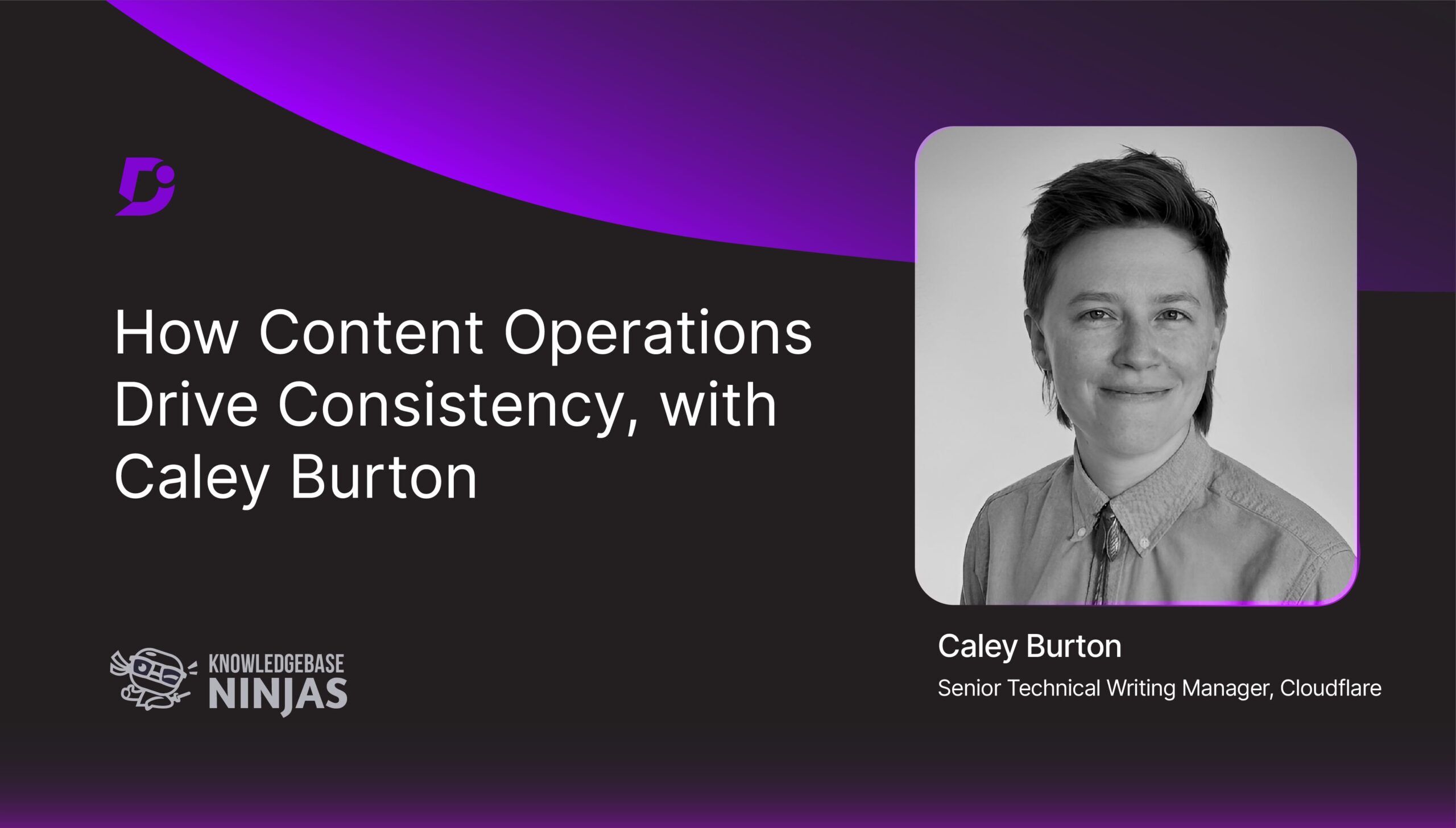

In this episode of the Knowledge Base Ninjas podcast, Caley discusses how content operations help distributed teams avoid silos by setting standards, tools, and processes for consistency across documentation. Caley explains ways to manage content debt, stressing the need to track issues in a backlog and prioritize fixes. We also discussed key factors in choosing a content management system. On AI, Caley highlights its role as a helper for repetitive tasks, reviews, summarization, and quick analysis, while not using it to solve complex problems.
Watch the full podcast episode video here
You can listen to the full episode on Apple, Spotify and YouTube.
About Caley
-
Caley’s LinkedIn
-
Caley Burton is a Senior Technical Writing Manager at Cloudflare. With an English degree from the University of Texas at Austin, Caley began a career journey that started in a call centre and later at LegalZoom. Writing internal process documents sparked an interest in technical writing, which led to an entry-level role at National Instruments. Over the past decade, Caley has built experience across writing, management, and content strategy. Caley continues to be driven by a love for documentation and its impact on the customer experience.
Quick jumps to what’s covered:
4:15 – Challenges of distributed teams and silos
4:29 – Role of Content Operations in creating consistency
4:52 – Importance of standards and processes for writers
5:25 – Reducing guesswork in content delivery
5:46 – Centralizing tools and information for distributed teams
5:58 – Consistency in style, language, and terminology across products
6:35 – Identifying and prioritizing content debt
Transcript:
-
Caley’s journey into Technical Writing
Gowri Ramkumar: Good day, everyone. Welcome to Knowledge Base Ninjas podcast. With us today, we have Caley Burton, Senior Technical Writing Manager at Cloudflare.
Welcome, Caley, to the Knowledge Base Ninjas podcast. How are you doing today?
Caley Burton: Hi. I’m doing great. Yeah, I’m really excited to be here.
Gowri Ramkumar: Fantastic. Now, when we looked at your LinkedIn profile, you’ve got ample experience in this space.
But before we dive into your experience, very curious to know how did you get into this beautiful journey?
Caley Burton: Oh yeah, for sure. I think, like most people who are on your podcast, it’s kind of a people are just kind of dipping into this career kind of by accident or like not necessarily being like, I’m going to school for technical writing. There are people who do that and hats off to them. But I did not go to school for this. So, but, you know, after I graduated college, I went to UT, and Austin, and I basically just kind of was like, I was an English major. So, I was just like, I’m open to many experiences.
So, I worked at a call centre for a little bit, but then what? I landed a job at LegalZoom doing business filings. So, I was basically filing articles of organization for customers around the 50 states in the US. And I realized very quickly that if you did not have like information on each state, like requirements, and didn’t have familiarity with their like, websites for filing a lot of these articles of organization, you would have a really difficult time meeting your quota.
So, I actually started writing internal process documentation for the rest of the team, in hopes of helping people meet their quota. And, you know, do an excellent job in terms of getting people their businesses in a timely fashion, as a result, because you could get rejected if you didn’t file them correctly. So that’s when I was like, I kind of really liked the process of writing and did like doing it step by step and providing the context and the why behind it, as opposed to doing the actual filing of those articles.
And so I kind of was just like, what is this called? And found out it’s called tech writing. And I was lucky enough to have a company in the area called National Instruments, and they’re still in the area. Shout out to NI to accept entry-level tech writers. So people who didn’t have any experience but could show that they could write. And they had some samples available. So I was able to get into tech writing via that. And I know I’ve never looked back. And I’ve worn many hats since then. I haven’t been, technical writer the whole time over the past, like ten-ish years. But I got into writer management. I’ve also done some work, managing documentation, product managers, so people who are, like, managing the portfolio and what’s coming in and prioritizing that work. But I really, really love just thinking about, talking about documentation and the customer experience through the doc experience.
Gowri Ramkumar: Nice. Fantastic. What a lovely journey it is, right?
-
How Content Ops Builds Consistency
Gowri Ramkumar: Now, when we were having a brief chat before the start of the podcast, you did mention about the various teams split in different geographical locations. Yeah. Now, when you have such teams, many teams struggle with being silos, right? Now, how does content ops help break those down and create consistency across documentation, product, and support content?
Caley Burton: Oh, great question. Yeah.
So content operations really is kind of like creating the standards and the strategies and the tools and the processes around how to create content consistently. Because consistency is such a huge factor and the customer experience as well as the writing experience. Because if you were a writer and you don’t have a standard set of expectations or processes or toolchains, you’re going to be really inefficient and you’re probably going to feel lost and confused and, lack confidence with what you’re delivering, you know, be it because of the toolchain or because you’re having to chase down, well, I don’t even know who my stakeholder is in this situation and getting feedback from them. Right?
So, content operations clarifies those things pretty quickly. And hopefully it takes a lot of the guesswork and the second-guessing out of a writer’s process for how they should be, you know, not only writing content but delivering it and where and what channels they should be focusing on, and how to do that and everything like that. So content operations help centralize some of that information for distributed teams or writers. Because a lot of writers, you know, they’re not writing on the same product as other writers on their team, if they’re a centralized team, or if they are an embedded writer and they don’t have a centralized group, you will likely find a lot of the documentation to be different. In both style, consistency, language, the terminology could be all over the place. And that could really confuse customers, especially if your customers are buying multiple products from you. And so yeah, you don’t really want to mess with consistency. So, it’s really content operations that helps with that because it’s all encompassing of tooling strategy, process, yeah, all of that.
Gowri Ramkumar: Nice.
-
Tackling Content Debt
Gowri Ramkumar: Now, once you’ve identified the content debt, what’s the best way to prioritize and also tackle it?
Caley Burton: Yeah, yeah. So content debt is something you have to be able to identify, like you said. So, other than identifying it, put it in your backlog. Because you also have to keep an awareness of how much there is, what there is, all of that. So, in terms of prioritizing it, you have to be able to assess, like, what are your biggest pains in your backlog? And that could be, you know, certain trends, like maybe you recognize, oh, wow, we have a lot of broken links. And that’s leading to a lot for us, which is causing customers to call support and say, where the heck am I supposed to go next? You know, how am I supposed to resolve this? So in that scenario, you would prioritize all of your broken links. And basically, depending on how many there are, maybe you organize a bug swarm or doc bug swarm, that is. Or maybe you say, okay, there are a lot of releases coming up. So hey, tech writers, part of these releases, the goal for you, in addition to writing your new feature, like writing the documentation for the new features or the workflows and functionality, you also need to be targeting these bugs specifically and making sure that they are they’re gone.
And, you know, here’s the strategy and standard around how we do linking, you know, are we working on redirects? Are we, you know, like info codes, things of that nature? And this is how you should be testing this moving forward, and that kind of thing. So that’s just one example. So, a lot of it comes down to having your known issues in a backlog and then understanding what those known issues are and really making sure that you are, you know, making a conscious effort of reviewing that backlog often and creating plans, making sure whatever those big issues are, they’re documented. You have solutions. You’re educating your writers, and if you have open-source docs, you’re also educating your contributors as well. So you have your linking strategy defined in your style guide potentially, or it’s somewhere within the repo. If it’s a GitHub repo, you have that documented. So it’s, everything encompassing like content governance just in a more microcosm or specific subset of how you should be governing those issues.
Gowri Ramkumar: Nice.
-
Choosing the Right CMS
Gowri Ramkumar: Now, you did touch base on the tool side a little bit, but with so many tools right, of different varieties as well. Like you have wikis, a knowledge base, CCMS tools, and LMS tools. Now, what factors should teams consider when choosing a content management system?
Caley Burton: Yeah, that’s a big one.
And so, I think there are many factors you should be thinking about. You should be thinking about what the ultimate customer experience is you’re aiming towards. And also, at the same time, looking at, you know, your business, goals, and demands. There are going to be some companies that require a way stricter version control and way stricter compliance guidelines, and others. So, you have to be very aware of like what kind of content management system you need. Some are really good about locking it down and doing a lot of branches and versions, to a specific doc set, and others are more like, you know, more open source, kind of like the whole doc sets being published at the same time.
And then at the same time, you need to be thinking about what’s your source, you know, what’s your framework that you’re also already using and doing? If you are a docs is code, you know, you want to be as nimble and fast and flexible as a developer with their code. And you want to sit really tightly with those devs and in that, in that life cycle for release and everything, and then maintenance as well.
Also, a major factor for a lot of companies, especially tech writing teams, is budget. You know, not everybody has a massive budget to go buy the most expensive CMS out there with all the bells and whistles. They have to consider what our budget is and what we can do within that. So, I don’t want to negate that. It’s one thing to come from a bigger company and potentially have a bigger budget. And then it’s another thing to be somebody just starting out and needing to spin up a static website doc site, you know, using a variety of tools like Docusaurus or GitHub pages or even Cloudflare has workers that allow you to spin up a website pretty quickly, the doc site.
But it’s it really does come down to what is your framework for working. What are your KPIs? What are your customers’ needs? And yeah, what’s your budget? That’s it. That’s a huge factor. And I think the most important thing when it comes to any CMS, though, is really thinking about how you’re going to scale over the years. And is that CMS going to lock you into something that’s going to cause you to slow down? A lot, because there are a lot of features and functionalities that you might kind of get tied to and bog you down.
So I think that’s another piece of this, like, what are you actually hoping to achieve in a year and five years and ten years? And is this going to be a technology that is potentially going to hinder you from integrating with a new, technology or process and consider those things? It doesn’t mean that you shouldn’t go with that CMS, but it should mean that you are constantly thinking about your strategy moving forward to prevent that, blocking, component a bit.
Gowri Ramkumar: Nice.
-
The Role of AI Today
Gowri Ramkumar: AI is now often described as both a help and as a disrupter as well. Right? Now, from your perspective, what role should AI realistically play in technical writing, as of today?
Caley Burton: I think, instead of the yeah, the role considering its role is very important. I think really understanding its strengths and really understanding your needs, I think should help tech writers navigate it. It’s going to be really good at doing repetitive tasks for you. It’s also really good at providing edits or reviews. Or being a little research buddy. If you can prompt it really well and make sure it’s, it’s engaging with something that has a lot of documentation readily accessible. It’s not going to be a good research buddy if it’s a bleeding-edge technology that very few people are talking about or writing about. So that’s something to consider, right?
So again, it comes back to what it is good at. And it’s really good at summarizing things, finding patterns. And you know, potentially doing quick analyses on things for you. It’s not 100% accurate. There are some models that, you know, are in the 90% range. And there and there’s some that are not. And that’s why you have to make sure that you’re not giving it complex tasks that are going to require a lot of time and effort and energy into training it and, vetting it. So I think it could be a helper if you’re utilizing it with strengths and using specific tasks around it.
So, you know, there are linter technologies out there with AI right now. You can also do a lot of good customer feedback analyses that are not super detailed, but just kind of giving you a quick gut check on positive, negative, and neutral. That way, you can hone in on potentially the negative or hone in on the positive because it’s also nice, look at the positive things. So, it’s not the silver bullet. It’s not going to magically fix everything for you or solve all your issues, but it is something that you can use as a small helper right now. And I think some teams are trying to figure out how it could be a bigger helper. But yeah.
Gowri Ramkumar: Alright.
-
⚡Rapid Fire Round
Gowri Ramkumar: That’s super. Let’s move on to the rapid-fire round questions. So, what are some valuable resources that you would recommend to our viewers? Something that you recently came across or read about, or heard about?
Caley Burton: For sure, yeah. So, I’m going to provide a very biased answer on this one. So, I actually organized the Austin chapter of Write the Docs. So if your city has a Write the Docs, meetup group or they offer virtual sessions, I really encourage you to join them because I think building community is huge in terms of growing your skills, learning about new concepts, even just like kind of philosophically talking about documentation is going to potentially unlock something that you hadn’t previously considered or thought of or get you engaged with. I’ve met a lot of great people through that organization, so I am very passionate about making sure those events continue to happen on a monthly basis, and hopefully we get new people come in. But we have a good, solid, regular contingent. And it’s lovely to see them monthly and talk about documentation, I get to know them.
I also love I’d Rather Be Writing, which is Johnson’s blog and resources. I think so many people have really learned a lot from him and seek out his advice. Also, passo.uno like that’s another great resource for blogs and thinking about, you know, how AI is impacting technical documentation, and just get it like a best practice is in there.
And then I also have quite a few books. I’m a bit of a book buyer, but I love really anything to do with content operations. So, Content Operations from Start to Scale. That’s a good one for folks if they are thinking about, you know, content operations and all the behind-the-scenes stuff. As a writer manager, this is still one of the best resources that I have. Managing Writers, okay. Yeah, it’s still one of the best resources. I think he wrote this like 10-15 years ago. And I come back to it. And then obviously Content Audits and Inventories by Paula Land.
Gowri Ramkumar: Thank you.
Caley Burton: She’s awesome. Yeah. So there are so many things out there. Luckily, if you were to jump on anybody’s LinkedIn profile and ask them a question, a lot of these folks are going to be happy to answer questions.
Gowri Ramkumar: Absolutely. And thank you for showing the assets as well, so people can buy them, the right ones.
Now, the one word that comes to your mind when you hear “Documentation”?
Caley Burton: I think Living, it’s, one of those resources that can be changed and based on feedback or change based on, you know, how people interact with technology over the years. And so, yeah, it’s something that I view as like something we can quickly update and also something that, if you get good feedback or even difficult feedback, you can improve it. So I view it as a living thing that is breathing and coming along with us and never really dies unless you just forget about it. Or you sunset it and you remove it from your website.
Gowri Ramkumar: Absolutely.
Now my last question to you is, that one piece of advice would you give to your 20-year-old self?
Caley Burton: I think it would be like getting out of my shell a little bit sooner and joining like groups like Write the Docs or when STC was available and alive, or I know tcworld conference has quite a few groups, you know, in Europe, in Asia as well. So I think trying to find a community to join and, you know, because you’re going to learn a lot from people who have been in the industry longer than you, you get to ask them questions that you might not be able to ask folks at your workplace, and you might even find a mentor or, you know, become a mentee to someone else who’s just joining. And you get to build good relationships that way. And it feels good because then you get to share knowledge, build your own skills, and, yeah, grow a community. And I think that’s such an underrated thing these days.
Gowri Ramkumar: Nice. Now is there anything else I missed to ask, or pick up from this conversation, please feel free to add now.
Caley Burton: I don’t think I have anything. Yeah, yeah, I think we covered a lot of bases.
Gowri Ramkumar: Thank you. Absolute pleasure to have you today. And all the very best for all the projects that you’re currently handling and for the future ones too. And yeah. Lovely to have this little chat with you.
Caley Burton: Thank you. It was great being here.
Gowri Ramkumar: Thank you! Take care.
Disclaimer: This transcript was generated using AI. While we aim for high accuracy, there may be minor errors or slight timestamp mismatches.

Enjoyed this conversation?
Don’t miss listening to other episodes of our Knowledgebase Ninjas Podcast , where we invite documentation experts from all walks of the industry to share practical, real-world insights, experiences, and best practices. Subscribe for the latest episodes, and if you found this helpful, pass it to your colleagues!
Read Our eBook
Discover how AI is shaping the future of technical writing:
The Future of Technical Writing – AI’s Impact on Knowledge Management
Watch Webinars
Learn from experts and product specialists in our Webinar Library
Explore Case Studies
See how leading teams are using Document360 to build powerful knowledge bases: Customer Success Stories
Browse Resources
Access our full Resource Library — including blogs, videos, guides, and more
Try Document360 for Free
Experience how top teams create world-class documentation with ease.
Start Your Free Trial
Follow Us for Updates, Tips & Best Practices
LinkedIn | Twitter (X) | Facebook | Instagram | YouTube


