 EN
EN 

AI Summary
- Documentation performance is a health indicator showing how effectively content helps users complete tasks, find information, adopt product features, and succeed without customer support.
- Performance analysis uses quantitative metrics, including page views, content satisfaction score, engagement rate, traffic patterns, search queries, bounce rate, and other content KPIs, alongside qualitative feedback.
- Qualitative insights from user feedback surveys, direct support interactions, stakeholder feedback, and support tickets explain why metrics occur; high engagement or page views can be misleading without context.
- Effective feedback mechanisms include visible page-level feedback buttons, short and simple forms, empathetic requests, and periodic surveys after product or documentation changes.
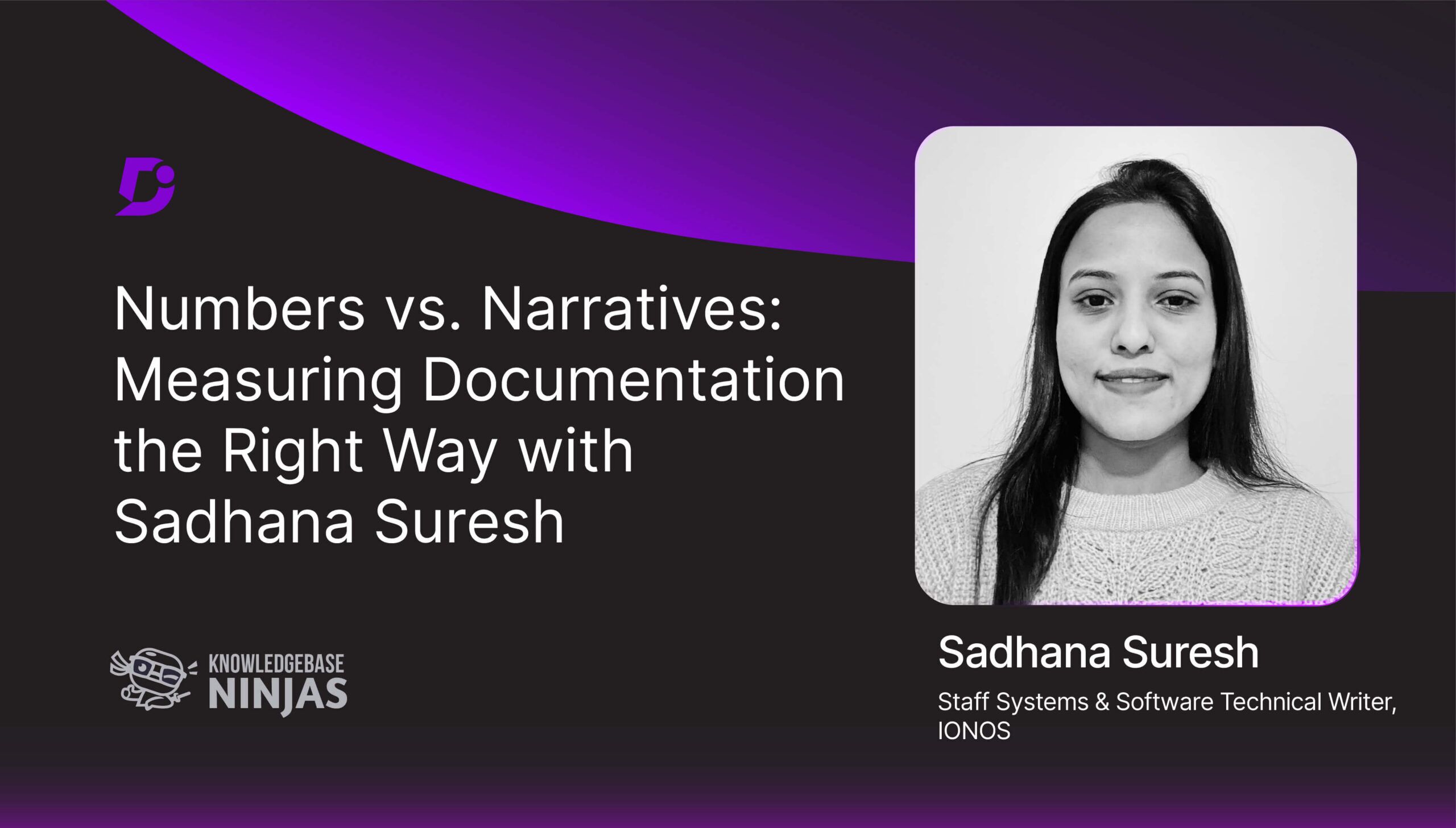
- Sadhana Suresh, Staff Systems and Software Technical Writer at IONOS, has over 12 years of experience and recommends combining feedback with continuous metric monitoring to improve documentation.
AI-generated content. It may contain errors.
See Document360 in action
In this episode of the Knowledge Base Ninjas podcast, Sadhana talks about what documentation performance really means and why it matters. Documentation performance is described as a health indicator or a pulse check for content. It shows how effectively documentation helps users complete tasks without relying on support.
But numbers alone are not enough. She emphasizes the importance of combining quantitative analytics with qualitative feedback to get the full picture of documentation performance. Through various examples, Sadhana throws light on how metrics can sometimes be misleading without user context.
The conversation also covers the different feedback channels that work best for documentation teams. Feedback structure, surveys, and support tickets are discussed as key sources of insight. She stresses on keeping feedback forms simple, visible, and empathetic.
Overall, the episode focuses on building a balanced approach to measuring, interpreting, and improving documentation performance.
You can listen to the full episode on Apple, Spotify, and YouTube.
Watch the full podcast episode video here
Quick jumps to what’s covered
- 1:46 – Sadhana’s transition from IT applications to technical documentation
- 4:30 – What documentation performance really means
- 5:45 – Using analytics to measure content effectiveness
- 6:18 – Making data-driven decisions with quantitative and qualitative inputs
- 7:16 – Combining quantitative metrics with qualitative insights
- 8:36 – When high engagement can be misleading
- 11:14 – Best feedback channels for documentation
- 14:39 – Leveraging support tickets for content improvements
- 15:10 – Using engagement rate, bounce rate, and page views proactively
About Sadhana Suresh
- Sadhana Suresh is a Staff Systems and Software Technical Writer at IONOS with over 12 years of experience in technical documentation.
- Coming from a technical education background, she began her career in IT application support, working closely with users to solve everyday issues.
- While documenting solutions for internal teams, she discovered her interest in building structured knowledge bases. This gradually led her to transition into technical writing, focusing on clear and practical end-user documentation. She has worked across domains, including e-commerce and cloud products, both in India and now in Germany.
- Over time, user and stakeholder feedback sparked her interest in improving content and analyzing documentation. Her work today centres on creating documentation that adds measurable value and improves user experience.

Transcript
-
Career Journey and Transition into Documentation
Gowri: Good day, everyone. Welcome to the Knowledge Base Ninjas podcast. With me today, I have Sadhana Suresh, Staff Systems and Software Technical Writer at IONOS. How are you doing, Sadhana?
Sadhana: Hi, Gowri. I’m doing great. Thank you. I’m happy to be here with you.
Gowri: The pleasure is mine. I should also highlight your total experience — 12+ years in this space. Tell me how it all started. Who inspired you, and how has the transition been across different domains?
Sadhana: I come from a technical education background. I started my career in IT applications, where I worked closely with users and helped them resolve application issues they encountered on a daily basis. After resolving each issue, I documented the solutions so that our internal teams could support users more effectively the next time. That’s how I began — by internally documenting content.
Over time, I found myself deeply interested in building the knowledge base. That’s when I realized I truly enjoyed writing. I also saw firsthand how clear documentation could help users interact better with both the content and the application itself. Eventually, this interest led me to transition into a technical documentation team, where I began creating content specifically for end users.
Over the past 12+ years, I’ve worked across different domains — starting with e-commerce, then moving into cloud products. I’m currently working for a cloud product company. I began my career in India, and now I’m based in Germany.
-
First Experience Seeing Documentation Impact
Gowri: How did you feel the first time you saw your documentation being consumed by customers? What was that experience like?
Sadhana: Initially, I was contributing mainly to content improvements. When I started receiving feedback from users and stakeholders saying that the documentation was helpful and adding value, it felt incredibly rewarding.
We also had content embedded within the application, and we could see that users were interacting with it. Very early in my career, receiving that kind of feedback made me realize that what I was creating truly added value.
That experience gradually led me toward analytics and measurement techniques, which is exactly why we’re here today discussing documentation performance.
Gowri: That leads perfectly to my next question.
-
Documentation Performance – A Health Check for Content
Gowri: You mentioned analytics. What does documentation performance really mean? We often discuss this with customers — how to measure ROI, how to determine whether documentation truly helps the organization move forward.
What does it mean to you, and why should someone care about it?
Sadhana: When we talk about documentation performance, I see it as a health indicator — like a pulse check. It tells us how well our content supports users in being successful.
For example, are users able to complete tasks efficiently without relying on customer support? Can they find the information they need? Are they able to adopt product features easily? These are important questions for anyone creating documentation.
From an organizational perspective, performance analysis helps answer critical questions such as:
- Is our documentation delivering value?
- Are we creating what users actually want?
As documentation scales, it becomes even more important to allocate time and effort efficiently. We must focus on creating content that adds real value to users and supports the product.
Performance analysis provides clarity and visibility — and that’s why measuring documentation is essential.
For example, in our organization, we leverage analytics to measure performance. This gives us insights into user behavior and content effectiveness.
We track metrics such as page views, content satisfaction score, engagement rate, and other content KPIs. These metrics help us understand which content resonates most with users and how we can improve engagement.
Importantly, we don’t rely only on quantitative metrics. We also consider qualitative inputs such as user feedback. Together, they help us make informed, data-driven decisions.
Gowri: That’s great. Let’s dig a little deeper into that.
-
Combining Quantitative and Qualitative Insights
Gowri: How do you combine quantitative analytics with qualitative insights? Many organizations struggle with this balance. How can someone effectively use both?
Sadhana: That’s a very important question.
Quantitative analytics gives us numbers — page views, engagement rates, traffic patterns, search queries, bounce rates. These numbers show us what is happening at scale and help identify patterns or potential gaps.
For example, we use tools like Google Analytics and GitBook to gather these metrics over time. However, numbers alone don’t tell the full story.
Qualitative insights help us understand why those numbers exist. These come from user feedback surveys, direct support interactions, and stakeholder feedback.
For example, analytics might show that a guide has high engagement time. At first glance, that looks positive. But user feedback might reveal that the steps are unclear or screenshots are outdated — causing users to spend more time trying to understand the content. Without qualitative feedback, we might misinterpret that engagement as success.
Another example is page views. A landing page might have high page views simply because it’s an entry point. That doesn’t automatically mean it’s effective.
When we combine analytics with user feedback, we get a complete and holistic picture. Relying only on quantitative data can sometimes be misleading.
Gowri: That makes a lot of sense. Collecting feedback isn’t always easy. Users need to feel comfortable sharing it, and organizations need the right channels to capture and use it effectively.
-
Feedback That Improves Documentation
Gowri: From your experience, which feedback channels have worked best? Inline feedback, surveys, support tickets, direct interviews?
Sadhana: Great question. This connects directly to building a strong feedback loop.
In our documentation platform, we’ve implemented a feedback mechanism directly on each page. Users can rate whether they found the content helpful and provide comments. Since this is tied to individual pages, we know exactly which content needs improvement.
Most documentation platforms offer similar capabilities. Beyond that, it’s important to encourage feedback.
For example:
- Add a visible feedback button on the page
- Use short and simple feedback forms
- Be empathetic in how you ask for input
The user should feel that the company is listening and genuinely cares about their experience.
This touches on UX principles. Documentation should focus on what users truly need — not just what we think should be included. Another method is running periodic surveys. These don’t need to run constantly, but they can be launched:
- After releasing a new product feature
- After updating the documentation structure
- After introducing new interactive elements like videos or downloadable files
Surveys should be simple, specific, and visible so users are encouraged to participate.
Support tickets are another valuable source. Internal teams can share recurring issues users face, and documentation can be updated accordingly.
At the same time, while collecting qualitative feedback, you should continuously monitor quantitative metrics like engagement rate, bounce rate, and page views. That way, you don’t have to wait for feedback — you can proactively identify performance trends.
Gowri: That’s fantastic. Thank you for that perspective.
-
⚡ Rapid Fire
Gowri: Now, let’s move to the rapid-fire round.
Sadhana: Yes. I would recommend:
- Write the Docs
STC (Society for Technical Communication) forum
TechComm communities
These platforms provide high-value discussions, community learning, best practices, and conference opportunities. They’re great places to learn and contribute.
Gowri: That’s great.
Now, one word that comes to your mind when you hear “documentation”?
Sadhana: Self-serviceability.
When I write documentation, I always ask – Will this help users accomplish their task independently? If it enables users to succeed without additional support, then it’s effective documentation.
Gowri: Nice. That’s a powerful word.
My final question — what advice would you give your 20-year-old self?
Sadhana: I would say – Go out and try.
Early in my career, I used to hesitate and overthink before trying something new. Today, especially in the AI era, I believe you just have to experiment.
No learning is wasted. Even if something doesn’t work out, you gain knowledge.
So my advice would be: be fearless and just try.
Gowri: That’s wonderful advice.
Gowri: You’ve shared such valuable insights today — especially about balancing quantitative and qualitative feedback. It’s clear that organizations need the right tools and processes to collect feedback effectively and use it to improve documentation.
Thank you so much for joining us. I wish you all the very best for your upcoming projects. I’m sure there are many exciting things ahead, and we look forward to seeing more great documentation from you.
Sadhana: Thank you, Gowri. It was a pleasure talking with you today.
Gowri: Thanks again. Take care.
- Write the Docs
Disclaimer: This transcript was generated using AI. While we aim for high accuracy, there may be minor errors or slight timestamp mismatches.
Enjoyed this conversation?
Don’t miss listening to other episodes of our Knowledgebase Ninjas Podcast, where we invite documentation experts from all walks of the industry to share practical, real-world insights, experiences, and best practices. Subscribe for the latest episodes, and if you found this helpful, pass it to your colleagues!
Read Our eBook
Discover how AI is shaping the future of technical writing:
The Future of Technical Writing – AI’s Impact on Knowledge Management
Watch Webinars
Learn from experts and product specialists in our Webinar Library
Explore Case Studies
See how leading teams are using Document360 to build powerful knowledge bases: Customer Success Stories
Browse Resources
Access our full Resource Library — including blogs, videos, guides, and more
Try Document360 for Free
Experience how top teams create world-class documentation with ease.
Book a demo
Follow Us for Updates, Tips & Best Practices
LinkedIn | Twitter (X) | Facebook | Instagram | YouTube


