EN
EN  DE
DE ES
ES FR
FR PT-BR
PT-BR

AI Summary
- Aditi Khanchandani, Senior Technical Writer / Editor at Cognizant, discusses her technical writing industry experience on Knowledgebase Ninjas.
- She began as a finance and investment researcher writing investment-firm profiles and has over ten years of content-creation experience. Her current work includes data virtualization with data analysts, internal process documentation, and editing tenders and policies.
- Her tools include MS Word, Adobe Acrobat, Microsoft Visio for flow charts and diagrams, and Stabilo for data analysis.
- She emphasizes keeping documentation simple, clearly defining its purpose, ensuring readability, and meeting the needs of the intended end-user.
- Quality documentation connects products and services with end-users. It does not necessarily reduce workload because standards, policies, procedures, and features require ongoing additions, although it helps when improvising.
AI-generated content. It may contain errors.
See Document360 in action
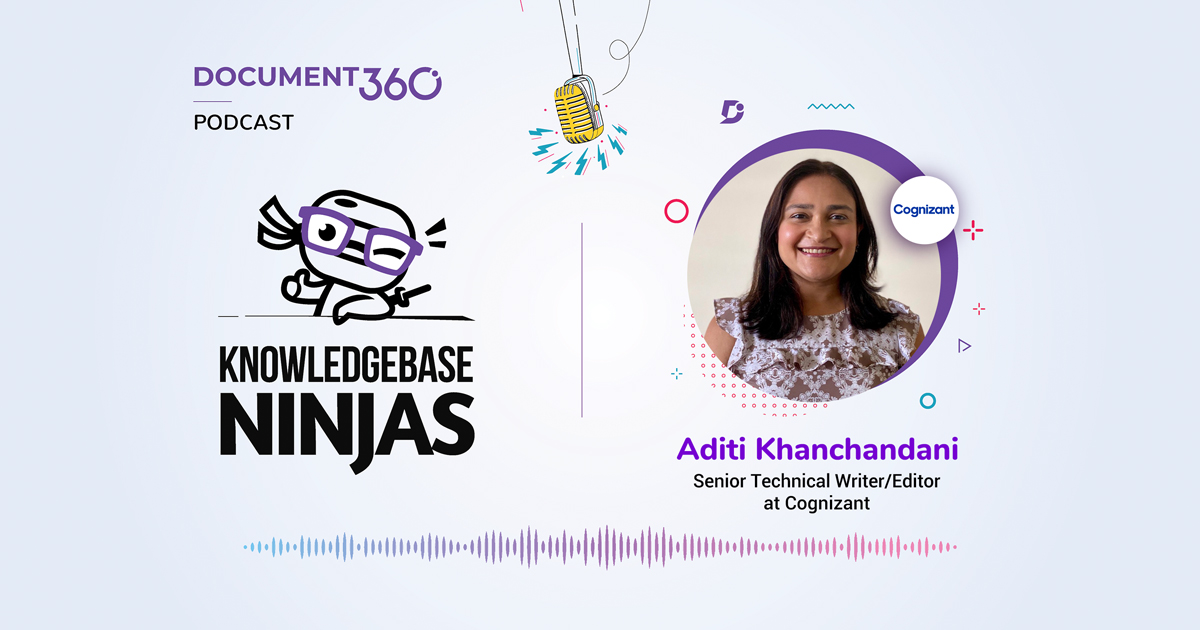
Aditi Khanchandani, Senior Technical Writer / Editor at Cognizant, joins us in this episode of Knowledgebase Ninjas and shares her experiences in the technical writing industry. Check out all the other episodes of Knowledgebase Ninjas here.
Connect with Aditi Khanchandani and Cognizant here:
Key Takeaways
Aditi’s journey into technical documentation
Aditi initiated her career with a financial service firm, where she started her work as a finance and investment researcher. The role of her job includes writing profiles about investment firms. She has been working in content creation for over ten years now. In her current job role, Aditi works besides data analysts, to create data virtualization. She has also been writing internal process-related documentation and apart from that Aditi also edits procedural documentations like tenders and policies etc.
Role of technology and tools in creating a documentation
Aditi realizes the importance of using tools in creating a document. The tools she uses to make a copy are regular MS Word, Adobe Acrobat, etc. For creating flow charts and diagrams she has been using Microsoft Visio, and apart from documentation, she is using the Stabilo tool for analysing the data.
Important factors for creating a document
According to Aditi, the most critical factors for creating a technical document are as follows:
-
Keep it simple, define purpose clearly and ensure readability:
The end-user must understand the purpose of writing documentation. The language of the document should be easy and readable. It is on the writer how he/she will present the document.
-
Keeping the end-user in mind:
The writer must know who they are writing for and what message you are going to deliver. But, most importantly, the writer should meet the needs of their audience.
Importance of quality documentation for the success of the company.
Writing high-quality documents is significant because documentation is known as the link between products and services with the end-users. One must have to be able to meet the needs of the customers through this documentation, and for doing such a task, high quality is an essential factor that should be maintained while writing documentation.
Reduction in workload due to quality documentation
According to Aditi, writing quality documentation does not help in reducing the workload because you always have to add more and more quality in the documentation. At times you also have to add more features in it, which includes standards, policies, and procedures, so it does not help much in reducing the workload. Still, yes it helps when improvising.
Who has inspired Aditi in technical writing?
She has learned a lot from many of her colleagues and supervisors.
Subscribe to Knowledgebase Ninjas
Quote: